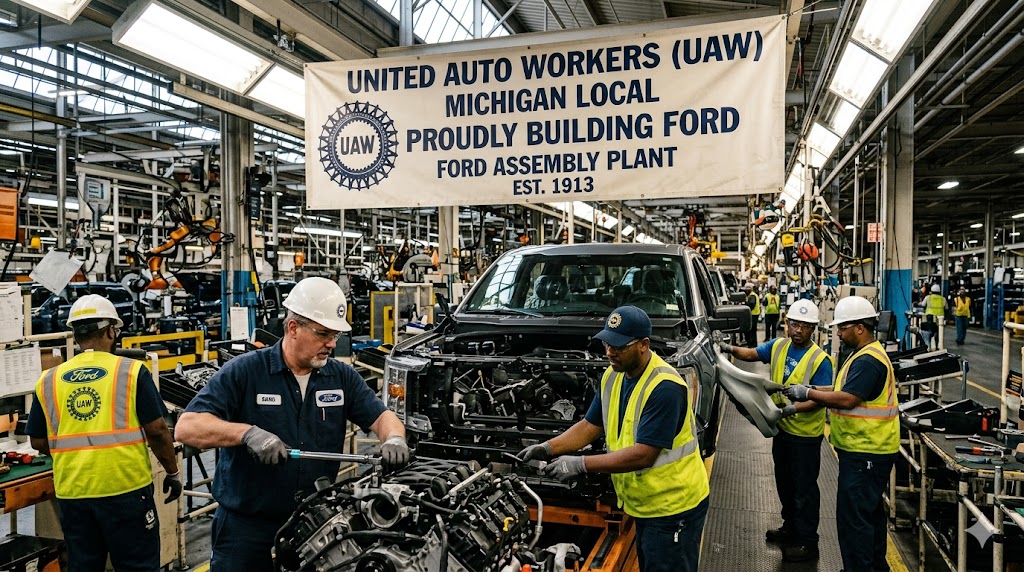
Walk onto the floor of a plant that has spent decades stamping steel, welding engine blocks, and bolting together transmissions, and you'll understand why the phrase "just switch to EVs" undersells one of the most expensive industrial transformations any manufacturer can undertake. Building an electric vehicle isn't a matter of swapping one component for another on the same line. It calls for a different manufacturing philosophy from the floor up, and that difference is precisely why automakers have spent years and enormous capital retooling plants rather than simply reprogramming the machines they already had.
Why "Retooling" Undersells the Actual Job
The word "retool" suggests a plant swaps out some equipment and continues on. The reality inside a conversion project looks more like a partial demolition. A traditional internal combustion vehicle is built around an engine and transmission supply chain that has nothing to do with how an EV is built, since a battery-electric vehicle replaces that entire mechanical core with a battery pack, one or more electric motors, and a power electronics system that manages how electricity moves through the vehicle. The stamping presses, the paint shop, and much of the general body assembly can sometimes be adapted, but the powertrain assembly area—historically one of the most capital-intensive parts of any plant—often needs to be rebuilt close to entirely.
Battery packs also introduce a manufacturing step that gasoline vehicles never required: handling large, heavy, energy-dense packs that need to be installed with a level of precision and safety protocol that a fuel tank never demanded. That alone changes the physical layout of a plant, the material-handling equipment on the floor, and the training every line worker receives, because a mishandled battery pack carries risks that a mishandled exhaust manifold simply doesn't. Automakers converting existing plants have had to design new conveyance systems just to move packs safely from receiving dock to vehicle chassis, a logistical challenge that didn't exist in the same form for combustion-engine assembly.
The Battery Supply Chain Is Its Own Factory Problem
Retooling the vehicle assembly plant is only one half of the challenge, and arguably not the more expensive half. Automakers pursuing serious EV volume have increasingly chosen to build or co-invest in dedicated battery cell manufacturing facilities, often through joint ventures with battery specialists, rather than relying entirely on outside suppliers. These battery plants are enormous, capital-intensive facilities in their own right, requiring specialized cleanroom-like conditions, entirely different safety systems around chemical handling, and a workforce with skills that look more like chemical or electronics manufacturing than traditional automotive assembly.
This means the true cost of an "EV transition" for a manufacturer with serious volume ambitions isn't the cost of one retooled plant—it's the combined cost of the vehicle assembly retooling plus a parallel investment in battery production capacity that often didn't exist in the company's footprint at all a few years earlier. Because battery chemistry and cell formats are still evolving, these facilities also carry a technology-risk dimension that traditional engine plants never had to consider: a plant tooled for one battery chemistry or cell format may need further investment if the industry or the automaker's own roadmap shifts to a different approach down the line.
Tooling and Equipment: New Machines for a New Product
Beyond the big structural changes, an EV transition touches an enormous number of smaller tooling decisions that add up. Robotic welding and stamping equipment calibrated for a combustion vehicle's body-in-white may transfer reasonably well to an EV built on a similar body architecture, but EVs built on dedicated "skateboard" platforms—where the battery pack itself forms a structural part of the vehicle's floor—often require fundamentally different body engineering and, in turn, different tooling to assemble that structure. Torque specifications, fastening methods, and quality-control checkpoints all have to be redeveloped and validated, not simply copied over from the gasoline model that used to run down the same line.
Testing and validation equipment changes too. End-of-line testing for a combustion vehicle checks things like engine calibration and exhaust emissions; testing for an EV checks high-voltage system integrity, battery management software behavior, and charging system function, which requires different diagnostic equipment and differently trained technicians at the end of the line. None of this is a simple software flash on existing test rigs—it's new equipment, new procedures, and a new set of pass/fail criteria that plants have had to develop essentially from scratch.
Retraining the Workforce Is Its Own Line Item
Perhaps the least visible cost of an EV transition, and one of the largest, is what it takes to retrain a workforce that may have spent years or decades building combustion vehicles. High-voltage systems carry genuine electrocution risk if mishandled, which means line workers, technicians, and even facilities staff need new safety certifications before they can work anywhere near battery packs or motor assemblies. Automakers and their union partners have had to negotiate new training programs, new job classifications in some cases, and new safety protocols across plants that previously had no need for high-voltage expertise on the assembly floor.
There's also a simple headcount question that varies by vehicle and plant, since electric powertrains generally involve fewer moving mechanical parts than a combustion engine and transmission, which has fed into broader debates between automakers and labor unions about how many workers a given EV assembly process actually requires compared to the combustion vehicle it replaces. That debate has been a genuine point of tension in labor negotiations at multiple manufacturers, precisely because it touches job security in a way that a routine model changeover never did. Retooling for EVs isn't just a capital and engineering question—it's a workforce and labor-relations question that plays out over years, not quarters.
The Timeline and Risk Calculus Behind the Investment
None of this happens quickly. Converting or building a plant for EV production typically takes years from the initial capital commitment to full-volume output, and that timeline includes not just construction and equipment installation but extensive validation to make sure the new processes produce vehicles that meet the same safety and quality standards buyers expect. Automakers have to make these enormous capital commitments years before they know with certainty how fast consumer demand for EVs will grow in a given market, which is precisely why several manufacturers have adjusted the pace of previously announced EV investments in response to shifting demand signals, rather than because the technical challenge changed.
This is the underappreciated tension at the heart of the EV transition: the manufacturing investment has to be made on a multi-year horizon, but the demand it's built to serve can shift meaningfully within that same window due to pricing, charging infrastructure availability, interest rates, or incentive policy changes. A plant retooled for a battery chemistry or vehicle platform that turns out to be less popular than projected represents a sunk cost that's much harder to walk back than a delayed product launch would be for a company selling a less capital-intensive product. That risk, as much as the sticker price of new equipment, is what makes factory retooling one of the more consequential bets an automaker makes.
What This Means for the Vehicles You're Actually Buying
None of this manufacturing complexity is visible when you're looking at a finished EV on a dealer lot, but it's embedded in the price, the availability, and even the reliability of that vehicle. A model built at a plant with a mature, well-validated EV assembly process is likely to show fewer early production quirks than one built during a rushed or recently converted line. It's part of why it's often worth waiting to see how a newly retooled plant's output performs in its first year or two before assuming an automaker's EV manufacturing process has been fully worked out, and why published reliability data and early owner feedback remain useful signals regardless of how impressive a vehicle's specifications look on paper.
Key Takeaways
- Retooling a factory for EV production usually means rebuilding the powertrain assembly area near completely, not simply reprogramming existing equipment.
- Battery pack handling introduces new safety protocols, material-handling equipment, and floor layouts that combustion vehicle assembly never required.
- Serious EV volume typically requires a parallel investment in dedicated battery cell manufacturing, which is its own capital-intensive and technically distinct undertaking.
- Workforce retraining and new safety certifications for high-voltage systems represent a substantial, often underestimated part of the transition cost.
- The multi-year timeline for retooling means automakers commit massive capital before knowing how demand will actually evolve, creating real financial risk if adoption is slower than projected.
- Bottom line: the sticker price of an EV reflects years of factory-level investment and risk-taking behind the scenes, so it's worth judging a newly retooled model on real-world reliability data rather than assumptions about how smooth the manufacturing transition has been.