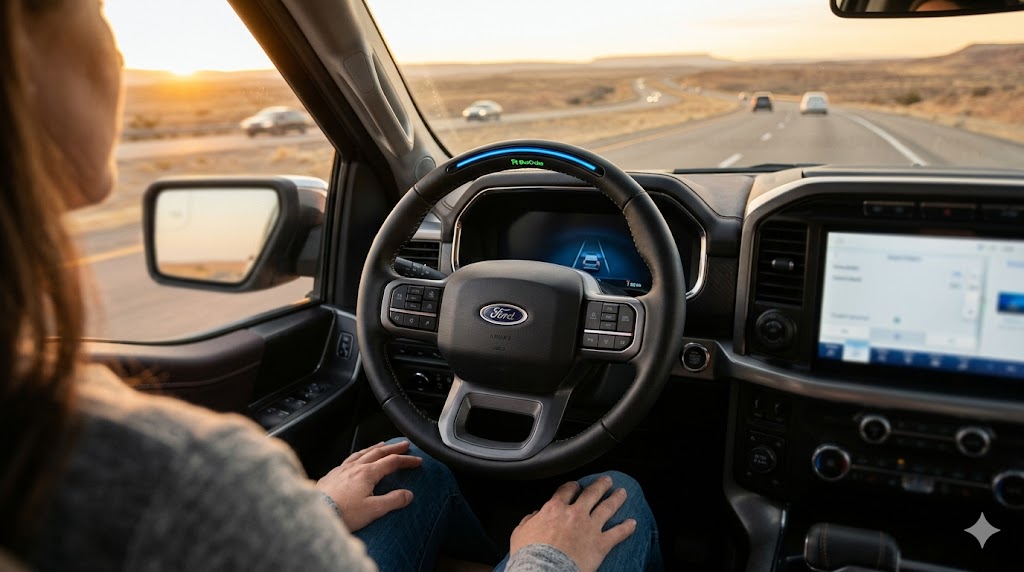

Ford's BlueCruise launched as a credible alternative to GM's Super Cruise in the hands-free highway driving category, and the 2.0 update that has rolled out to compatible F-150 and Mustang Mach-E owners via over-the-air delivery represents a meaningful improvement in the system's capability and real-world usability.
The distinction between hands-free driver assistance and autonomous driving is critical to understanding these systems correctly. BlueCruise 2.0 is not autonomous driving. It is a driver assistance system that enables hands-free operation on pre-mapped divided highways while monitoring driver attention through an infrared driver-facing camera. The driver remains responsible for vehicle operation and must remain attentive.
What BlueCruise 2.0 Added
The most significant operational improvement is lane change capability. BlueCruise 1.2 was a lane-keep-and-maintain-speed system; 2.0 introduces BlueCruise Lane Change, which executes lane changes on enabled roadways when the turn signal is activated by the driver. The system evaluates adjacent lane conditions, executes the change when safe, and returns to the original lane-following mode. This reduces the frequency of driver intervention that limited the original system's real-world utility.
The driver attention monitoring has been refined to reduce the false alerts that made the original version frustrating. The infrared system tracks head position and eye gaze direction with improved accuracy, which means fewer unwarranted beeping interruptions that pulled attention back to the monitoring system rather than the road.
Expanded mapped road coverage has added highway miles that weren't previously enabled, which matters practically for specific regional users who found the original system's covered-road limitations frustrating.
The subscription model remains in place and remains a point of discussion. BlueCruise requires an active subscription after the trial period, with annual pricing that varies by vehicle. The value proposition of the subscription versus the feature depends on highway mileage driven and the specific use patterns that benefit from hands-free operation.
Summary
What it is: Ford's hands-free highway driving assistance system, updated to version 2.0 with lane-change capability and improved driver monitoring, delivered via OTA update to compatible vehicles.
Best for: High-mileage highway drivers who regularly use divided highways and want to reduce attention-management fatigue on long stretches.
Biggest cost/risk factor: Subscription pricing adds ongoing cost; the system requires continuous driver attention despite the hands-free designation.
When to act: Evaluate based on your actual highway driving profile - infrequent highway drivers won't recover the subscription cost in meaningful benefit.
AutosAdvisor is not a licensed technology evaluator. Driver assistance system capabilities and availability vary by vehicle and region.