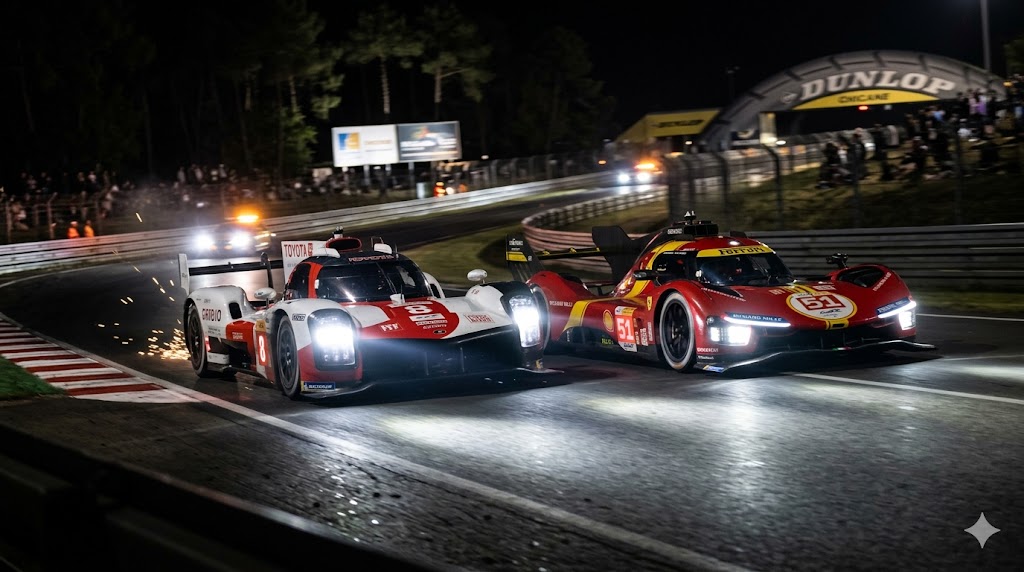
Winning Le Mans once can happen through a mix of preparation and fortune. Winning it repeatedly, across consecutive years, against a field that kept adding capable new competitors, requires something closer to a systemic advantage that rivals simply couldn't close fast enough. Toyota's GR010 Hybrid program built exactly that kind of sustained edge, and unpacking how it did so tells you more about what actually wins modern endurance races than any single dramatic finish could.
Starting From a Position of Continuity, Not a Blank Sheet
The GR010 Hybrid didn't emerge from nowhere. Toyota had already spent years campaigning LMP1 hybrid prototypes before the Hypercar era began, including through the late stretch when the brand was essentially the only committed factory manufacturer left in the top class. That unusual circumstance, uncomfortable as it was for the sport's competitive health at the time, gave Toyota's engineering and operations group an enormous accumulated base of hybrid powertrain data, reliability learnings, and endurance-specific race craft that a manufacturer starting a Hypercar program from scratch simply didn't have access to. When the rules transitioned to the Hypercar formula, Toyota wasn't beginning a hybrid endurance racing program; it was adapting a mature one to a new technical framework, and that head start mattered enormously in the category's early seasons.
This continuity advantage is easy to underrate because it doesn't show up as a single dramatic technical innovation. It shows up instead as fewer of the reliability surprises that plague new programs, a driver lineup and engineering staff who already understood how to manage a hybrid prototype through a full 24-hour cycle, and an institutional memory about exactly the kinds of failure modes that catch less experienced programs off guard during the demanding overnight hours of the race.
Execution Over a Full Season, Not Just One Night
Toyota's run of success wasn't built on a single overwhelming Le Mans performance each year so much as consistent, disciplined execution across the demands of a full 24-hour race, repeated across multiple seasons. Hybrid energy deployment strategy, tire management across long stints, and minimizing time lost in the pits all compound over twenty-four hours in ways that are easy to underestimate if you only watch highlight packages from the final hour. A program that loses fewer seconds in every routine pit stop, makes fewer unforced strategic errors during Safety Car periods, and suffers fewer reliability issues across the full race distance will beat a rival with faster outright pace but sloppier execution, and that pattern showed up repeatedly during Toyota's championship stretch.
Reliability specifically deserves emphasis here, because it's the least glamorous and most decisive factor in any 24-hour race. A car capable of running at a strong, sustainable pace for the entire race distance without costly mechanical dramas will consistently beat a faster car that loses laps to unscheduled repairs, and Toyota's GR010 program built a reputation for exactly that kind of dependability during its championship run. That reputation didn't happen by accident; it reflected the accumulated engineering discipline carried over from the brand's earlier hybrid prototype years.
Racing Into a Field That Kept Getting Tougher
What makes this stretch of dominance more impressive in hindsight is the trajectory of the competition around it. Toyota's early Hypercar-era success came at a moment when several rival manufacturer programs were still new, still working through the reliability and development challenges that come with any first-generation Hypercar or LMDh effort. As the era progressed, additional manufacturers arrived with increasingly mature programs, narrowing the competitive gap year over year. Sustaining a leading position while the field around you gets measurably stronger requires continuous development rather than simply defending an early advantage, and Toyota's program had to keep evolving the GR010 Hybrid's setup, strategy approach, and reliability engineering to stay ahead of rivals who were rapidly catching up.
That dynamic is worth stressing because it's easy, in retrospect, to flatten a multi-year winning streak into a story about one dominant car that never had serious competition. The more accurate version is that Toyota's competitive margin narrowed considerably over the course of its run, and each successive victory required more from the team than the one before it, even as the brand's overall record continued extending.
The Trade-Offs Behind a Dominant Streak
It's worth being balanced about how this run is remembered within the sport. Balance of Performance adjustments, applied by the FIA and ACO to keep Hypercar and LMDh entries competitive with each other despite their different technical approaches, became an increasingly prominent talking point as rival manufacturers pushed for parity with Toyota's program. Some fans and rival teams argued that regulatory adjustments played a larger role in eventually narrowing the gap than genuine performance convergence did, a familiar tension in any racing category that uses success handicapping to manage competition across different technical philosophies. That criticism doesn't erase what Toyota's program achieved, but it's a legitimate part of the full picture, and it's a reminder that no dominant stretch in a heavily regulated category happens in a vacuum separate from the rules governing it.
There's also a fair question about what a long winning streak does to a category's broader appeal. Sustained dominance by one manufacturer, even when earned through genuine engineering and operational excellence, can make a championship less compelling to a casual audience that gravitates toward closer competition. Toyota's run coincided with real efforts from the sport's stakeholders to grow manufacturer participation and tighten competitive margins, and the eventual arrival of a genuinely deep, closely matched Hypercar grid should be read as the intended outcome of the entire regulatory project taking hold, not as evidence that the earlier era of Toyota dominance reflected anything other than a program executing better than its rivals during that specific window.
What the Streak Actually Proves
Strip away the narrative flourishes and the GR010 Hybrid's run demonstrates a fairly unglamorous truth about endurance racing: sustained success over 24-hour distances rewards accumulated experience, disciplined execution, and reliability engineering more consistently than it rewards raw outright speed. Toyota's advantage was real and well earned, built on years of hybrid prototype development that predated the Hypercar era itself, and reinforced by a team that consistently made fewer costly mistakes than its rivals across full race distances. As the field caught up and the competitive margins narrowed, that same discipline is what kept the program competitive rather than fading quickly once the early-mover advantage eroded. Any manufacturer hoping to build a comparable stretch of success in this category would do well to study that formula rather than assuming a fast car alone is enough to win at La Sarthe once, let alone repeatedly.
Key Takeaways
- Toyota's GR010 Hybrid program benefited enormously from years of prior LMP1 hybrid development, giving it a reliability and race-craft head start entering the Hypercar era.
- Consistent execution across pit stops, tire strategy, and hybrid energy deployment across a full 24-hour race mattered more than any single dramatic moment.
- Reliability, not outright pace, was the decisive factor separating Toyota's program from less experienced rivals during its championship run.
- The competitive gap narrowed significantly over time as rival manufacturer programs matured, meaning later wins required considerably more from the team than earlier ones.
- Balance of Performance debates are a legitimate part of how this era is remembered, and critics reasonably note regulatory adjustments contributed to eventually closing the gap.
- Bottom line: Toyota's Le Mans dynasty was built on accumulated hybrid experience and disciplined execution rather than a single technical breakthrough, a formula worth studying for any manufacturer chasing similar sustained success.