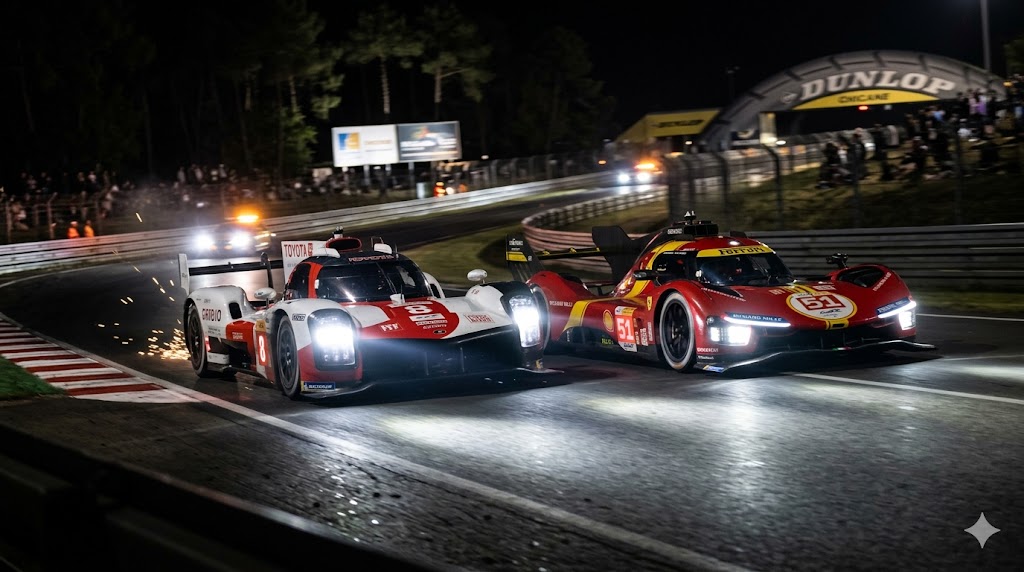
Pull up to the grid at almost any regional road racing weekend and you'll find a Spec E30 field packed nose to tail, a dozen or more cars separated by fractions of a second, with passes happening three and four times a lap in the same corner. That's not an accident of scheduling or a lucky group of drivers. It's the direct result of a rule set designed to strip away the variables that let money and horsepower decide races, leaving driver input as the deciding factor. Ask anyone who has raced both a spec class and an open-rules class, and they'll tell you the racing itself feels different. In Spec E30, you rarely win by simply having a faster car. You win by braking ten feet later, carrying more mid-corner speed, or out-thinking someone on strategy, because the car underneath you is functionally the same as the one next to you.
Why a Spec Class Changes the Nature of Competition
Most club racing categories, even ones with modest budgets, still allow enough latitude in suspension, aerodynamics, and engine tuning that a well-funded team can buy its way to the front. Spec racing inverts that dynamic on purpose. In Spec E30, the rules narrow the mechanical variables that separate cars: engines are restricted to a tightly controlled specification so that power differences between competitors stay minimal, suspension components are generally limited to a defined set of approved parts, and bodywork and aerodynamic additions are kept close to stock proportions. The intent isn't to make every car identical down to the bolt, but to compress the range of possible performance outcomes so tightly that the driver becomes the largest remaining variable. When you take away the temptation to spend your way into lap time, you're left racing the person beside you rather than racing a spec sheet.
This is precisely the angle that makes Spec E30 worth understanding on its own terms rather than as just another vintage-BMW story. The class isn't interesting because the E30 is a beloved chassis, though it is. It's interesting because the combination of a naturally well-balanced platform and a genuinely enforced spec formula produces something rarer than raw speed: parity. Parity is what turns a race into theater. When twenty cars can run within a few tenths of each other over a full lap, restarts and late-race battles turn into genuine contests rather than formalities, and that's the reputation Spec E30 has built over years of regional and national competition.
The E30 Chassis Was the Right Starting Point
None of this works if the base car is wrong, and the E30 3-Series happens to check nearly every box a spec-class organizer wants. It's rear-wheel drive, which rewards throttle modulation and car control in a way that front-drive platforms don't. Its chassis balance is close to neutral from the factory, so the car doesn't need extensive re-engineering to handle predictably at the limit. It was built in large numbers over roughly a decade of production, which for years meant there were plenty of clean, inexpensive donor cars floating around and a deep well of used parts to draw from. And because BMW's enthusiast community has supported the E30 for decades, the aftermarket and specialist knowledge base for maintaining these cars is unusually mature compared to what you'd find with a more obscure chassis.
That combination of low entry cost and mechanical simplicity is what let the spec formula work in the first place. A class built around a rare or expensive chassis would filter out exactly the kind of driver-first competition it was trying to create, because only well-funded teams could afford to play. The E30's abundance did the opposite: it opened the class to weekend racers, driving coaches, and teams running on tight budgets, which is a big part of why grids fill up and why the level of competition stays so consistently high from top to bottom.
Setup Nuance Still Matters, Just Differently
None of this means Spec E30 cars are identical or that setup knowledge is irrelevant. Within the boundaries of the spec rules, there's still room to work on corner balance, alignment settings, brake bias, and mechanical grip, and the teams that understand their car deeply do gain an edge. But the ceiling on what setup work can buy you is much lower than in an open class, and that changes what "working on the car" actually means. Instead of chasing horsepower or exotic aero, crews spend their time on the margins: shock valving within allowed parameters, tire management across a run, gearing for a specific track, and making sure the car is consistent lap after lap rather than fast for one flying lap and inconsistent for the other twenty. That shift in emphasis, from raw performance to consistency and fine-tuning, is exactly why driver feel and race craft carry so much more weight relative to the equipment than they do elsewhere.
It also means that driver development becomes a more honest measure of talent. Coaches and teams frequently point to Spec E30 as a proving ground precisely because a driver who improves their braking points or their exit speed can see that improvement show up in lap times without wondering whether it was actually the new parts that did the work. That clarity is valuable both for drivers trying to build a resume and for anyone using the class as a stepping stone toward higher levels of motorsport.
The Trade-Offs Nobody Should Gloss Over
The picture isn't without real costs, and it's worth being direct about them. The E30's popularity as a racing platform, combined with rising general interest in these cars among collectors and enthusiasts, has pushed the price of clean, rust-free donor cars up substantially compared to years past. Finding a straight, low-rust shell to start a build is harder and pricier than it once was, and that has raised the effective entry cost into a class that built its reputation on affordability. Sourcing certain trim, interior, and even some mechanical parts has also gotten tougher simply because the car is aging and fewer clean examples remain in daily use to be parted out.
Building the car to a genuine race-ready standard isn't free either. A proper roll cage, safety harnesses, a fire suppression system, and the fuel cell and electrical cutoff work that most sanctioning bodies generally require add up to a meaningful portion of the overall build cost, and that work is not a place to cut corners given what's at stake in wheel-to-wheel racing. And the very thing that makes Spec E30 racing exciting, cars running close together for entire races, also raises the odds of incidental contact. Tight racing means less margin for error in traffic, and drivers moving up into the class from open-passing track days sometimes need a lap or two to recalibrate how aggressively they can dive for a gap. None of that erases the appeal, but anyone budgeting for a season should weigh the safety build and the contact risk alongside the fun factor.
Why the Format Keeps Earning Its Reputation
What keeps Spec E30 relevant, even as the donor car market tightens, is that the fundamental trade the class offers hasn't changed. You give up the freedom to out-engineer your competition, and in exchange you get races where the last lap is genuinely in doubt and where a mid-pack qualifier has a real shot at a podium if they drive a clean, smart race. That's a rare thing in motorsport at any level, let alone in grassroots club racing where budgets are usually the quiet determinant of finishing order. As long as organizers keep enforcing the spec rules tightly and the E30 chassis remains serviceable and available, even at higher prices than a decade ago, the class is likely to keep producing the kind of racing that made its reputation in the first place.
Key Takeaways
- Spec E30's tightly enforced rules on engines, suspension, and bodywork compress performance differences between cars, shifting races toward driver skill rather than budget.
- The E30 3-Series was chosen as the platform because its rear-wheel-drive layout, neutral factory balance, and historically plentiful, affordable donor cars suited a low-cost spec formula.
- Setup work still matters within the class, but it shifts toward consistency, tire management, and fine margins rather than chasing raw horsepower or exotic aerodynamics.
- Rising prices for clean, rust-free E30 donor cars and harder-to-source parts have pushed up entry costs compared to the class's early years.
- A proper safety build, including a roll cage, harnesses, and fire suppression, adds real cost and shouldn't be shortcut, and tight racing inherently raises the risk of contact.
- Bottom line: if you want racing decided by driver ability rather than checkbook size, Spec E30 remains one of the most reliable ways to find it in grassroots motorsport, provided you budget honestly for the car search and the safety equipment.