Ask a casual motorsport fan to name a 24-hour race and you'll almost always get one answer, even though the calendar's other great round-the-clock classic takes place on a circuit that many drivers will tell you, off the record, is more physically demanding and less forgiving than La Sarthe. The Spa 24 Hours doesn't get anywhere near the mainstream attention of Le Mans, and that gap between its actual difficulty and its public profile is exactly what makes it worth explaining properly.
Why Spa-Francorchamps Punishes Drivers Like Nowhere Else
Circuit de Spa-Francorchamps sits in the Ardennes forest, and its elevation changes are not a cosmetic detail — they fundamentally change how a car behaves compared to the flatter, more rhythmic layout of the Circuit de la Sarthe. Eau Rouge and Raidillon compress a car's suspension through a blind, uphill, off-camber sequence taken at enormous speed, and doing that reliably for twenty-four hours, in a full field of GT3 cars running nose to tail with vastly different closing speeds, is a different kind of test than anything Le Mans asks of a driver. Where Le Mans rewards fuel-saving discipline and strategic patience across long, more predictable straights, Spa rewards raw car control and unrelenting concentration through a lap that offers almost no true rest, because even the circuit's flowing middle sector demands precision at speed rather than a breather.
Ardennes weather compounds all of this. The region is notorious for localized, rapidly changing conditions, and it's entirely normal for one part of the circuit to be dry while another is soaked, forcing teams into tire-strategy gambles that have no clean analog at Le Mans's more uniform weather patterns. Drivers describe committing to slick tires on one part of the lap while treating another section like a rally stage, and getting that balance wrong at Spa's blind, high-speed sections carries consequences that are considerably less forgiving than a similar miscalculation on La Sarthe's more open layout.
A GT3 Showcase Rather Than a Prototype Battle
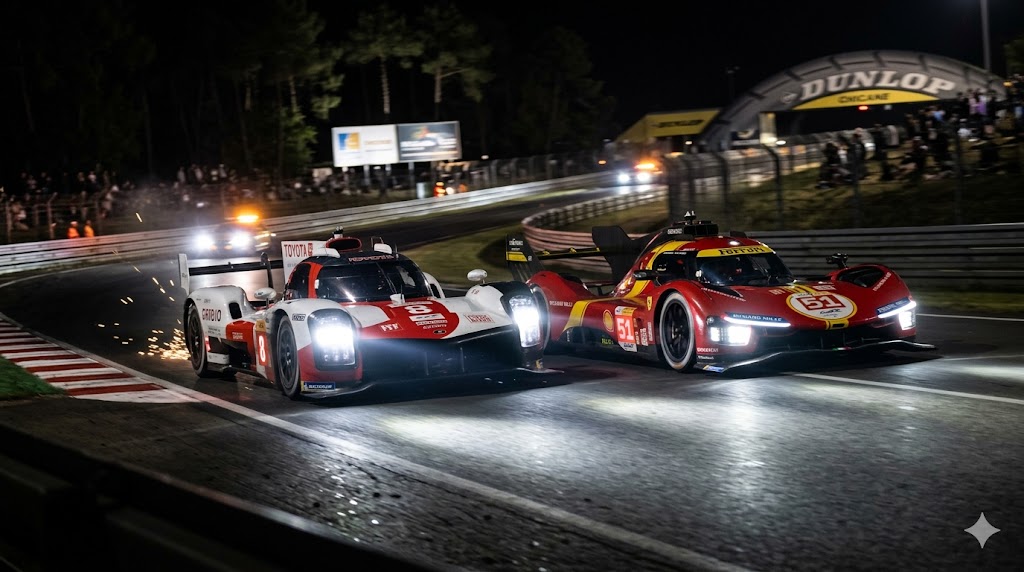
One of the clearest structural differences between the two races is what class headlines them. Le Mans is built around Hypercar prototypes chasing outright victory, with GT3 racing as an important but secondary undercard. Spa's 24 Hours is fundamentally a GT3 race, run as one of the flagship rounds of GT racing's global calendar, and that difference shapes the entire character of the event. Instead of watching prototypes lap slower GT traffic, you're watching a full field of closely matched GT3 cars from multiple manufacturers race each other directly for outright position, which produces a different, arguably more relatable style of racing since the cars involved are far closer in silhouette and concept to cars enthusiasts can actually buy and drive.
That GT3 focus also means Balance of Performance and success-handicapping decisions carry even more weight at Spa than they do in Le Mans's Hypercar class, since the entire outright classification depends on a single category being kept genuinely competitive across many different manufacturers' cars. Getting that balance right is part of what makes Spa's outright winner feel earned rather than a product of one brand simply out-engineering a thinner field, and it's a big part of why the race has built such a loyal following among GT racing purists even without Le Mans's broader name recognition.
The Driver Lineups That Make Spa Special
Because Spa's 24 Hours sits within the GT World Challenge Europe calendar rather than the World Endurance Championship, its driver lineups blend factory-supported professionals with talented gentleman drivers and rising prospects in a way that creates genuinely compelling storylines independent of the outright results. Teams frequently run four-driver lineups rather than the three-driver norm at Le Mans, which changes stint strategy and rest patterns across the twenty-four hours and adds another layer of tactical decision-making that dedicated fans follow closely. The mix of professional and amateur talent sharing a cockpit across a full day and night of racing at one of the world's most demanding circuits produces a different kind of drama than watching factory-only prototype lineups trade the lead at Le Mans, and it's part of why the race has such a devoted niche following even as it remains comparatively under-covered by mainstream motorsport media.
Why the Attention Gap Persists
Le Mans benefits from a century of accumulated cultural weight, a location and history baked into motorsport folklore, and its position atop endurance racing's overall Hypercar hierarchy. Spa's 24 Hours, despite arguably offering a tougher physical challenge and a deeper, more competitive single-class field, sits within GT racing's ecosystem rather than at the peak of prototype competition, and that structural position affects how much mainstream media attention it receives regardless of the quality of racing it actually produces. There's also a simple matter of calendar crowding — Spa's race takes place amid a packed European racing calendar that includes Formula 1's own visit to the same circuit, which can dilute broader public attention even among fans who follow the sport closely.
None of that reflects the actual difficulty or competitive integrity of the event. If anything, the fact that Spa's 24 Hours continues attracting strong manufacturer and team commitment despite operating with a smaller media footprint than Le Mans is a testament to how much genuine respect it commands within the paddock, even if that respect hasn't fully translated into mainstream recognition.
What Newcomers Should Actually Watch For
If you're coming to Spa's 24 Hours for the first time, resist the instinct to compare it directly against Le Mans as though they're the same event with a different location. Watch instead for how teams manage the circuit's brutal Eau Rouge–Raidillon sequence in changing light and weather conditions across the night, watch for how Balance of Performance adjustments shape the outright battle among GT3 manufacturers rather than assuming one brand will simply dominate, and pay attention to how four-driver rotation strategies differ from the three-driver norm you might be used to from Le Mans coverage. Approached on its own terms, Spa's 24 Hours offers a leaner, arguably more visceral version of endurance racing's core appeal — man, machine, and a punishing circuit, sustained across a full day and night — without the layered prototype-versus-GT hierarchy that adds complexity to following Le Mans.
For fans willing to look past the attention gap, Spa's race rewards that curiosity generously, offering some of the most demanding driving conditions in motorsport wrapped inside a genuinely competitive single-class battle that deserves a far larger audience than it currently receives.
Key Takeaways
- Spa-Francorchamps's elevation changes and blind high-speed sections, especially Eau Rouge–Raidillon, make sustained concentration over 24 hours arguably harder than at Le Mans.
- Unlike Le Mans, Spa's 24 Hours is a GT3-focused race, producing closer, more direct wheel-to-wheel competition among similarly matched cars.
- Ardennes weather's localized unpredictability forces tire and strategy gambles with less margin for error than Le Mans's more uniform conditions typically allow.
- Four-driver lineups blending professionals and gentleman racers create tactical and storyline dynamics distinct from Le Mans's three-driver factory norm.
- The race's smaller media footprint reflects its position within GT racing's calendar rather than any shortfall in competitive quality or difficulty.
- Bottom line: Spa's 24 Hours deserves recognition as one of endurance racing's toughest and most competitively pure events, not merely as a lesser-known cousin of Le Mans.