
The restoration-versus-buying-restored question is one of the most persistently misanalyzed decisions in classic car ownership. The romantic narrative of buying a project car and transforming it through personal effort is powerful enough to override the economic analysis that most buyers, if they ran the numbers honestly, would find unfavorable. The result is a large population of unfinished or poorly executed restorations and a smaller population of buyers who paid full market prices for professionally restored vehicles and were genuinely satisfied with the outcome.
Neither path is universally wrong. Both paths are frequently chosen for the wrong reasons, based on assumptions that don't survive contact with reality.
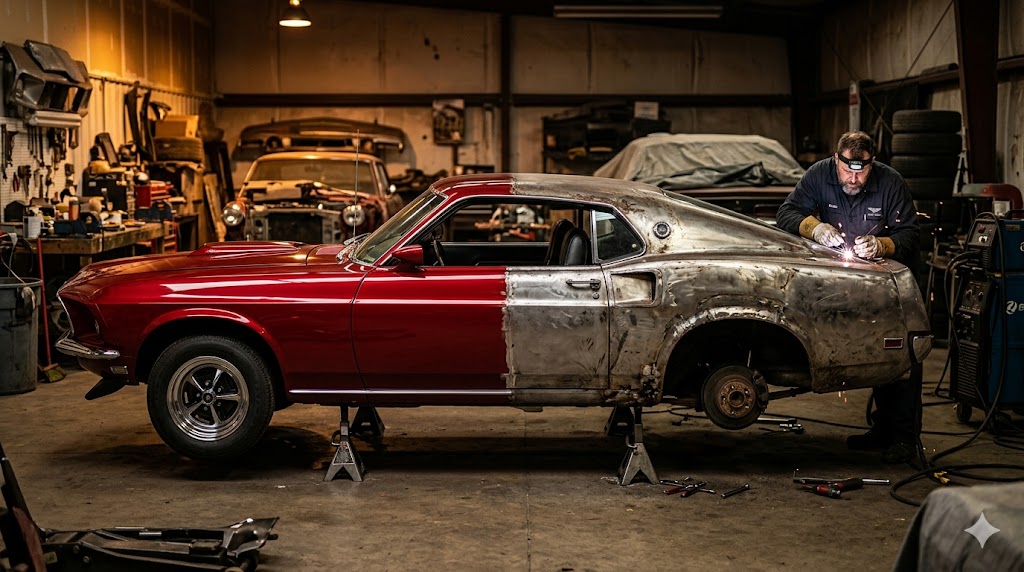
The project car argument rests on the belief that the labor investment, whether personal or paid, will produce a vehicle worth more than the total of acquisition cost plus restoration cost. This is sometimes true. It requires conditions that are less common than the argument assumes: a car that was priced as a project at a meaningful discount to its post-restoration value, a restoration that comes in at or below budget, and a finished product that achieves the condition and documentation level the market rewards.
Restoration costs have increased dramatically relative to 2015 and 2020 levels. Shop rates at quality restoration facilities in most markets now run at rates that produce total restoration costs on comprehensive projects that exceed what the resulting car commands in the market for common configurations. The economic case for buying a project car and paying for professional restoration exists for rare, high-demand vehicles where the restored value genuinely exceeds total costs. It rarely exists for common configurations.
Personal labor changes the equation if - and only if - the buyer has genuine restoration skills and values the process as much as the outcome. A buyer who enjoys the work, has the tools and space, and is honest about doing it correctly over a realistic timeline can produce results that paid restoration achieves at a lower total cost. A buyer who has never completed a restoration and underestimates the skill requirements typically produces a lower-quality result at higher total cost than expected.
Buying a professionally restored vehicle from a shop or private seller with documentation of the work performed is the most predictable path for buyers who want a quality classic without the restoration journey. The premium for documented, professionally restored work reflects a real difference in quality and authenticity that shows up in resale value.
Summary
What it is: A practical analysis of the restoration-versus-buying-restored decision for classic car buyers, including honest cost analysis and the conditions that favor each approach.
Best for: Prospective classic car buyers who are considering a project car and want an honest economic assessment before committing.
Biggest cost/risk factor: Underestimating restoration costs and timeline - the gap between project-car purchase price and total restoration cost frequently exceeds the restored vehicle's market value.
When to act: After getting shop quotes for the restoration work needed on any specific project car - the real number changes the calculation significantly.
AutosAdvisor does not provide financial investment advice. Classic car values vary and professional appraisal is recommended before significant purchases.