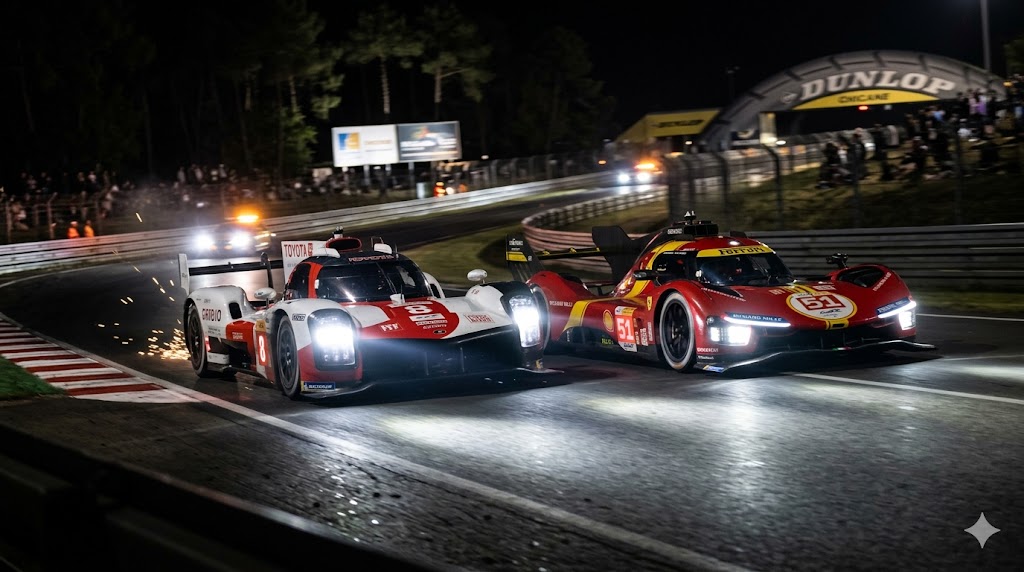

The racing line - the specific path through a corner that minimizes lap time - looks counterintuitive to drivers experiencing it for the first time. It uses more of the road than seems necessary. It carries the car toward the outside of the track at points where instinct says to stay centered. And it produces faster lap times through corners than any more intuitive path, for reasons that are rooted in physics rather than convention.
Understanding why the racing line works is the prerequisite for actually using it under the cognitive and physical pressure of real driving. Drivers who understand the geometry apply it more consistently than those who have been told where to position the car without understanding why.
The core physics principle is radius maximization. A car can corner at maximum speed without losing traction when the centripetal force required to maintain the corner doesn't exceed the tire's available grip. The centripetal force required to navigate a corner increases as the radius decreases - a tighter corner requires more force to maintain, which limits the speed at which it can be navigated without exceeding tire grip.
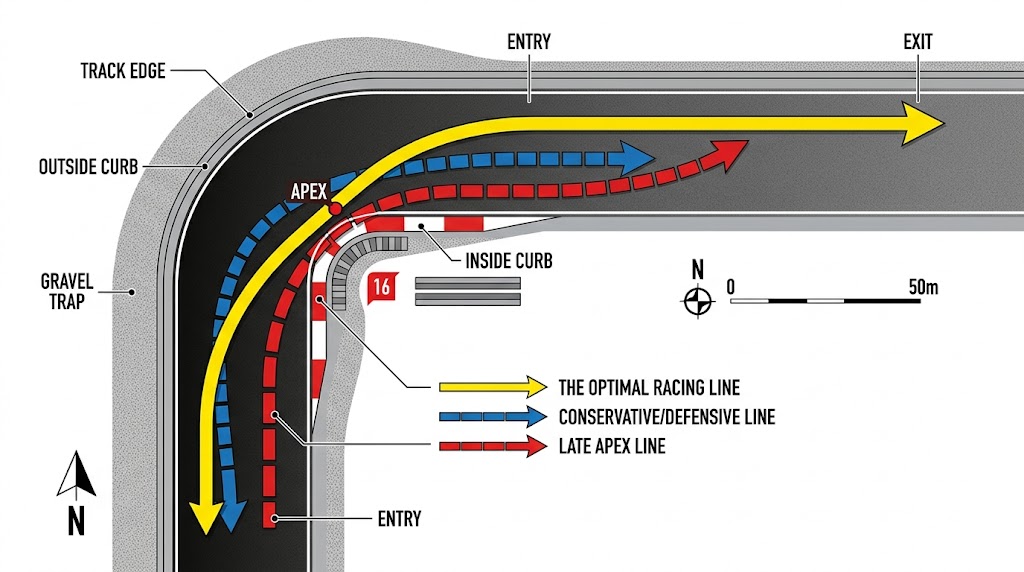
The ideal racing line through a corner increases the effective radius of the turn by using the full width of the track. A car entering from the outside of the track, touching the apex - the geometric inside peak of the corner - and exiting toward the outside creates a larger radius arc than a car that stays in the center of the track throughout. The larger radius arc can be navigated faster without exceeding available grip.
The late apex is the practical application that most driving schools teach as the foundation skill. Rather than apexing at the geometric center of the corner, the late apex delays the turning point and places the apex later in the corner. This has two advantages: it allows a straighter exit line, which permits earlier throttle application and better use of the engine's power output on corner exit; and it provides a margin for error on corner entry, since a car that turns in too early can correct, while a car that turns in too late is past the point of correction.
The practical process for learning corner lines involves walking tracks before driving them, understanding each corner's type (decreasing radius, increasing radius, constant radius, and combinations), and noting where the exit of one corner affects the optimal entry of the next.
Summary
What it is: An explanation of the physics behind the racing line - why the ideal corner path is faster and how the principles apply to real track driving.
Best for: Track day participants and driving enthusiasts who want to understand the 'why' behind corner technique rather than just following instructions.
Key tradeoff: The ideal racing line for lap times isn't always the safest path in traffic - understanding the differences between track and road application matters.
Bottom line: Racing line fundamentals are learnable physics, not mysterious talent - understanding them is the most accessible improvement most drivers can make.
AutosAdvisor is not a certified driving instructor. Track driving carries inherent risk. Instruction from a qualified driving coach is recommended before applying performance techniques on circuit.