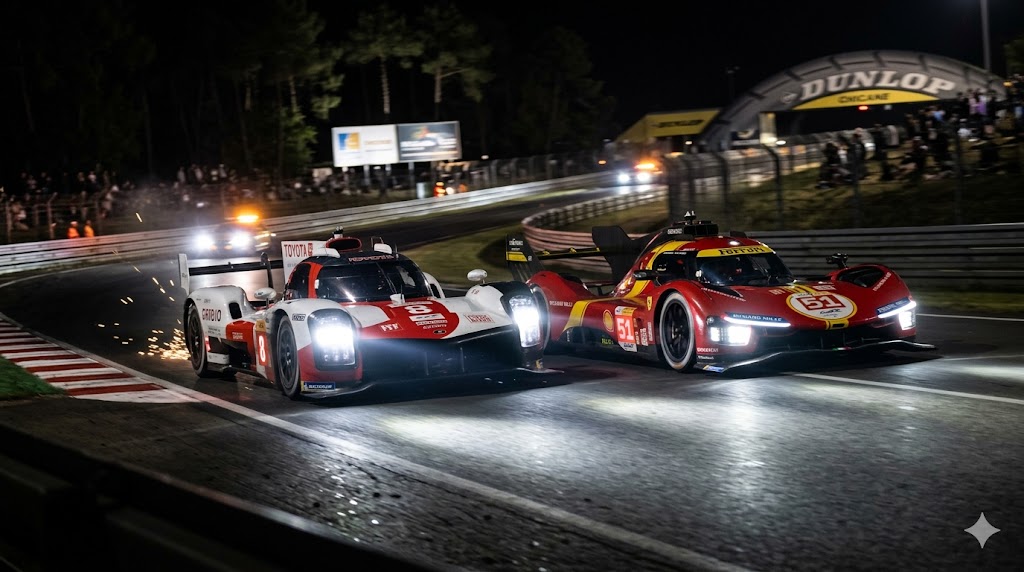
Somewhere around 11 p.m. on race day, the Circuit de la Sarthe stops looking like a racetrack and starts looking like a light show moving at 200 mph. Headlights carve tunnels through the darkness along the Mulsanne Straight, brake discs glow orange under braking into Indianapolis and Arnage, and drivers who were reading braking points off curbing and tree lines twelve hours earlier are now doing it almost entirely from memory and instrument feedback. Night racing isn't a footnote at Le Mans, it's roughly a third of the race, and how well a team prepares for those dark hours often decides who's still running at dawn.
Why the Night Hours Are Different, Not Just Darker
The obvious change is visibility, but the deeper issue is how much information a driver loses all at once. In daylight, a huge amount of a driver's braking and turn-in reference comes from peripheral cues: the tree line, a curbing pattern, the shape of a grandstand, the shadow cast by an overpass. At night, most of that disappears, and the driver is left working almost entirely off headlight throw, reflective curbing, and marshal post lighting. Depth perception suffers too, which matters enormously at a track like Le Mans where drivers are constantly closing on slower GT traffic at closing speeds that can exceed 100 mph between a Hypercar and a GTE or GT3 car.
Temperature swings compound the visibility problem. Track temperature drops significantly overnight, which changes tire grip levels and the balance of the car in ways that catch out anyone who hasn't planned for it. A setup that felt neutral in the heat of the afternoon can turn edgy and unpredictable once the asphalt cools, and teams that treat the car's night setup as an afterthought tend to pay for it with spins or contact in the small hours.
How Drivers Train Their Eyes and Reflexes
Professional endurance drivers don't wait until race week to adapt to night conditions. Many spend time in simulators specifically running night-condition models of the track, training their brain to recognize braking and turn-in points using the reduced visual information available after dark. It sounds almost trivial, but the muscle memory built from thousands of daylight laps has to be partially overwritten, because the visual cues a driver's brain has learned to trust simply aren't there anymore.
Physical fatigue management becomes just as important as visual adaptation. A driver might do a night stint after already having raced in the day, dealt with the adrenaline crash that follows every stint, and tried to get real sleep in a motorhome bunk while the race continues outside. Teams increasingly work with sports scientists and sleep specialists to structure driver rotations so that each driver's night stints land, as much as possible, during a window when their body is capable of sharp reaction time rather than fighting through a circadian low point. Getting that rotation wrong doesn't just cost lap time, it raises the real risk of a fatigue-related mistake at the exact hours when recovery vehicles and marshals are hardest to see.
The Engineering Side: Lighting, Setup, and Visibility
Modern Le Mans prototypes and GT cars run lighting systems that are engineered as seriously as any other performance component on the car. Headlight output, beam pattern, and even the color temperature of the light are all considered, because a beam that's too narrow leaves a driver blind in fast, sweeping corners, while a poorly focused wide beam can wash out reflective curbing and actually reduce the useful visual information a driver gets. Teams also pay close attention to windshield and visor treatments, since glare from other cars' headlights, condensation, and the accumulated grime of hours of racing all get worse as the night goes on.
On the setup side, engineers typically plan distinct night and day characteristics into the car from the start, adjusting ride height, aerodynamic balance, and tire strategy to account for the cooler track and reduced grip window. Some of this is baked into pre-race simulation work using historical weather and track temperature data, but plenty of it comes down to real-time adjustments as the team reads what the car is actually doing once darkness falls. Radio communication between driver and engineer becomes more detailed and more frequent overnight, since the driver's ability to self-diagnose subtle handling changes is naturally reduced when so much sensory input is already compromised by low light.
Team Strategy Shifts After Dark
Race strategists treat the night hours as a distinct phase of the race, not just a continuation of the afternoon's pace. Pit stop timing, fuel windows, and driver-change sequencing are often planned specifically around getting the most experienced night drivers into the car during the highest-risk hours, typically the deep overnight stretch when fatigue is at its peak across the entire field, not just for one team. Teams also tend to be more conservative about overtakes and traffic management at night, since the cost of a mistake, both in time lost and in physical risk, rises sharply when a spin or contact happens in a low-visibility zone where following cars have less time to react.
Communication with slower GT and LMP2 traffic becomes a much bigger factor in the night hours as well. Blue flags and mirror checks matter at any hour, but the speed differential between class leaders and the tail of the field is at its most dangerous overnight, when a GT driver nursing a car home might not see a Hypercar closing at a rate their daytime instincts would have caught sooner. Race control and team strategists both factor this into how aggressively they push drivers to attack overnight versus simply maintaining position and banking clean laps.
Why the Dark Hours Often Decide the Race
It's a well-worn cliché in endurance racing that Le Mans isn't won in the day, it's survived at night, and the cliché persists because it holds up. Cars that were comfortably in contention at sunset routinely fall out of the race or lose a lap during the overnight hours, whether from a driver error induced by fatigue or reduced visibility, a mechanical issue that a cooler track exposes, or a strategic miscall on tire choice as temperatures swing. Teams that treat the night as simply "more of the same race" tend to be the ones explaining a disappointing finish the next morning, while the teams that specifically plan, train, and engineer for those dark hours are disproportionately represented among the cars still running strong when the sun comes back up over the Sarthe.
Key Takeaways
- Night racing at Le Mans strips away most of the visual reference points drivers rely on in daylight, forcing reliance on headlights, reflective curbing, and instrument feedback instead.
- Drivers train specifically for night conditions using simulators and structured rest schedules designed to align their sharpest reaction times with their toughest stints.
- Lighting systems and car setup are engineered with distinct night-specific considerations, since cooler track temperatures change grip levels and car balance after dark.
- Team strategy shifts overnight toward more conservative traffic management and careful driver-change sequencing during the highest-fatigue hours.
- Mixing with slower GT and LMP2 traffic is more dangerous at night because closing speeds are harder to judge with reduced visibility.
- Bottom line: the overnight stretch is where Le Mans is most often lost, and the teams that prepare for it as a distinct phase of the race consistently outperform those that treat it as an afterthought.