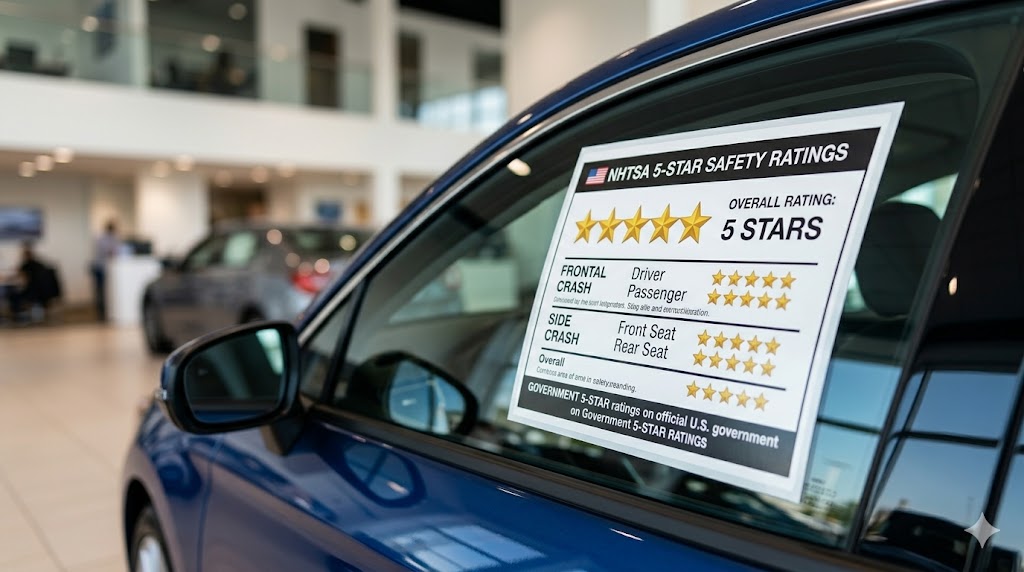

The National Highway Traffic Safety Administration's New Car Assessment Program has provided safety ratings for American-market vehicles since 1978, and those ratings - the familiar one-to-five star system visible on new vehicle Monroney stickers - influence purchasing decisions for a significant share of the car-buying public. The program's 2026 criteria update is the most significant revision in over a decade, adding evaluation components that address the types of accidents that have increased in frequency as vehicle use patterns and road populations have changed.
Understanding what changed and why matters for buyers who rely on NHTSA ratings in their purchase decision, because some vehicles that earned five stars under the previous criteria may not earn them under the revised framework, and some vehicles that perform strongly in new evaluation areas will move up in relative standing.
The most significant new additions address pedestrian automatic emergency braking performance, intersection collision avoidance, and rear-seat occupant protection. Each of these additions reflects crash data analysis that identified underrepresented risk areas in the previous evaluation framework.
Pedestrian AEB evaluation addresses the increasing use of automatic emergency braking in pedestrian protection scenarios. As urban vehicle-pedestrian interactions have increased - driven by higher pedestrian activity in urban environments and by distracted driving - the effectiveness of factory AEB systems in pedestrian detection scenarios has become a meaningful safety differentiator. Vehicles whose AEB systems perform well in pedestrian detection in the new evaluation criteria receive credit that the old framework didn't provide.
Intersection evaluation tests vehicles' ability to detect and respond to cross-traffic scenarios at intersections - the collision type that accounts for a significant share of injury-producing accidents in urban environments. The test scenario involves a vehicle crossing into the path at an intersection, evaluating how effectively the vehicle's detection systems identify and respond to the threat.
Rear-seat belt geometry and airbag evaluation addresses occupant protection in rear seats, which have historically received less sophisticated restraint system development than front seats. As the share of car occupants using rear seats has increased and as awareness of rear-seat occupant injury patterns has grown, NHTSA's evaluation of rear-seat protection has become more comprehensive.
Summary
What it is: An explanation of the 2026 NHTSA New Car Assessment Program criteria updates and what the changes mean for vehicle safety ratings.
Best for: Car buyers who use NHTSA ratings as a purchase criterion and want to understand what the ratings now evaluate.
Biggest cost/risk factor: Assuming a five-star rating under previous criteria guarantees strong performance in the new evaluation areas - the criteria change means the ratings are not directly comparable across model years.
When to act: Verify ratings for specific vehicles at nhtsa.gov under the current testing criteria before purchasing based on prior-year rating data.
AutosAdvisor is not affiliated with NHTSA. Safety ratings change and nhtsa.gov is the authoritative source for current vehicle ratings.