
The word 'hybrid' appears on window stickers, in advertising copy, and in manufacturer fuel economy claims in ways that cover a wider range of actual technology than most buyers realize. A mild hybrid and a full hybrid both carry the designation, both involve some form of electrification, and both deliver improved fuel economy compared to their conventional counterparts. The practical difference between them - in how they work, how much fuel they save, and what driving experience they deliver - is substantial enough to matter significantly to buyers trying to evaluate real-world running costs.
Understanding the distinction starts with what each system actually does, because the marketing language consistently obscures it.
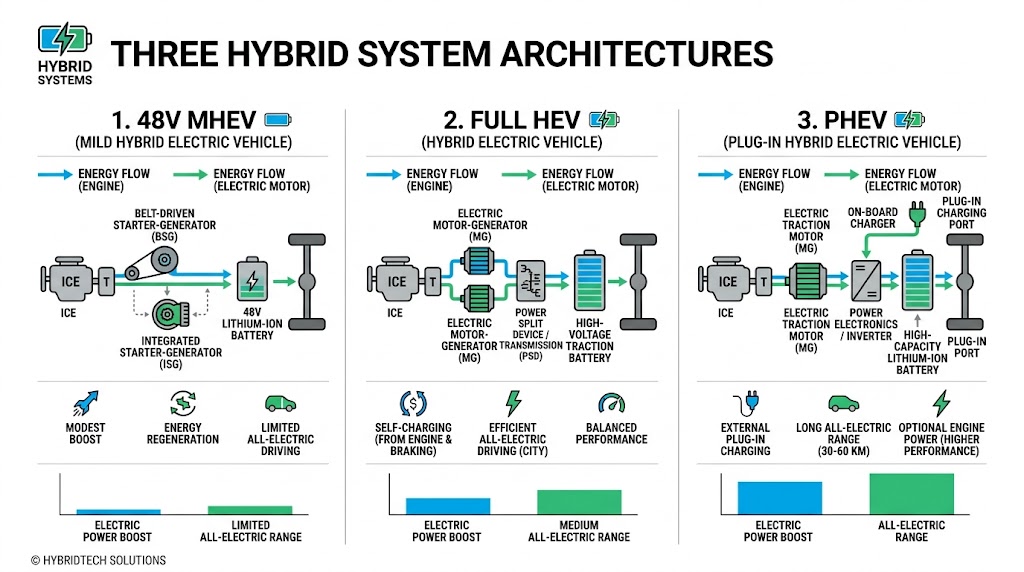
A mild hybrid - also called a MHEV or 48-volt hybrid - uses a small battery and motor-generator to capture energy during deceleration and use it to assist the engine under acceleration and to power accessories. The electric motor in a mild hybrid cannot propel the vehicle independently. It can only assist the gasoline engine. The fuel economy benefit is real - typically in the 8-15% range in mixed driving - but it comes primarily from engine-off coasting capability and more efficient accessory power rather than from electric-only driving.
The key distinction is that a mild hybrid never eliminates the gasoline engine from the propulsion equation. The engine runs whenever the vehicle is moving under power. The electric system reduces how hard the engine works, not whether it works.
A full hybrid - Toyota's Hybrid Synergy Drive, Honda's two-motor system, Hyundai's TMED system - can propel the vehicle on electricity alone at low speeds. At parking lot speeds and in stop-and-go city traffic, a full hybrid regularly operates in pure electric mode with the gasoline engine completely off. This electric-only capability is where the largest fuel economy gains come from, because stop-and-go city driving is precisely the condition where gasoline engines are least efficient and where an electric motor's efficiency advantage is greatest.
The EPA fuel economy figures reflect this difference. A mild-hybrid vehicle in the same class as a full hybrid will show fuel economy advantages over its non-hybrid counterpart, but typically less than the full hybrid. The gap is most pronounced in city driving: a full hybrid RAV4 achieves significantly better city fuel economy than a mild-hybrid equivalent, while the gap narrows on the highway where neither system's electric capability provides as much advantage.
For buyers whose driving is primarily urban and suburban - which represents the majority of American driving patterns - the full hybrid's advantage in city fuel economy translates to meaningful real-world cost difference over a typical ownership period. For buyers whose driving is primarily highway, the mild hybrid's lower cost premium may represent better value since the full hybrid's electric capability provides less advantage at constant highway speeds.
Summary
What it is: A technical comparison of mild hybrid and full hybrid technologies - how each works, what fuel economy each delivers in real-world conditions, and which makes sense for different buyer profiles.
Best for: Buyers evaluating electrified vehicles who want to understand the actual difference between mild and full hybrid systems before comparing fuel economy figures.
Biggest cost/risk factor: Paying a full-hybrid premium when your driving pattern is primarily highway-dominated, where the fuel economy gap between mild and full hybrid narrows significantly.
When to act: Use your actual driving pattern - city percentage vs highway percentage - to calculate which system's real-world efficiency advantage justifies its purchase premium.
AutosAdvisor is not a licensed automotive engineer. Fuel economy figures vary by driver and conditions.