
Ask any EV owner what actually causes stress on a road trip and it's rarely the driving itself — it's the mental math. How many miles until the next charger, how long is the wait going to be, will the battery percentage hold up if the route includes a mountain pass or a headwind. The 2025 Tesla Model Y Long Range is built to make that math boring, and boring is exactly what you want from a road-trip companion. Among mainstream electric SUVs, the Long Range trim consistently sits at or near the top of the range charts, and that single characteristic reshapes almost everything else about how the car feels to live with day to day.
Why Range Is the Headline, Not a Footnote
It's tempting to treat range as just another spec on a window sticker, but for an EV it functions more like the foundational trait that everything else gets built on top of. A car with class-leading range needs fewer charging stops on a long drive, tolerates more aggressive climate control use without anxiety, and gives you a bigger buffer when winter temperatures or highway speeds eat into efficiency, both of which happen to every EV regardless of brand. The Long Range trim's battery and drivetrain tuning are specifically aimed at stretching usable range further than the standard trim, and it shows in how the car behaves in the situations that actually matter: a spontaneous detour, a colder-than-expected morning, a stretch of interstate where the nearest fast charger is farther out than you'd like.
You should check Tesla's current published EPA range figures before buying, since numbers shift with model-year updates and wheel or trim choices, but the qualitative point stands regardless of the exact figure: the Long Range consistently ranks among the best of any mainstream electric SUV you can buy today, not just competitive with rivals but often meaningfully ahead of them. That gap is the entire reason this trim exists, and it's the lens through which the rest of the ownership experience should be judged.
What Class-Leading Range Actually Buys You on a Road Trip
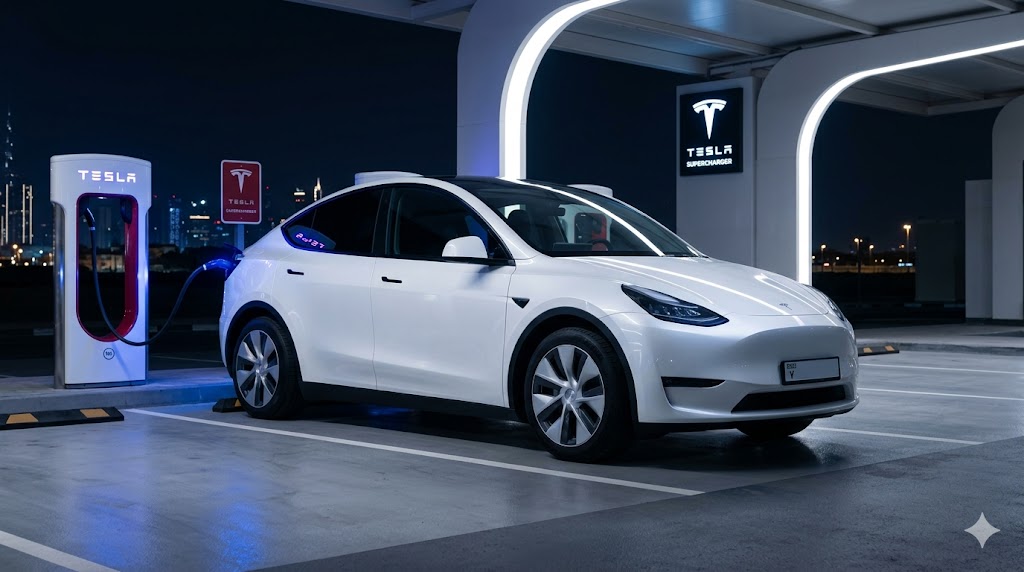
The practical payoff shows up most clearly on trips longer than a couple hundred miles, which is precisely the scenario where range anxiety tends to spike. A longer range means fewer stops strung together end to end, and because Tesla pairs the Model Y with its own fast-charging network, the stops you do make tend to be quicker and more predictable than relying on third-party charging infrastructure of inconsistent speed and reliability. The car's built-in trip planner factors in your battery level, the route, and charger locations automatically, which removes a layer of manual planning that owners of many other EVs still have to do themselves with a separate app.
The bigger range buffer also means you're not charging to 100 percent as often just to feel safe, which is good for long-term battery health and means most of your charging sessions can stay in the faster, more efficient part of the charging curve. On a cross-country trip, that combination of longer range per stop and shorter time per stop compounds in a way that's hard to appreciate until you've actually driven a shorter-range EV on the same route and felt the difference in how often you're thinking about the battery at all.
The Everyday Case: Less Charging Anxiety, Lower Cost Per Mile
Range matters just as much on ordinary days as it does on road trips, just in a quieter way. A Long Range battery means you can go a full week of commuting and errands without plugging in at all for many typical driving patterns, charging at home on your own schedule instead of treating it as an urgent task. That flexibility reduces the low-grade anxiety that comes with watching a percentage gauge, especially for owners who don't have reliable access to a home charger and instead rely on public charging on a less predictable schedule.
There's also a cost angle worth considering, even without pinning down exact cents-per-mile figures that vary by electricity rates and driving style. Electricity has generally remained cheaper than gasoline on a per-mile basis in most regions, and a longer-range battery lets you take fuller advantage of charging during off-peak utility rate windows since you're not forced to charge as frequently or urgently. Combined with the lower mechanical complexity of an EV drivetrain relative to a gas engine, the Long Range trim's efficiency and range together make a reasonably strong case for lower total cost of ownership, though your actual savings depend heavily on local electricity rates, driving habits, and how the specific numbers compare to whatever gas vehicle you're cross-shopping against.
Where the Model Y Still Asks for Trade-Offs
None of this means the Long Range is without real friction points, and the most talked-about one is Tesla's minimalist interior philosophy. Nearly every function, from adjusting the mirrors to opening the glovebox to changing HVAC settings, routes through the central touchscreen rather than a physical button or stalk. Some owners adapt quickly and come to prefer the clean, uncluttered look; others find themselves fumbling through menus for basic functions they'd rather control with muscle memory, particularly in the first few weeks of ownership. The turn signal stalk's removal in favor of steering wheel buttons on the current design has been especially polarizing, and it's worth sitting in one and actually using the controls before you decide it won't bother you.
Build quality is the other recurring caveat. Tesla's reputation for panel gaps, interior trim rattles, and inconsistent fit and finish has improved over the years but hasn't fully disappeared, and quality can vary noticeably from one individual vehicle to the next in ways that are harder to predict than with more established manufacturers. It's worth inspecting your specific car carefully at delivery rather than assuming uniform quality across the production run. Ride quality is generally firm, tuned more for handling composure than plushness, which some drivers appreciate and others find tiring on rough pavement or longer drives. And Tesla's driver-assistance systems, whether badged Autopilot or the more advanced Full Self-Driving package, remain driver-assistance features requiring constant attention and hands-on supervision, not autonomous driving in the way casual conversation sometimes implies — treat any marketing language around these systems with appropriate skepticism and lean on official documentation for what the systems can and cannot actually do.
Styling and Positioning: Not Universally Loved, But Coherent
The Model Y's exterior styling is polarizing in a way that's worth acknowledging honestly. Its rounded, almost featureless silhouette prioritizes aerodynamic efficiency, which directly supports that class-leading range, over the more aggressive or traditionally handsome proportions you'll find on some competitors. Some buyers find the look clean and futuristic; others find it bland or find the fit-and-finish details, like panel gaps around the hood and doors, distracting up close. It's a reminder that the range advantage isn't free even in aesthetic terms — Tesla made deliberate design choices to achieve it, and not every choice will land the same way with every buyer.
The Verdict on Long Range as the Right Trim
If you're deciding between the standard and Long Range trims, the calculus mostly comes down to how often you actually drive beyond a typical daily radius. For owners who mostly commute and run errands, the standard range trim might cover real-world needs just fine at a lower cost. But for anyone who road-trips regularly, lives somewhere with inconsistent access to home charging, or simply wants the largest possible buffer against range anxiety, the Long Range trim's core advantage — genuinely class-leading range among mainstream EVs — is worth paying for. It's the trim that makes the Model Y's biggest strength actually usable in the situations where range matters most.
Key Takeaways The Long Range trim's defining strength is range that consistently ranks at or near the top among mainstream electric SUVs, not just "competitive" but often clearly ahead. That range advantage translates directly into fewer, faster-feeling road trip charging stops when paired with Tesla's own fast-charging network and built-in trip planner. Day-to-day, the larger buffer reduces charging anxiety and can lower cost per mile, though actual savings depend on your local electricity rates and driving habits. The minimalist, touchscreen-dependent interior and inconsistent build quality remain real trade-offs that some buyers adapt to and others never fully embrace. Driver-assistance features require full attention regardless of branding, and exterior styling is polarizing enough that a test drive matters more than photos. Bottom line: if long trips or unpredictable charging access are part of your life, the Long Range trim's class-leading range justifies the upgrade over the standard trim more convincingly than almost any other spec difference in the lineup.