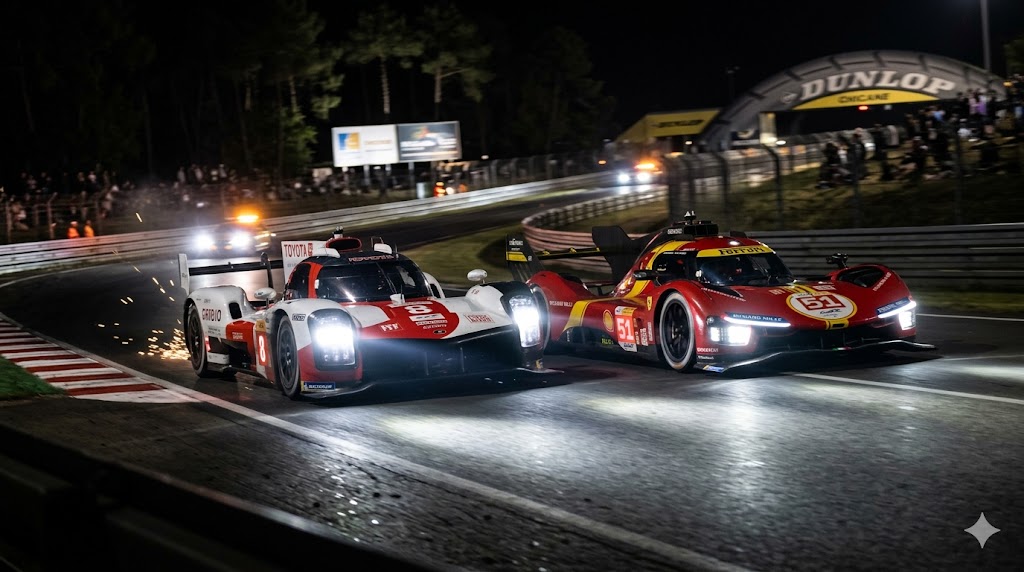
A Hypercar program from a major manufacturer can burn through a season's budget that would make most privateer race teams' eyes water. LMP2 was built to solve a completely different problem: how do you let a team without a factory budget or a manufacturer's engineering department field a genuine, fast, closed-cockpit prototype and race it credibly at Le Mans and across a full international season, all for a budget that's often cited in the range of roughly $600,000 for a season's racing. That number is the whole reason the class exists, and understanding how it's kept that low explains why LMP2 has become one of the most competitive, deepest fields in endurance racing.
The Spending Cap Is the Whole Design Philosophy
LMP2 works because the rulebook deliberately removes the areas where manufacturer money would otherwise create an arms race. Every team in the class runs a chassis from one of a small handful of approved constructors, and every one of those chassis uses the same specified engine, typically a Gibson V8 supplied as a spec unit rather than something teams or manufacturers can develop themselves. That single decision eliminates the two biggest cost centers in prototype racing: bespoke aerodynamic development racing between constructors and proprietary engine programs. Teams aren't allowed to out-develop each other on the car itself, so the competitive differentiation shifts almost entirely to driver skill, team execution, strategy, and the quality of the mechanics turning wrenches in the garage.
That's a deliberate philosophical choice, and it's what makes the roughly $600,000 season figure plausible in a sport where a single Hypercar program's annual spend can run into the tens of millions. Teams aren't paying for wind tunnel time or engine dynamometer development, because those variables are locked by the regulations before a team even signs up. What they're paying for is car acquisition or lease, spec parts, tires, travel and logistics for a genuinely global calendar, and driver fees, which brings up the class's other defining feature.
The Driver Lineup Rules That Keep It a Privateer Class
LMP2 requires at least one bronze or silver-rated driver in every car's lineup, under the FIA's driver categorization system that ranks drivers from platinum, for full-time professionals at the top level, down to bronze, for gentleman drivers and amateurs. This rule exists specifically to keep the class from turning into a backdoor way for manufacturers to run all-professional lineups in a cost-capped car. By mandating that at least one seat go to a less experienced or amateur-rated driver, the rules preserve LMP2's identity as a genuine home for privateer outfits, often funded partly by a wealthy gentleman driver who wants to race at Le Mans alongside professional teammates, rather than a shadow factory class.
That driver-mix requirement shapes team strategy in ways that go beyond just filling a seat. Teams have to build a car setup and a race strategy that works for drivers with genuinely different skill levels and experience, which is a different challenge than optimizing purely around a lineup of professionals. The bronze or silver driver's stints have to be planned carefully, often during less critical phases of the race, while still making sure that driver gets meaningful track time and doesn't become a liability during a safety car restart or in traffic.
Why the Racing Is Some of the Closest in the Sport
Because every car in the field shares the same chassis options and the same spec engine, LMP2 races are frequently decided by tenths of a second across a huge chunk of the grid, and pit strategy or a single driver error can swing the result far more dramatically than in a class where one team has genuinely faster machinery. That parity has made LMP2 a proving ground where driving talent and team execution are unusually visible, since there's no engineering advantage to hide behind. A team that wins consistently in LMP2 is winning largely because of driver skill, strategic calls, and pit crew execution, not because it found an extra few tenths a lap from an aerodynamic package its rivals don't have.
This is also why LMP2 has become such an important pipeline class. Young professional drivers use strong LMP2 performances to get noticed by manufacturer programs looking for talent to promote into Hypercar seats, and gentleman drivers get a legitimate opportunity to race wheel-to-wheel with some of the best sports car talent in the world in a genuinely competitive prototype, not a watered-down also-ran category. Both of those outcomes depend entirely on the class staying close, which is exactly what the spec parts philosophy is designed to guarantee.
The Trade-offs Privateer Teams Accept
None of this comes without real compromises, and it's worth being honest about what LMP2 privateer teams give up. Because the chassis and engine are fixed, teams can't chase the kind of open-ended performance gains that a factory-backed Hypercar or GT program pursues. If your car isn't a natural fit for a particular circuit's characteristics, there's very little you can do about it beyond suspension and setup tweaks within the allowed parameters. That ceiling can be frustrating for engineers and team principals who came up through more open categories where clever technical solutions could unlock real speed.
There's also the reality that even at roughly $600,000 for a season, LMP2 racing is still an expensive, resource-intensive undertaking that's out of reach for most amateur racers without either a personal fortune or serious sponsorship backing. The relatively low cost by prototype racing standards is a relative measure, not an absolute one, and the class still functions as a space for well-funded gentleman drivers and small, professionally run teams rather than a genuinely grassroots category.
What LMP2 Says About the Future of Cost-Capped Racing
LMP2's success as a template has influenced how other categories think about controlling costs without sacrificing competitiveness, and its DNA is visible in how newer formulas like LMDh balance manufacturer involvement with shared, regulated components. The lesson other series have taken from LMP2 is that removing certain expensive variables from competition doesn't necessarily make racing less interesting. If anything, LMP2's tight, driver-decided finishes suggest the opposite: when the machinery is leveled, the racing gets more unpredictable and more genuinely competitive, not less.
For a privateer team owner weighing whether to commit to a season of LMP2 racing, the pitch is straightforward. You get a real prototype, a real shot at overall class wins at some of the biggest endurance races in the world including Le Mans, and a cost structure that, while still substantial, is genuinely achievable without a manufacturer's backing. What you give up is the freedom to engineer your way past a faster rival, which for most privateer teams is a trade worth making.
Key Takeaways
- LMP2's roughly $600,000 season budget is achievable specifically because every team shares the same approved chassis options and a single spec Gibson V8 engine, removing the two most expensive variables in prototype racing.
- Mandatory bronze or silver-rated drivers in every lineup keep LMP2 a genuine privateer and gentleman-driver class rather than a backdoor professional category.
- Shared machinery means races are decided disproportionately by driver skill, strategy, and team execution rather than engineering advantage.
- The class functions as a key talent pipeline, helping young professionals get noticed while giving amateur drivers real seat time in a competitive prototype.
- Teams give up the ability to chase open-ended performance gains, since chassis and engine development are locked by the rules.
- Bottom line: LMP2 proves that leveling the machinery doesn't dull the racing, it sharpens the value of driving talent and team execution, making it one of the most genuinely competitive classes in endurance racing.