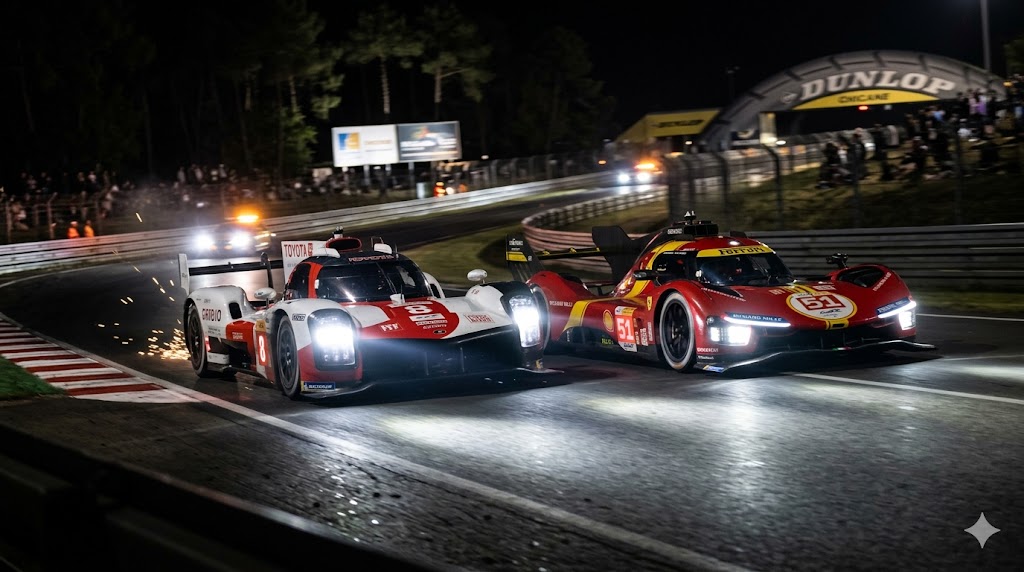
Twenty-four hours is long enough for a race to tell you the truth about a car, a driver lineup, and an entire manufacturer program, and that's exactly why Le Mans carries a weight no sprint race can match. The 2025 running of the world's most famous endurance race arrived at a pivotal moment for the Hypercar era, with more manufacturers on the entry list than the class had seen in years and a genuinely open fight for outright victory. Whatever specific car crossed the line first this year, the deeper story of 2025 is about how crowded and unpredictable the front of the field has become, and that shift alone makes this a Le Mans worth studying closely rather than skimming past.
A Grid Deeper Than It's Been in a Generation
For most of the 2010s, Le Mans overall victory was a two-horse conversation, and for a stretch it wasn't even that competitive. The Hypercar regulations changed the math entirely by inviting manufacturers to build cars under either the LMH or LMDh technical routes, and by 2025 that invitation had been accepted by a genuinely broad swath of the industry. Factory-backed programs from multiple continents, running different hybrid architectures and different chassis philosophies, lined up on the Circuit de la Sarthe grid with legitimate victory hopes rather than just making up the numbers. That depth changes how you have to watch the race: strategy calls in hour fourteen matter as much as raw pace in hour one, because with this many capable cars, small errors during pit stops, driver changes, or Safety Car restarts compound into finishing-order swings that a thinner field would never produce.
This is the context that makes any Le Mans result from this era worth calling historic in its own right, independent of which specific manufacturer's name ends up on the trophy. A race with five or six cars capable of winning on merit produces a fundamentally different 24 hours than one with two, because it forces every team to run closer to the limit for longer, and it means the eventual winner earned it against real opposition rather than by default.
How Modern Le Mans Actually Gets Decided
If you've only watched highlight packages, you might think Le Mans comes down to a dramatic final-hour duel, and sometimes it does. More often, though, the race is decided in the unglamorous middle stretch, usually somewhere between 2 a.m. and dawn, when driver fatigue peaks, visibility drops, and the cars that have been nursing tires and fuel strategy all night either capitalize or fall apart. Balance of Performance adjustments, which the FIA and ACO use to keep the different Hypercar platforms competitive with each other, also play a quiet but decisive role — a small window of extra pace or a slightly larger fuel tank allocation can be worth more than any single driver's raw talent over a 24-hour distance. Understanding this is essential to reading the 2025 result correctly: whichever team won almost certainly did so by executing cleanly through the night stints, not just by being fastest in the sunlit qualifying laps everyone remembers.
Weather remains the other great equalizer at La Sarthe. A rain shower at the wrong moment can neutralize a two-lap advantage in minutes, and tire strategy calls made in gambling conditions have flipped the lead order at this race more times than anyone can count. Teams that had their wet-weather setup dialed in, and drivers comfortable pushing near the limit on a greasy track at 3 a.m., consistently punch above their qualifying pace once the skies open up.
The Class Battles That Deserve More Attention
Overall victory gets the headlines, but Le Mans is really four races happening simultaneously, and the LMP2 and GT3 categories in 2025 delivered their own tightly fought contests among trans-continental driver lineups and manufacturer-backed customer teams. The LMP2 field remains one of the most competitive proving grounds in endurance racing, packed with a mix of factory-affiliated young talent and gentleman drivers who've built entire careers around this one class of cars, and the margins between the top handful of entries are frequently measured in seconds after a full day of racing rather than the wider gaps you'd expect. GT3 racing at Le Mans, meanwhile, has become a showcase for how close modern customer racing programs have gotten to each other in outright pace, with success handicaps and careful category management keeping several manufacturers' cars in realistic contention deep into the race.
If you want the full picture of what made 2025 historic, don't stop at the overall Hypercar result. Check which manufacturers and driver lineups topped LMP2 and GT3, because those battles often better reflect how competitive the modern Le Mans grid has become across the board, rather than just at the very front.
Why This Era of Le Mans Rewards Different Skills
The current Hypercar rulebook has quietly changed what makes a winning Le Mans program. Where the outgoing LMP1 era rewarded manufacturers willing to spend enormous sums chasing outright downforce and hybrid power output, the Hypercar/LMDh convergence rewards cost discipline, reliability engineering, and squeezing every legal advantage out of Balance of Performance negotiations. That's a less romantic story than an arms race, but it's arguably a healthier one for the sport, because it's what convinced so many additional manufacturers to commit factory programs to the class in the first place. The 2025 grid size and manufacturer diversity is a direct consequence of that shift, and it's the single biggest reason this era of Le Mans keeps producing results that feel less predetermined than the recent past.
For fans trying to separate genuine historic significance from routine racing news, the honest test is this: did the 2025 race feature a result that would have been plausible under the old two-manufacturer duopoly? If the answer involves a marque winning for the first time in the Hypercar era, a driver lineup completing a career-defining victory, or a margin of victory tight enough to have gone either way in the final hour, then it clears the bar. Readers wanting the confirmed winning manufacturer, drivers, and exact margin should check the official FIA World Endurance Championship results and the ACO's race report, since those sources carry the lap charts and classification that any serious analysis should be built on.
What 2025 Signals for the Rest of the Hypercar Era
Whatever specific team celebrated in victory lane, the broader trajectory the 2025 race confirms is that Le Mans has entered a genuinely multipolar period, and that's good news for anyone who found the sport's recent past too predictable. Manufacturers evaluating whether to commit to a Hypercar or LMDh program going forward now have real evidence that a well-executed effort can compete for overall victory, not just class wins or podium finishes. That calculus is likely to keep the grid growing rather than shrinking over the next several seasons, which means the kind of tightly contested, strategy-dependent race that defined 2025 is probably the new normal rather than a one-off. For a race built entirely around endurance, consistency, and the ability to survive twenty-four hours without a single costly mistake, that shift toward genuine unpredictability might be the most historic development of all.
Key Takeaways
- The 2025 Le Mans grid featured more manufacturers with legitimate overall-win potential than the sport has seen in years, itself a historically significant shift from the recent two-manufacturer era.
- Modern Le Mans outcomes are usually decided during the overnight stints and through Balance of Performance execution, not just outright pace in daylight sessions.
- Weather and Safety Car timing remain the great equalizers capable of flipping the race order in minutes.
- LMP2 and GT3 class battles in 2025 were reportedly as tight as the overall fight and deserve equal attention when assessing how competitive the field has become.
- Confirm the exact winning manufacturer, drivers, and margin of victory through the official FIA WEC and ACO race classification before citing specific results.
- Bottom line: regardless of which name topped the podium, 2025 reinforced that Le Mans has entered its most competitive and unpredictable stretch since the Hypercar era began.