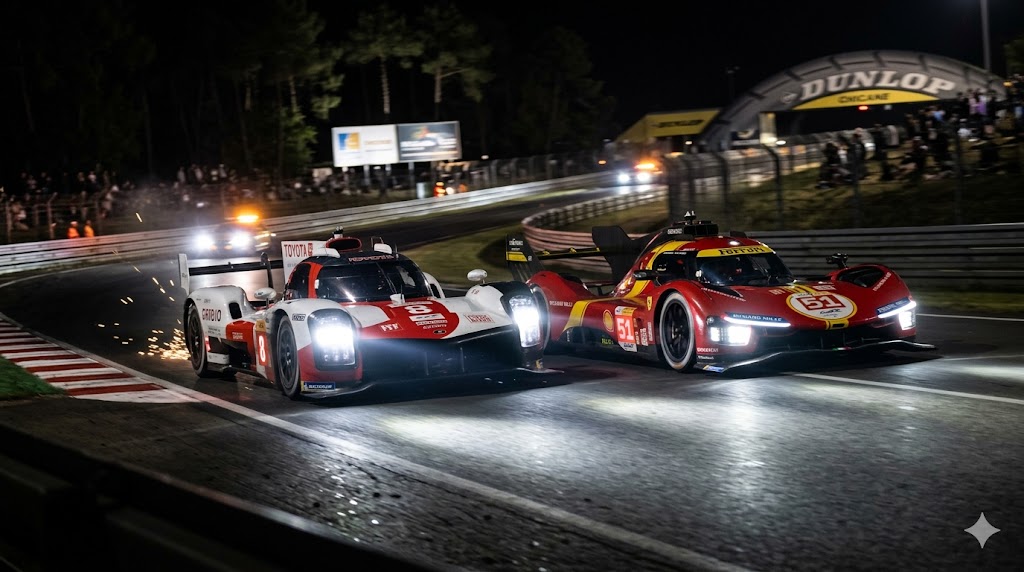
Every January, a NASCAR Cup regular, an IndyCar frontrunner, and a sports car specialist can climb into the same prototype at Daytona and share it for twenty-four hours straight. That single fact tells you almost everything about what the IMSA WeatherTech SportsCar Championship actually is in the American racing ecosystem. It is not a rival to NASCAR or IndyCar competing for the same eyeballs. It is the connective tissue between them, a place where drivers, engineers, and manufacturers from separate disciplines collide, compare notes, and occasionally decide to stay.
A Pipeline Built Into the Format Itself
Most racing series ask a driver to master one discipline and repeat it. IMSA does the opposite by design. Its multi-class fields put prototypes and GT cars on track together, and its marquee events run for hours rather than minutes, which forces teams to field two, three, or four drivers per car. That structural quirk is the whole reason the pipeline exists. A team chasing overall victory at the Rolex 24 at Daytona or the twelve hours of Sebring needs a mix of speed, experience, and stamina that a single driver roster rarely provides, so team owners go shopping across NASCAR, IndyCar, and international sports car racing to build a lineup. The result is a championship that functions less like a closed club and more like a marketplace where cross-series talent gets tested against genuinely different problems: traffic in the dark, fuel strategy, brake conservation, and sharing a car with people who drive it differently than you do.
For NASCAR and IndyCar drivers, that marketplace offers something their home series cannot: a legitimate reason to try something else without abandoning their primary commitment. A Cup driver can take a partial IMSA program, run the Rolex 24 as a specialist entry, and return to stock cars the following week with a different set of instincts sharpened. An IndyCar regular can do the same with GT machinery, learning to manage tire wear and traffic in a car that behaves nothing like an open-wheel chassis. Neither has to choose. That flexibility is precisely why the format keeps attracting outside talent year after year, and why team owners keep recruiting it.
The Rolex 24 as the Great Convergence Point
If there is one event that crystallizes this whole relationship, it is the Rolex 24 at Daytona. The race has built a reputation as the point on the calendar where NASCAR and IndyCar drivers routinely show up as part-time or specialist entries, slotting into endurance lineups alongside full-season IMSA competitors. It is worth being precise about why this happens rather than treating it as some vague tradition. Teams need bankable speed for twenty-four hours of racing, sponsors want recognizable names on the entry list, and drivers get a low-risk, high-visibility opportunity to test themselves in a different kind of car during a period when their home series is often on its winter break. The timing lines up almost too conveniently, and that convenience has helped the Rolex 24 become the sport's unofficial off-season showcase for cross-discipline curiosity.
Sebring plays a similar, slightly less glamorous role later in the spring. It is punishing on cars and bodies alike, famous for a surface that beats up suspension components and rattles drivers who are not used to its bumps. Where Daytona rewards raw speed and night-racing composure, Sebring rewards mechanical sympathy and patience, which makes it a different kind of test for a visiting driver. Together, the two races give NASCAR and IndyCar drivers two very different proving grounds within the same championship, each exposing weaknesses or strengths that a single-discipline career would never reveal.
Endurance Racing Tests Skills a Single Series Never Will
Oval racing and single-driver road racing measure a fairly narrow band of skill: one person, one setup, one continuous rhythm for the length of the race. Endurance sports car racing measures something broader. A driver has to communicate a car's changing balance to teammates who will inherit it hours later, adapt to a setup that someone else tuned, and manage a stint knowing that a mistake does not just cost a position, it costs the whole team's night. That co-driving dimension is arguably the single biggest skill gap between IMSA and the series that feed it or draw from it. NASCAR drivers are used to owning their car for the entire race. IndyCar drivers are used to a qualifying and race rhythm built entirely around individual performance. Handing a car off to a teammate, then getting back in hours later to drive on old brakes and a different fuel load, is a discipline of its own, and it is one that only sports car racing teaches at this level in North America.
That is also where the honest trade-offs start to show up. Learning to co-drive is valuable, but it takes real time and mental energy away from a driver's primary series commitment, especially during a season where every practice session and simulator hour matters. Endurance races run long into the night, sap sleep, and carry a physical toll that a single Sunday oval race does not, and a driver nursing fatigue or a minor injury picked up in a GT car at Daytona brings that risk straight back to his primary ride the following week. Team owners and series officials have quietly debated for years whether these crossover programs sharpen a driver's overall craft or simply spread his focus thinner across too many commitments. There is no universal answer. Some drivers clearly use the variety to become better racers everywhere; others take on more than their schedule can support and it shows in results. Both outcomes exist in the same sport, and pretending otherwise would flatten a genuinely open question.
Manufacturers Use the Same Bridge the Drivers Do
Drivers are only half of this story. Manufacturers treat IMSA the same way, as a proving ground that connects to their commitments in NASCAR and IndyCar. A manufacturer with a factory GT or prototype program gets real endurance data on braking systems, hybrid components, and aerodynamic durability under conditions that a shorter sprint race never produces. Some of that knowledge and some of those personnel relationships flow sideways into a manufacturer's other racing programs, even when the cars themselves are entirely different formulas. It also gives a manufacturer a broader footprint across American motorsport with a single, coordinated marketing story, which matters as much to a boardroom as it does to an engineering department. A brand that can point to a strong showing at Daytona, a competitive NASCAR season, and an IndyCar entry all in the same year is telling a more complete story to fans and sponsors than any one series could tell alone.
Why Fans and Drivers Keep Showing Up
None of this would matter if the events themselves were not genuinely appealing on their own terms. The Rolex 24 and Sebring have built decades of mystique precisely because they ask something different of everyone who enters, and that includes fans as much as drivers. Watching a NASCAR name or an IndyCar frontrunner adapt to a discipline they do not do every week is compelling in a way that watching them do their usual job simply is not. For drivers, the appeal is just as real. A one-off or partial IMSA program offers a low-stakes way to stay sharp, meet new engineers, and race somewhere that will not follow them home if it goes poorly. For a career, that kind of variety can be as valuable as another trophy, provided it is managed with the same discipline the endurance format demands on track.
Key Takeaways
- IMSA's multi-driver endurance format forces teams to recruit across NASCAR, IndyCar, and sports car racing, making crossover a structural feature rather than a novelty.
- The Rolex 24 at Daytona has become the sport's central convergence point, drawing part-time and specialist entries from drivers based in other series.
- Sebring complements Daytona by testing mechanical sympathy and patience over a punishing surface, rounding out a different kind of challenge for visiting drivers.
- Co-driving and car-sharing teach communication and adaptability skills that single-driver oval or road racing rarely demands.
- The physical toll and scheduling conflicts of cross-series racing are real, and not every driver who attempts it manages the balance well.
- Manufacturers use IMSA the same way drivers do, turning it into a technology and marketing bridge that connects their programs across American motorsport.
- The bottom line: IMSA's WeatherTech Championship works less as a standalone series and more as the shared proving ground where NASCAR and IndyCar talent and technology quietly cross paths.