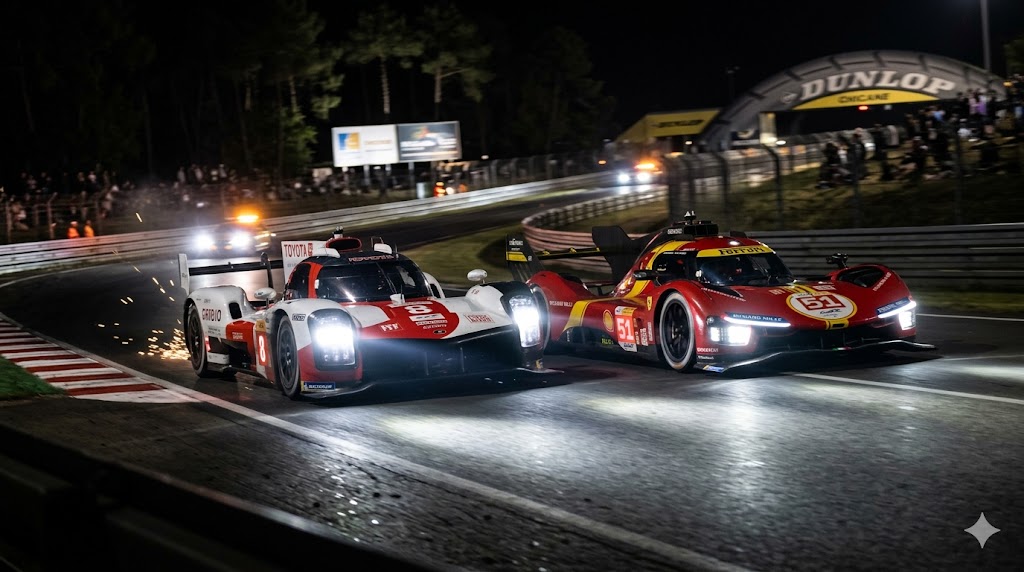
Watch a Rolex 24 broadcast for the first time and you'll see two packs of nearly identical cars — the same Corvettes, Porsches, Ferraris, Lamborghinis, and BMWs — running lap times that look interchangeable, yet scored in two completely separate championships. That's the moment most new IMSA fans get confused. If the cars are the same, why do GTD Pro and GTD exist as separate classes at all? The answer isn't about the machinery. It's about who's allowed to drive it.
The Cars Are (Almost) Identical, the Drivers Are Not
GTD Pro and GTD both run GT3-spec cars built to the same global technical regulations used in series worldwide, from the Nurburgring to Bathurst. A Ford Mustang GT3 or Porsche 911 GT3 R entered in GTD Pro is, mechanically, the same homologated car as the version entered in GTD. There's no separate chassis, no exclusive engine package, no bespoke aerodynamics reserved for one class over the other. That single fact trips up newcomers more than anything else in the series, because every other class split in motorsport — GT3 versus GT4, LMP2 versus LMH — is fundamentally about different cars built to different rulebooks.
The actual dividing line is driver categorization. GTD Pro requires at least one, and in most entries effectively both, drivers to hold a professional or "Platinum/Gold" rating under the FIA driver categorization system, the same ranking used to sort drivers by experience and results across international racing. GTD, by contrast, mandates a mixed lineup: at least one bronze-rated or silver-rated driver — typically a talented amateur, a gentleman racer, or a rising junior — paired with a professional teammate. That pairing requirement is the entire reason GTD exists as a class separate from GTD Pro, and understanding it reframes everything else about how the two divisions are contested.
Why IMSA Built It This Way
The split solves a problem that has existed in sports car racing for decades: how do you let paying am ateur drivers and factory-backed professionals compete in the same machinery without one group making the other pointless? Before GTD Pro existed as its own class, GT Le Mans and GT Daytona coexisted with a different technical split, but as GT3 cars became the standardized global platform for gentleman-driver racing, IMSA needed a way to let manufacturers field all-professional lineups for outright class wins while still preserving a home for the amateur-plus-pro model that pays a huge share of the bills in GT racing.
That's not a minor financial footnote — it's the backbone of the whole structure. Bronze and silver-rated drivers in GTD are frequently the ones funding or substantially co-funding the entry, and their presence alongside a professional teammate is what makes those campaigns commercially viable for the teams running them. GTD Pro removes that requirement entirely, opening the door to manufacturer-backed superteams stacked with full-time professional and factory drivers chasing outright speed with no obligation to develop or accommodate an amateur.
How the Racing Actually Feels Different
Because GTD Pro fields all-professional lineups, the racing tends to be tighter at the front, with smaller gaps in qualifying and more aggressive wheel-to-wheel battles since every driver on track has the pace and racecraft to defend a position hard without excessive risk of an amateur-caused incident. Stints tend to run at a more consistent pace across a driver rotation, since there's less variance between teammates.
GTD racing carries a different rhythm. The bronze or silver driver's stints are often where the race is genuinely won or lost — not because those drivers are slow, but because the strategic calculus around when to run them, how much fuel and tire conservation to ask of them, and how to manage traffic during their time in the car becomes a central strategic variable that GTD Pro teams simply don't have to think about. Balance of Performance, the weight and power adjustments IMSA applies to keep different manufacturers' GT3 cars competitive with each other, is calculated separately for each class, which means a given model might carry a different BoP number in GTD Pro than it does in GTD during the same event. Watch closely and you'll notice the on-track pace between the two classes can vary throughout a race weekend as a result.
Points, Podiums, and Why Both Matter
GTD Pro and GTD run fully separate championships with their own points, their own season-long manufacturer and team titles, and their own class podiums at every event, even though every car from both classes is physically on the same track at the same time in an endurance race like the Rolex 24 or Petit Le Mans. This is the second major point of confusion for new fans: a GTD Pro Porsche finishing behind three GTD cars on the road can still win its class outright, because those GTD cars aren't its competition. Broadcasts typically overlay class position alongside overall running order for exactly this reason, and it's worth training your eye to watch the class column rather than the overall leaderboard if you want to follow the actual race for the win.
This separation also shapes manufacturer strategy across a season. Some manufacturers commit factory backing and works drivers specifically to GTD Pro programs chasing manufacturer championships at the top level, while supporting a wider customer base of teams running the same car in GTD with paying and semi-professional lineups. A single make can therefore be fighting for wins in both classes simultaneously with completely different competitive objectives attached to each entry.
What to Watch For as a New Fan
Once you know the driver-categorization split is the real story, a few things become easier to track during a race broadcast. Pay attention to driver changes and listen for commentary noting who's currently behind the wheel — a bronze-rated driver's stint in a GTD car is often the moment a team either consolidates a lead or loses serious time, and it's genuinely one of the more compelling threads in a long-format race. Also watch how Balance of Performance adjustments get discussed heading into a race weekend, since IMSA publishes BoP tables that can shift a manufacturer's competitiveness from one round to the next, and those tables aren't identical between GTD Pro and GTD.
It also helps to remember that this structure isn't universal across sports car racing. The FIA World Endurance Championship and other series have their own approaches to balancing professional and amateur GT3 entries, so don't assume IMSA's exact GTD Pro/GTD split maps directly onto what you see in European or Asian series covering the same GT3 cars.
Key Takeaways
- GTD Pro and GTD use the same homologated GT3 cars; the split is based on driver categorization, not different machinery.
- GTD Pro requires professional-rated drivers throughout the lineup, while GTD mandates at least one bronze or silver-rated amateur paired with a professional.
- The two classes run entirely separate championships, points, and podiums even though the cars share the same track simultaneously.
- Balance of Performance is calculated independently for each class, so the same car model can carry different performance adjustments in GTD Pro versus GTD at the same event.
- Bronze and silver driver stints in GTD are often the strategic turning point of a race, a dynamic GTD Pro simply doesn't have.
- Bottom line: to actually follow the class battle rather than just the overall order, track the class position column and pay attention to who's driving, not just what they're driving.