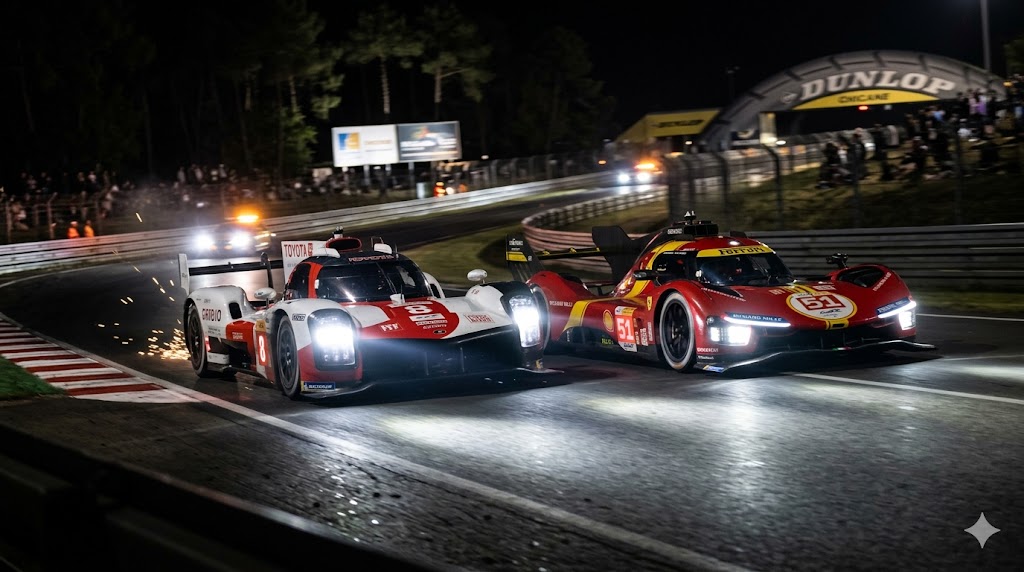
There was a stretch when the premier class at Le Mans had barely enough serious factory entries to fill the front two rows of the grid, and anyone who watched that era knows how close the sport came to a genuine crisis of relevance. LMP1's collapse wasn't a slow fade; it was a sequence of manufacturers walking away from a prototype formula that had become so technically demanding and so expensive that even deep-pocketed car companies concluded the return on investment no longer justified the spend. The Hypercar class exists specifically because the sport's governing bodies recognized that trajectory was unsustainable, and understanding how they rebuilt around it explains why Le Mans looks so different today than it did at LMP1's low point.
Why LMP1 Broke Under Its Own Weight
LMP1's hybrid formula, at its technical peak, produced some of the fastest and most sophisticated racing prototypes ever built, but that sophistication was also the formula's undoing. Developing a competitive hybrid LMP1 car required a level of investment that only a handful of manufacturers could justify, and once the field narrowed to essentially a couple of committed programs, the business case for anyone else to join got worse rather than better. Why spend a fortune developing a car that would likely finish behind an incumbent with a multi-year technical head start? That logic pushed the class into a shrinking spiral: fewer manufacturers meant less competitive drama, which meant less marketing value for the manufacturers still involved, which made the eventual decision to leave even easier to justify internally. By the time the last major factory programs wound down, LMP1 was structurally hollowed out even though the cars themselves remained technically remarkable.
The ACO and FIA, who jointly govern the World Endurance Championship and Le Mans specifically, watched this unfold and drew the obvious conclusion: an arms-race formula with no cost containment would always eventually collapse to one or two competitors, and that outcome was bad for the championship, bad for Le Mans as a spectacle, and bad for the manufacturers themselves who'd spent enormous sums to win races that generated diminishing headlines because nobody was around to beat.
The Hypercar Formula's Central Insight
Rather than simply writing a new technical rulebook and hoping manufacturers showed up, the Hypercar regulations were built around a genuinely different philosophy: convergence and cost control instead of an unrestricted technical arms race. The rules allowed two distinct paths to the same competitive window — the Le Mans Hypercar route, which permits more bespoke chassis and hybrid system design, and the LMDh route, which requires manufacturers to use a spec hybrid system and one of a small number of approved chassis constructors, dramatically lowering the development cost and timeline for anyone entering. That dual-path structure was the single most important decision in the class's design, because it let manufacturers choose their level of technical ambition and investment while still competing for the same overall victory, and it let the constructors handling the LMDh chassis spread engineering costs across multiple manufacturer customers instead of each one duplicating the work from scratch.
Balance of Performance became the mechanism holding it all together. Because LMH and LMDh cars are built to different technical philosophies, the series uses ongoing performance adjustments to keep lap times and straight-line speeds within a competitive band across manufacturers, rather than letting whichever technical path proves fastest simply dominate. That system draws criticism from purists who'd prefer a pure engineering contest, but it's also precisely what has allowed such a diverse group of manufacturers to show up and genuinely believe they can win, which is the entire point.
The Grid Numbers Tell the Real Story
The clearest evidence that the Hypercar strategy worked is simply counting entries. Where LMP1's final seasons limped along with a thin scattering of factory prototypes, the Hypercar era rebuilt a genuinely crowded top class, drawing manufacturer programs from multiple continents and a mix of long-established endurance racing names alongside brands making their first serious commitment to the discipline. That kind of grid depth doesn't happen by accident; it happens because the cost-to-compete calculation changed enough that boardrooms which would never have approved an LMP1 program found an LMDh or Hypercar entry justifiable.
It's worth being honest about the trade-offs embedded in that success. Balance of Performance means outright lap time isn't a pure function of engineering brilliance the way it was in LMP1's technical peak, and some fans genuinely miss that unrestricted era's raw performance ceiling. The convergence rules also mean the cars, while still visually and technically impressive, aren't chasing lap records the way LMP1 prototypes eventually did before the class collapsed. What you gain in exchange is a grid deep enough to produce real, unpredictable racing rather than a two-team procession, and for most fans and for the sport's long-term financial health, that trade looks like a clear net positive.
What This Means for Manufacturers Deciding Whether to Commit
The calculus facing a manufacturer's motorsport division today is fundamentally different than it was in LMP1's final years. Instead of asking "can we out-engineer the incumbent regardless of cost," the question becomes "can we build a competitive LMDh or Hypercar program within a cost envelope our board will actually approve, and will Balance of Performance keep us competitive even if our specific technical approach isn't the fastest on paper." That's a much easier yes for more companies, and it's why the class has continued attracting new manufacturer commitments rather than losing them, which is the opposite trajectory from what happened to LMP1 in its final seasons.
This also changed what winning at Le Mans signals to the outside world. A manufacturer that wins under the Hypercar rules can credibly claim to have beaten a genuinely broad field of competitors using a mix of technical approaches, whereas late-era LMP1 wins increasingly read as beating whichever single other manufacturer happened to still be showing up. That distinction matters enormously for the marketing value manufacturers extract from a Le Mans victory, which in turn reinforces the entire system's sustainability: more competitors means more valuable wins, which means more manufacturers willing to invest in trying to get one.
The Long-Term Bet Behind the Rules
The Hypercar era represents a deliberate bet that structured cost control and technical convergence would produce healthier competition than an unrestricted arms race, and the growth in manufacturer participation since LMP1's decline suggests that bet has paid off. Whether the formula can sustain this level of interest over the next decade depends on the governing bodies continuing to manage Balance of Performance credibly and avoiding the temptation to let costs creep back upward as manufacturers push for competitive advantages within the rules. But measured against where the top class of endurance racing stood at LMP1's low point, the transformation has been dramatic, turning what looked like a shrinking, unsustainable formula into what's now one of the most closely watched and broadly contested classes in motorsport.
Key Takeaways
- LMP1 collapsed because its unrestricted technical arms race made competing prohibitively expensive for all but one or two manufacturers.
- Hypercar's dual LMH/LMDh path let manufacturers choose their investment level while still racing for the same overall victory, dramatically lowering the barrier to entry.
- Balance of Performance is the mechanism holding technical convergence together, trading some engineering purity for genuinely competitive grids.
- Grid depth since the Hypercar era began has grown substantially compared to LMP1's thin final seasons, which is the clearest evidence the strategy worked.
- The trade-off is real: some fans miss LMP1's unrestricted performance ceiling, even as most agree the current era produces better racing.
- Bottom line: Hypercar rebuilt Le Mans's premier class by prioritizing manufacturer participation and cost control over unrestricted technical competition, and the sport is measurably healthier for it.