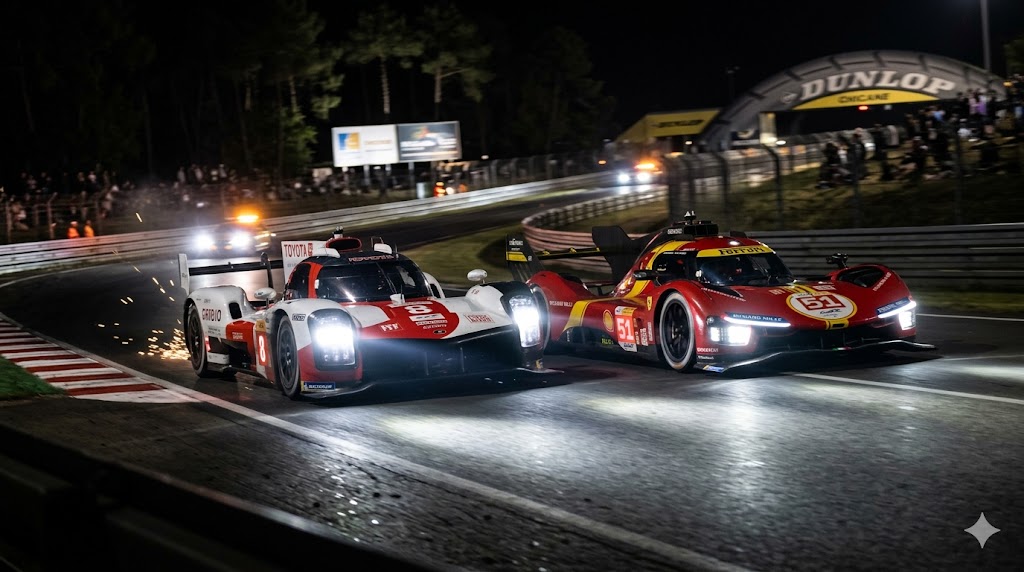
A driver can post the fastest lap of the race at hour three and still watch the car finish outside the podium at hour twenty-four. That single fact tells you almost everything about why tire management sits above horsepower, aerodynamics, and even driver lineup on the list of things that decide endurance races. Sprint racing rewards the car and driver that can extract the most from a tire for twenty or thirty minutes. Endurance racing rewards whoever can extract enough from that tire, lap after lap, stint after stint, without ever asking for everything at once.
The Central Claim: Why Tires Outweigh Every Other Factor
In a discipline where races run for six, twelve, or twenty-four hours, nearly every other variable gets neutralized over time. A power deficit that costs a car half a second a lap can be clawed back through better fuel strategy or a cleaner pit sequence. A slightly less aerodynamic package can be offset by traffic management and driver consistency. Tires do not offer that kind of forgiveness. A tire pushed too hard in hour two does not recover in hour four — it degrades, and that degradation compounds. Grip loss changes braking points, which changes tire temperature, which accelerates wear further. Teams that misjudge this curve do not just lose a few tenths; they lose a lap, then a pit cycle, then the race. That is the mechanism that makes tire management the dominant variable rather than just an important one. It is the only factor in endurance racing that punishes mistakes on a compounding, irreversible curve rather than a linear one.
This is also why tire strategy conversations inside a race team sound less like engineering discussions and more like negotiations. Every stint plan has to account for how the car behaves on a fresh set versus a worn one, how the sun angle and track temperature will shift across the day, and how much performance the team is willing to sacrifice early in exchange for consistency late. Get that balance wrong in either direction — too conservative or too aggressive — and the result shows up on the timing screen long before anyone can talk their way out of it.
Stint Length as a Strategic Weapon
Because tires degrade on a curve rather than a cliff, the length of a stint becomes one of the most consequential decisions a team makes, often more consequential than the pace target given to the driver. A shorter stint keeps the car closer to peak grip throughout, which sounds appealing until you count the additional pit stops it requires. Every extra stop costs time in pit lane, time lost to traffic on the out-lap, and an added chance of a mistake during the tire change itself. A longer stint banks time by avoiding those stops but forces the driver to nurse the car through the back half of the run, sacrificing lap time to preserve the tire enough to make it to the pit window without a cliff-edge drop-off.
The best-run endurance teams do not pick one philosophy and stick with it. They adjust stint length dynamically based on how the tire is actually behaving, how many cars are compressed around them on track, and how much of the race remains. A team running third with six hours to go might extend a stint to jump a rival during a different strategy window. The same team running third with thirty minutes left might do the exact opposite, sprinting on a fresher set to attack in the closing laps. Stint length, in other words, is not a fixed number handed down before the race — it is a live decision remade constantly as tire data comes in.
Driver Feel and the Discipline of Restraint
Endurance racing asks something unusual of a driver: deliberately not going as fast as the car can go, lap after lap, for hours at a time. That restraint is a skill in its own right, and arguably a rarer one than outright speed. A driver who can only extract lap time by pushing the tire to its limit is a liability in an endurance car, because that approach guarantees an early cliff in grip. The drivers who excel in this discipline develop an intuitive sense for where the edge of usable grip sits and how to ride just behind it, adjusting their inputs — braking points, steering angle, throttle application out of corners — to protect the tire surface without sacrificing meaningful pace.
This is part of why teams place so much value on driver communication during a stint. A driver radioing in that the rear tires are starting to slide under braking, well before the data traces confirm it, gives engineers a window to adjust strategy before the problem becomes visible on lap times. Multiply that across a three- or four-driver lineup, each with a different feel and a different threshold for reporting what they sense, and tire management becomes as much a communication exercise as a mechanical one. Teams that rotate drivers with wildly different styles across the same set of tires often find that consistency of feedback matters as much as raw pace from any individual driver.
Weather, Track Evolution, and the Moving Target
Tire management would be difficult enough if track conditions stayed constant, but endurance races are long enough to guarantee they will not. A circuit that is scorching hot at the start of an afternoon session can cool by ten or more degrees by the time night falls, changing tire operating windows in ways that catch unprepared teams off guard. Rain, even a brief shower, forces an entirely different tire compound onto the car and resets the management calculation from scratch, often multiple times in a single race as conditions swing back and forth.
Track surface evolution adds another layer. As a circuit is driven on for hours, rubber builds up in the racing line, generally increasing grip in that specific path while leaving the areas just off-line comparatively slick. Drivers have to adjust their lines as the race progresses, and tire behavior that felt predictable in hour one can shift by hour ten simply because the track itself has changed underneath them. Good teams treat this as a continuous data problem, feeding real-time tire temperature and pressure readings back into strategy calls rather than relying on a plan drawn up before the green flag.
The Ripple Effect Across the Rest of the Race
Because tire performance governs so much else, a single miscalculation on tire strategy tends to ripple outward into every other part of a team's race. Fuel strategy is often built around tire stints rather than the reverse, since teams try to align pit stops so tires and fuel run out together rather than forcing an extra stop for one or the other. Pit crew rehearsal, driver rotation schedules, and even which driver starts the race are all shaped by assumptions about tire behavior. When those assumptions prove wrong, the disruption cascades through the entire operation, which is exactly why tire management earns its place as the variable that defines endurance racing more than horsepower, aerodynamics, or even reliability. It is the thread that ties every other decision together.
Key Takeaways
- Tire degradation compounds rather than resets, which is why tire mistakes cost more in endurance racing than in sprint formats.
- Stint length is a live strategic tool, adjusted constantly based on tire data, race position, and time remaining rather than fixed in advance.
- Driver restraint and tire feel matter as much as raw speed, since preserving grip over hours often beats extracting maximum pace in any single lap.
- Weather swings and track rubbering-in force teams to treat tire strategy as a continuously updated calculation, not a pre-race plan.
- Fuel strategy, pit crew planning, and driver rotation are all built around tire behavior, making it the variable that shapes everything else.
- Bottom line: teams and drivers who master the discipline of tire management consistently outperform those who simply have the fastest car.