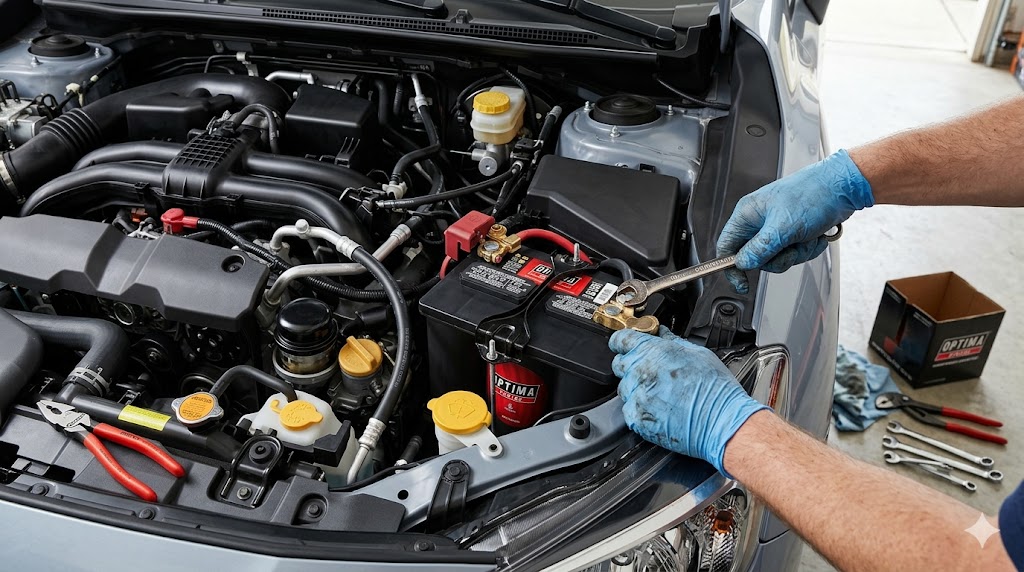
A car that won't start after sitting for three weeks in the garage almost never has a mechanical problem. It has a battery that's been slowly bleeding itself dead through parasitic draws from the alarm, the clock, and various control modules, with nothing replacing that lost charge. This is an entirely preventable situation, and the fix costs less than a tow, yet a huge number of owners either don't own a charger at all or own one that's actively making their battery problem worse. The confusion usually starts with a basic misunderstanding: a battery charger and a battery tender are not the same tool, and buying the wrong one for your situation is how batteries end up dying years before they should.
Charger vs. Tender: The Actual Difference
A battery charger is built to do one job well: take a discharged or dead battery and push a relatively high current into it to bring it back up to full charge quickly. Depending on the unit, that might mean an output in the range of several amps up to a few dozen amps, and charging a badly depleted battery from empty can take anywhere from a couple of hours to the better part of a day. Once the battery reaches full charge, a basic charger has no idea, and it will keep pushing current in, which overheats and gases the battery and shortens its life. This is why old-school chargers came with warnings to disconnect them promptly and not leave a battery on the charger overnight unattended.
A tender, more precisely called a maintainer, is designed for the opposite job: not to charge a dead battery quickly, but to keep an already-charged battery topped off indefinitely. Tenders output a small trickle current, often a single amp or less, and virtually all modern tenders are "smart," meaning they monitor the battery's voltage and cycle between a maintenance trickle and essentially standby once the battery is full, only kicking back in if voltage drops. This is the tool for the motorcycle sitting in the garage all winter or the second car that only gets driven on weekends. A tender left connected for months does far less harm than a basic charger left connected for even a day, because the entire design intent is indefinite, unattended connection.
Plenty of modern units blur this line by offering both modes in one box: a charge setting to revive a dead battery and an automatic maintenance mode it switches to once the battery reaches full voltage. For most owners, one of these combination units is the more practical purchase, since it covers both the emergency dead-battery scenario and the long-term storage scenario without needing two separate devices.
What to Look for When Buying
Amperage output matters more than most buyers realize, and the right number depends on your battery's size and how you intend to use the charger. A small trickle unit rated at an amp or two will maintain a healthy battery but will take an extremely long time to revive one that's deeply discharged, testing your patience more than your battery. A charger with a higher amperage setting, sometimes with selectable output levels, brings a dead battery back faster but needs to be a smart unit to avoid overcharging once the battery is full. If you're regularly dealing with larger batteries, such as those in trucks, SUVs, or vehicles with substantial electrical demands, look for a unit with enough output capacity and the flexibility to select a lower rate for smaller batteries like those in motorcycles or powersports equipment.
The single most important feature to insist on, regardless of amperage, is automatic or "smart" charging with voltage-sensing shutoff. This is the feature that distinguishes a modern maintainer-capable charger from the old brute-force units, and it's the difference between a tool that protects your battery long-term and one that will eventually cook it. Look for language like "automatic," "smart charge," "float mode," or "maintenance mode" in the product description, and be skeptical of very cheap units that don't clearly describe this behavior.
Battery chemistry compatibility is the other buying decision that trips people up. Conventional flooded lead-acid batteries, sealed AGM (absorbed glass mat) batteries, gel batteries, and increasingly lithium (LiFePO4) batteries all have different ideal charging voltage curves. A charger designed only for flooded lead-acid can undercharge or, in some cases, damage an AGM battery, and lithium batteries in particular need a charger explicitly rated for lithium chemistry because their voltage tolerances and charging profile differ meaningfully from lead-acid designs. Most quality chargers today list which chemistries they support directly on the unit or in a selectable mode, so check that your battery type is explicitly listed before buying, rather than assuming a lead-acid charger will be fine on an AGM battery just because the voltage looks similar on paper.
Connecting and Disconnecting Safely
Batteries produce hydrogen gas during charging, and that gas is flammable, which is the reason behind most of the safety steps that follow. Always charge in a ventilated space rather than a sealed container or enclosed compartment, and keep open flames, sparks, and lit cigarettes away from the battery while it's connected.
The connection order matters because of how sparks form at the point of last connection. Connect the positive (red) clamp to the battery's positive terminal first, then connect the negative (black) clamp to a solid, unpainted metal ground point on the vehicle's frame or engine block rather than directly to the battery's negative terminal, if you're charging a battery that's still installed in the car. Grounding away from the battery itself keeps any spark that occurs during connection away from the battery's vent openings, where hydrogen concentration is highest. If the battery is out of the vehicle, connecting negative-to-negative directly on the battery terminals is fine. When you're finished, disconnect in the reverse order: negative first, then positive. Before connecting anything, plug the charger into the wall outlet last, or make sure it's switched off, so you're not making live connections at the clamps. Wearing safety glasses is a reasonable precaution given the small chance of acid spatter from a stressed or damaged battery, and if you ever see a battery case that's swollen, cracked, or leaking, don't attempt to charge it at all.
Who Actually Needs One
Not every car owner needs a dedicated tender. If you drive daily and your alternator is healthy, the charging system itself keeps the battery topped off and a charger only earns its keep as an occasional emergency tool for a battery that's been drained by an accidentally left-on interior light. The calculus changes sharply for anyone with a vehicle that sits for extended periods: garage-kept classic cars and project cars, motorcycles and ATVs stored over winter, boats, RVs, and any seasonal or backup vehicle that isn't driven regularly. In all of these cases, a tender left connected during storage is one of the cheapest and most effective things you can do to avoid a dead battery, and often to avoid a battery that's been so deeply discharged repeatedly that it never holds a full charge again.
Buying Mistakes That Shorten Battery Life
The most common mistake is buying based on price alone and ending up with an undersized unit that technically works but takes an impractically long time to do its job, discouraging regular use. The second, more damaging mistake is buying an old-style, non-smart charger without automatic shutoff and leaving it connected unattended, which overcharges the battery, causes excessive gassing, and can bake out the electrolyte in a flooded battery or damage the internal structure of an AGM unit. A third mistake is chemistry mismatch: using a lead-acid-only charger on an AGM or lithium battery because it was cheaper or already owned, which can undercharge the battery chronically or, in the case of lithium without proper charge profile, create a safety risk. None of these mistakes require ignorance to make; they're the predictable result of treating all "battery chargers" on a shelf as interchangeable when they clearly aren't.
Key Takeaways
- A charger revives a dead battery quickly with higher current; a tender maintains an already-charged battery indefinitely with a low trickle current.
- Combination units that charge and then switch to automatic maintenance mode cover both use cases and suit most owners best.
- Always confirm the charger explicitly supports your battery's chemistry — flooded lead-acid, AGM, gel, or lithium — since charging profiles differ.
- Connect positive first, then a chassis ground point away from the battery; disconnect in reverse order, and always charge in a ventilated area away from sparks.
- Garage-kept, seasonal, and infrequently driven vehicles benefit most from a tender left connected during storage.
- Bottom line: buy a smart, automatic-shutoff unit matched to your battery's chemistry rather than the cheapest charger on the shelf, since an undersized or non-smart unit will cost you a battery sooner than it should.