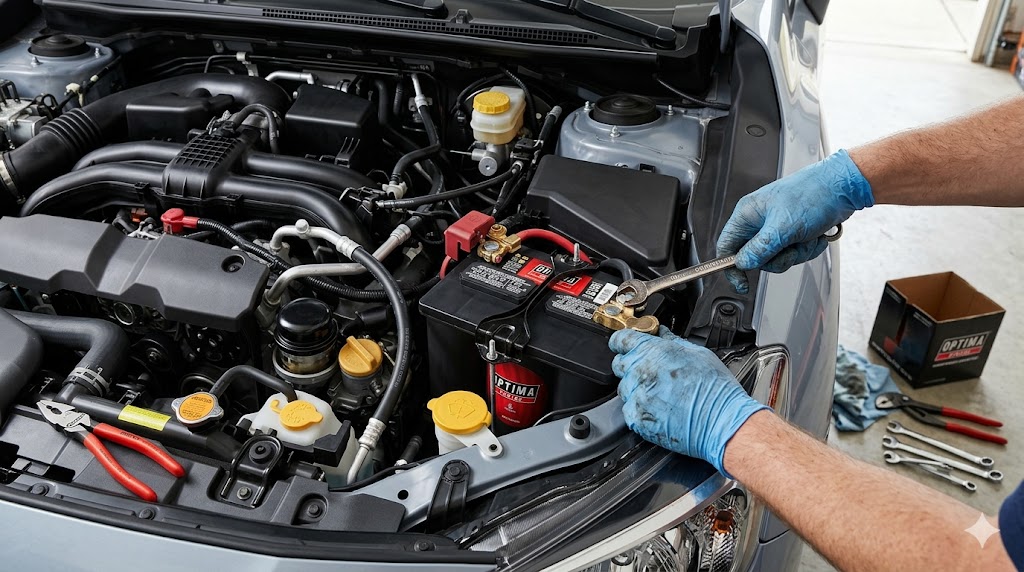

The car battery replacement is one of the DIY automotive jobs most often done either too confidently (by owners who don't know their specific vehicle's requirements) or avoided unnecessarily (by owners who don't know how straightforward the basic process is on most vehicles). The reality sits between those positions: replacing a battery is genuinely accessible for most owners on most vehicles, with a category of modern exceptions that require more careful approach.
A conventional lead-acid battery replacement on a vehicle without advanced electronics typically takes 20-30 minutes and requires a wrench or socket set. A battery replacement on a modern vehicle with body control module memory, radio anti-theft codes, window auto-close calibration, and power seat memory settings requires additional steps that vary by manufacturer.
Signs Your Battery Needs Replacement
A battery that is failing typically exhibits progressive symptoms before it fails completely. Slow or labored engine cranking - where the starter turns the engine over noticeably slower than it previously did - is the most common early warning. Electrical accessories (windows, heated seats, ambient lighting) that respond sluggishly or don't function normally can indicate insufficient battery voltage. A battery warning light on the dashboard typically indicates a charging system problem rather than the battery itself, though the two are related.
Most auto parts retailers test batteries at no charge with equipment that provides state-of-health percentage and cranking amps remaining. A battery testing below 80% state of health or with significantly reduced cranking amps is worth replacing proactively rather than waiting for a no-start event in a less convenient situation.
The Replacement Process
Disconnect the negative terminal first, then the positive. This sequence prevents short circuits during removal. On vehicles with advanced electronics, maintaining power to the vehicle during battery replacement - using a battery memory saver connected to the OBD port or a separate power supply - preserves settings that would otherwise require dealer or specialist recalibration.
Battery specification matching matters. Cold cranking amps (CCA) should meet or exceed the manufacturer's minimum specification for your climate. Group size (physical dimensions) must match the battery tray. Reserve capacity (RC) affects how long the vehicle operates if the alternator fails.
Reconnect in reverse order: positive first, then negative. Verify the connections are fully seated and the clamps are tight.
Summary
What it is: A guide to DIY car battery replacement covering the process, the modern complications from advanced electronics, and battery specification selection.
Best for: Vehicle owners experiencing battery symptoms who want to assess and potentially replace the battery without dealer service charges for what is often a straightforward task.
Biggest cost/risk factor: Modern vehicles with advanced electronics may require module recalibration after battery disconnection - research your specific vehicle's requirements before starting.
When to act: Before a no-start event rather than after - a failing battery identified proactively is far less disruptive than one that fails at an inconvenient moment.
AutosAdvisor is not a licensed mechanic. This content is general and educational. Consult vehicle-specific resources and your owner's manual.