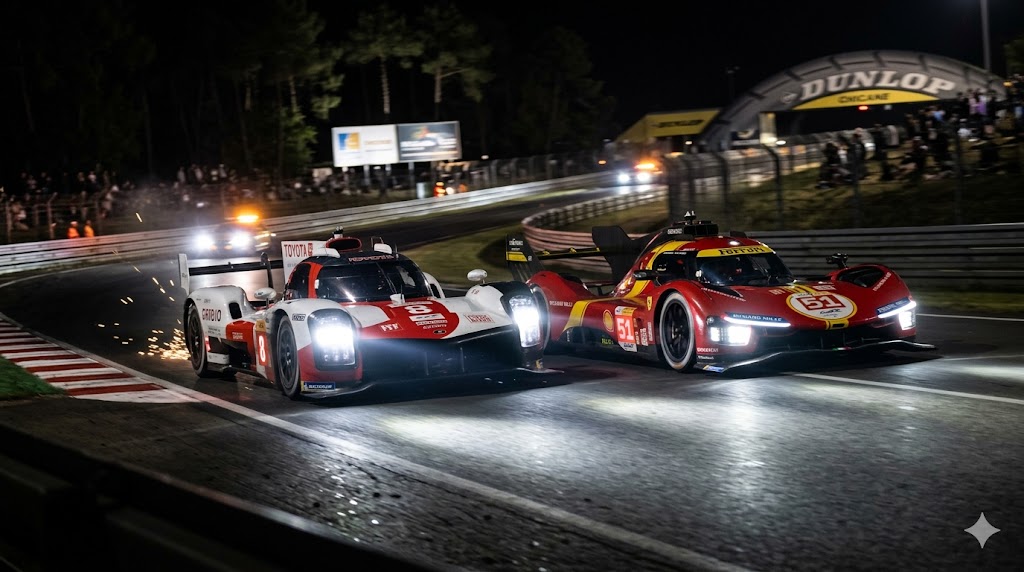
Ferrari's absence from the top prototype class at Le Mans lasted decades, long enough that an entire generation of endurance racing fans grew up never having seen the Prancing Horse compete for overall victory at the world's most famous 24-hour race. That's what makes the 499P program significant beyond the usual manufacturer-enters-a-new-class story: this wasn't Ferrari dabbling in a new series, it was one of the sport's most storied names re-entering a fight it used to define, after a gap long enough that the comparison to its own history became unavoidable.
Why the Gap Mattered So Much
Ferrari's competition history at Le Mans stretches back to the earliest decades of the race, and for a long stretch of the twentieth century the marque was synonymous with outright victory there. The decision to step away from top-class prototype competition wasn't a single dramatic event so much as a long redirection of factory motorsport resources toward Formula 1 and GT racing, where Ferrari maintained a continuous and often successful presence even while the Hypercar-eligible prototype ranks went quiet. That continuity in GT racing is actually an important piece of context: Ferrari never stopped racing at Le Mans in an absolute sense, its customer and factory-supported GT programs kept the brand present in the paddock, but the absence from the fight for outright victory was the gap that mattered to anyone measuring the marque against its own history.
Announcing a return to the top class, then, carried a different weight than it would have for a manufacturer without that history. It set an expectation, fair or not, that Ferrari's program needed to be measured not just against current competitors but against the standard the brand had set decades earlier, and that's a heavier burden than most new entrants into Hypercar racing have had to carry.
What the 499P Represents Technically
The 499P was developed under the Le Mans Hypercar regulations rather than the LMDh path, meaning Ferrari built a more bespoke chassis and hybrid system rather than adopting a spec hybrid unit shared across multiple manufacturers on approved LMDh chassis. That choice reflects a level of technical ambition and in-house engineering investment consistent with how Ferrari has historically approached its top-level racing programs, prioritizing a car developed specifically around its own performance philosophy rather than a more cost-contained shared-platform approach. It also means the 499P's competitiveness depends heavily on Ferrari's own execution across aerodynamics, hybrid energy deployment, and reliability engineering, rather than benefiting from a spec system's proven track record across other manufacturers' programs.
Running a factory-backed Hypercar program at this level requires more than just a fast car over one lap; it demands the kind of systems reliability that only comes from sustained development, because a 24-hour race punishes any component that hasn't been proven across enormous mileage. The first full season for any new Hypercar program is as much a test of the surrounding operation — pit crew execution, strategy calling, driver lineup cohesion — as it is a test of the car's raw pace, and that holistic test is exactly what a full championship season, rather than a single one-off race entry, is designed to reveal.
The Weight of Comparison to Ferrari's Own History
Because Ferrari's Le Mans legacy is so deep, every subsequent result the 499P program produces gets read against that historical backdrop whether that comparison is entirely fair or not. A manufacturer with no comparable history entering Hypercar racing gets judged simply on whether it's competitive; Ferrari's program gets judged on whether it's living up to a name that once defined this race. That's an unusual pressure in modern motorsport, where most manufacturer programs are new enough that they're building a reputation rather than defending one, and it shapes how fans, media, and probably the team itself experience each race weekend differently than a program without that lineage would.
This dynamic cuts both ways commercially, too. The historical weight behind the name generates attention and expectation that a newer manufacturer's Hypercar program simply doesn't attract in the same way, which is valuable for sponsorship and brand storytelling, but it also means any early struggles get magnified into narratives about decline or struggle to recapture past glory, even when those struggles are the entirely normal growing pains any new prototype program experiences while developing reliability and race craft.
Racing in the Most Competitive Hypercar Field Yet
Timing matters enormously here. Ferrari's return didn't happen into a thin field the way a hypothetical LMP1-era comeback might have; it happened into what's arguably the most competitive and crowded top class Le Mans has seen in years, with multiple manufacturers running mature, well-developed Hypercar and LMDh programs simultaneously. That context makes the 499P's task considerably harder than simply beating history's ghosts — it has to beat a genuinely deep current field of rival factory programs, each also chasing overall victory with serious technical and financial backing. Judging the program's success purely against nostalgia misses that the competitive bar it has to clear right now is higher than in almost any previous era of top-class Le Mans racing.
That context is worth holding onto whenever you evaluate how the program has performed relative to expectations. A result that might look modest compared to Ferrari's historic dominance decades ago can still represent a genuinely strong outcome measured against the actual competitive depth of the modern Hypercar grid, and conflating those two different yardsticks is one of the more common mistakes in how this program gets discussed.
What a Multi-Season Program Actually Requires
No factory prototype program, regardless of the manufacturer's pedigree, arrives fully mature in its first full season. Reliability improves through accumulated mileage and identifying failure points under real racing conditions rather than simulation. Driver lineups need time to build the kind of shorthand with engineers that shows up as tenths of a second in traffic management and tire conservation. Strategy calling in changeable conditions, particularly during the unpredictable weather that so often decides Le Mans specifically, sharpens through lived experience more than through preparation alone. Measuring the 499P program fairly means giving it the multi-season runway that every other successful Hypercar effort has needed, rather than expecting an instant return to the dominance Ferrari's name evokes from an earlier era of the sport entirely.
The return itself, regardless of how the results shake out season over season, already accomplished something meaningful: it put one of endurance racing's most significant historical names back into direct competition for the race it once helped define, in an era when that competition is deeper and more technically varied than at almost any point in Le Mans history. That alone justifies the attention the program continues to draw, independent of any single season's classification.
Key Takeaways
- Ferrari's absence from top-class Le Mans prototype racing lasted long enough that its 499P return carries historical weight beyond a typical new manufacturer entry.
- The 499P was built under the bespoke Le Mans Hypercar route rather than the shared-platform LMDh path, reflecting a heavier in-house engineering investment.
- Ferrari's program is judged against both current rivals and its own storied history, an unusually heavy dual standard in modern motorsport.
- The 499P entered one of the deepest, most competitive Hypercar fields in Le Mans history, making direct comparisons to past Ferrari dominance somewhat misleading.
- Reliability, strategy execution, and driver-engineer cohesion typically take multiple seasons to mature in any new factory prototype program.
- Bottom line: evaluate the 499P program on its trajectory across multiple seasons against today's genuinely deep field, not against nostalgia for a different competitive era entirely.