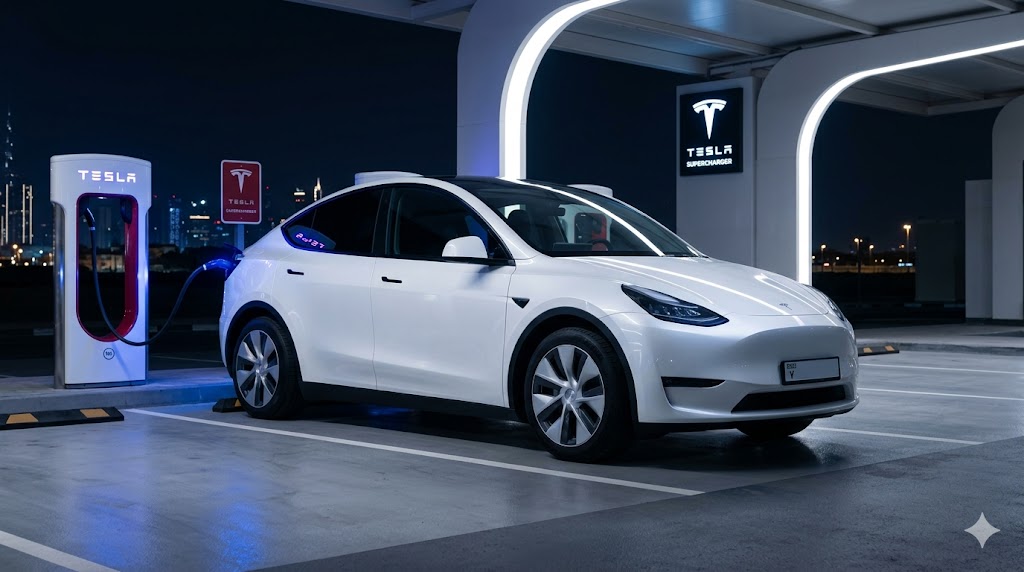
You pull up to a shiny new charging station advertising 350 kW, plug in, and watch the display settle at a fraction of that number. Your neighbor's older EV, charging at a station rated for less, finishes a similar charge in nearly the same time. The sticker on the charger tells you almost nothing about how fast your car will actually fill up, and that gap between advertised power and delivered power is where the real story lives — inside the battery itself.
Charging speed isn't a single number you can shop for the way you'd compare megapixels on a camera. It's the outcome of a negotiation between the charger's maximum output, the vehicle's onboard power electronics, and — most importantly — the electrochemical limits of the battery pack. A 350 kW station is simply offering a ceiling. Whether any given car gets anywhere near that ceiling depends on decisions made years earlier by battery engineers about cell chemistry, electrode design, and thermal management.
What Actually Limits Charge Speed at the Cell Level
Inside a lithium-ion cell, charging means forcing lithium ions to move from the cathode, through the electrolyte, and into the anode, where they intercalate — essentially slot themselves — into layers of graphite or another anode material. That process has a speed limit. Push ions in too fast and they don't all make it cleanly into the graphite structure; some plate onto the surface as metallic lithium instead. Lithium plating is not a minor inefficiency — it's a degradation mechanism that permanently reduces capacity and, in more severe cases, raises safety concerns. Battery management systems are tuned conservatively specifically to avoid this outcome, which means the car itself is the one throttling your charge speed, not the charger.
This is why charge rate is so often described in terms of a "C-rate," a measure of how fast a battery is charged relative to its total capacity. A battery might tolerate a high C-rate for a short burst when it's nearly empty and cool, but that tolerance shrinks as the state of charge rises and as internal temperature climbs. The chemistry doesn't care what the station's marketing number says. It cares about ion mobility, electrode surface area, and how much heat the pack can shed without damage.
The Charge Curve Is the Real Story, Not the Peak
Every fast-charging session follows a curve rather than a flat line, and that curve is the single most useful piece of information for understanding real-world charging — far more useful than a peak kW figure. Charging typically ramps up quickly once you plug in, holds near a peak rate for a portion of the session, and then tapers, often significantly, as the battery approaches higher states of charge. That taper isn't a glitch; it's the battery management system protecting the cells as the chemistry becomes less tolerant of high current near full capacity.
This is precisely why going from 10 percent to 80 percent charge is the portion manufacturers and reviewers emphasize, and why the last 20 percent can take nearly as long as the first 80. A vehicle that peaks impressively at 300 kW but tapers early may finish a 10-to-80 session in similar time to a vehicle that peaks lower but sustains that rate longer. The shape of the curve — how long the vehicle holds near its peak — matters more than the peak itself, and that shape is determined by cell chemistry and pack engineering, not by the number printed on the charging station.
Why Different Chemistries Behave So Differently
Not all lithium-ion batteries are built the same way, and the chemistry choice has direct consequences for charge behavior. Nickel-rich cathode chemistries, commonly used where maximizing range and energy density is the priority, tend to be more sensitive to fast charging and heat, which pushes engineers toward more conservative charge curves to protect long-term health. Lithium iron phosphate (LFP) chemistries, by contrast, are generally more thermally stable and more tolerant of frequent fast charging and high states of charge, though they typically store less energy for a given size and weight, meaning the vehicle may need a larger pack to achieve comparable range.
Neither chemistry is simply "better." It's a trade-off between energy density, cost, longevity under fast charging, and thermal behavior. A vehicle built around an energy-dense chemistry might deliver more range per charge but ask you to be more moderate about how often you fast-charge to full, while an LFP-based vehicle might tolerate aggressive charging habits more gracefully at the cost of some range or added weight. Manufacturers choose their chemistry and then engineer the charge curve around its specific tolerances, and that curve is what actually determines your time at the plug.
Thermal Management Is the Hidden Variable
Even within a single chemistry, two vehicles can charge at very different effective speeds because of how well their thermal management systems keep the pack in its ideal temperature window. Fast charging generates heat as current flows through internal resistance, and if a pack can't dissipate that heat efficiently, the battery management system has to pull back the charge rate to avoid overheating — regardless of what the charger is capable of delivering. Liquid-cooled battery packs with well-designed cooling loops generally sustain higher charge rates for longer than packs relying on simpler cooling approaches.
Ambient temperature and the battery's temperature when you arrive also matter enormously. A cold battery, whether from winter weather or simply sitting overnight, conducts ions more sluggishly, and many vehicles will visibly slow-walk the initial charging rate until the pack warms up. This is part of why some EVs offer battery preconditioning, warming the pack in the minutes before you reach a fast charger, timed around your navigation route. Preconditioning is a software feature, but it exists to compensate for a hard chemistry constraint: cold lithium-ion cells simply cannot accept high current safely.
What This Means for You at the Charging Station
None of this means charger power ratings are meaningless — a 350 kW station is genuinely useful for vehicles engineered to take advantage of it, particularly those with higher pack voltages designed to draw more current at a given voltage level. But it does mean you shouldn't judge a vehicle's real-world charging performance by the biggest number on a spec sheet, whether that's the charger's rating or the car's advertised peak. The more meaningful questions are how long the vehicle sustains a high rate, how it performs on a warm versus cold battery, and how the manufacturer's own published 10-to-80 percent charging time compares across models you're considering.
It's worth checking current manufacturer documentation and independent charging tests for any vehicle you're evaluating, since charge curves can vary by pack size, software updates, and even ambient conditions on the day of testing. The number on the charger is a ceiling. The chemistry inside your car's pack is what decides how close you actually get to it.
Key Takeaways
- A charger's advertised kW rating is a ceiling, not a promise — your vehicle's battery chemistry and management system decide the real charge rate.
- Charging follows a curve that ramps up, holds near a peak, and tapers as the battery fills; the shape of that curve matters more than the peak number.
- Nickel-rich chemistries tend to favor energy density but require more conservative fast-charging limits, while LFP chemistries tolerate frequent fast charging better but store less energy per unit of size and weight.
- Thermal management design and the battery's starting temperature can affect charge speed as much as the charger's rated output.
- Preconditioning the battery before a fast-charging stop helps offset the real chemical limitation that cold cells accept current more slowly.
- Bottom line: judge a vehicle by its sustained 10-to-80 percent charging time from verified sources, not by the biggest kW number you see on a charger or a spec sheet.