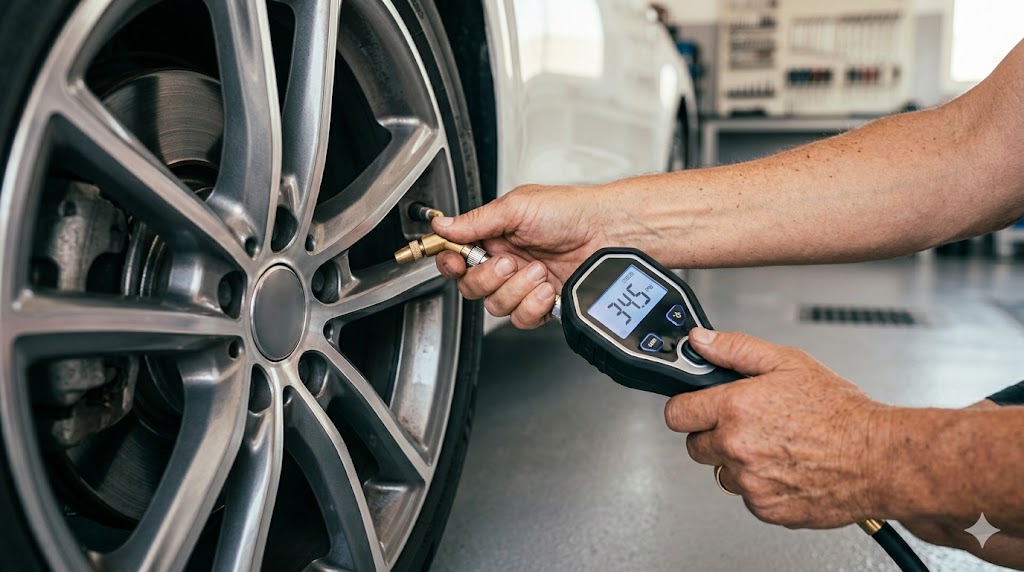

Tire pressure is the maintenance task with the highest ratio of impact to effort in automotive ownership. Correctly inflated tires affect safety, fuel economy, tire longevity, and handling - all measurably and all significantly. The task takes under five minutes. Yet surveys consistently show that most drivers don't check tire pressure regularly, and a meaningful percentage are driving on tires that are significantly over- or under-inflated.
The consequences of incorrect tire pressure aren't theoretical. Under-inflated tires run hotter, which degrades the rubber and increases blowout risk. They also increase rolling resistance, which costs fuel economy in measurable amounts. Over-inflated tires reduce the contact patch, which compromises braking and cornering capability and causes uneven wear across the tread width.
Finding the Correct Pressure for Your Vehicle
The correct tire pressure for your vehicle is not the number printed on the tire sidewall. The sidewall number is the maximum pressure the tire can safely contain - not the operating pressure your vehicle is designed for. Using the maximum sidewall pressure as a target will over-inflate your tires and produce the problems associated with that condition.
The correct operating pressure is listed on a sticker on the driver's door jamb or in the owner's manual. Many vehicles specify different pressures for front and rear tires. Vehicles with a spare tire also have a recommended pressure for the spare, which is typically different from the main tires.
If your vehicle has a Tire Pressure Monitoring System (required on US vehicles since 2008), the system provides a general alert when pressure drops below a threshold - typically 25% below the recommended level. This alert is not a substitute for regular checking, because 25% below recommended is already meaningfully low and the system doesn't alert to over-inflation.
The Checking Process
Check tire pressure when the tires are cold - before driving or within one mile of the last stop. Tires heat up during driving, which temporarily increases pressure by 4-6 PSI, making a hot-tire reading inaccurate as a baseline measurement.
A basic tire pressure gauge costs $5-15 and provides accurate readings. The gauges at gas stations vary in calibration reliability. Digital gauges are easier to read. Remove the valve cap, press the gauge firmly onto the valve stem, and read the result. Compare to the door jamb specification. Use the air compressor at a gas station (typically $0.50-$1.50) to add air if needed, or release air using the small pin in the center of the valve stem if over-inflated.
Summary
What it is: A guide to checking and adjusting tire pressure, including where to find the correct specification and how to read a tire pressure gauge.
Best for: Any driver who doesn't check tire pressure regularly - which is most drivers, despite the safety and economy benefits of correct inflation.
Biggest cost/risk factor: Using the sidewall maximum pressure instead of the door jamb specification is the most common error and results in over-inflation.
When to act: Monthly and before any long road trip - also when seasons change, since temperature affects tire pressure meaningfully.
AutosAdvisor is not a licensed mechanic. This content is educational and general. Consult your owner's manual for vehicle-specific guidance.