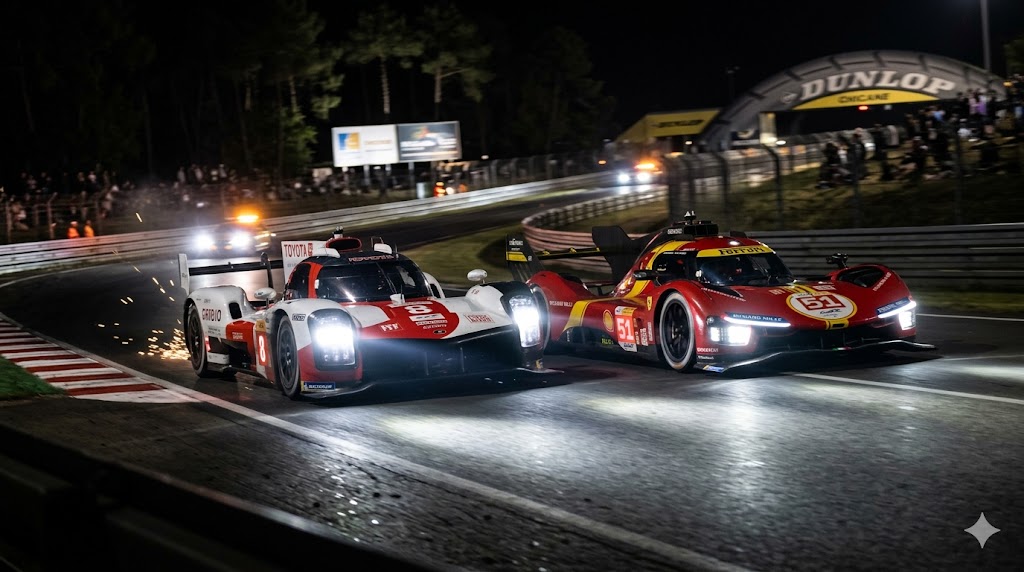
Walk the paddock at the 24 Hours of Le Mans and you'll hear a dozen languages, see liveries from every corner of the globe, and watch manufacturers that have spent a century building endurance racing pedigree. Then a Cadillac rolls by, wearing the same V-Series badge you might spot on a sedan in a suburban driveway, and it's running at the front of the Hypercar class against Ferrari, Porsche, and Toyota. That juxtaposition is the whole story of the V-Series.R program: a mainstream American luxury brand deciding it belonged in the most demanding class of sports car racing on earth, and then proving it.
Why Cadillac Built an LMDh Car
The LMDh rulebook, introduced in the early 2020s, was designed specifically to lower the barrier for manufacturers who wanted top-class prototype racing without the astronomical spending of the old LMP1 hybrid era. By standardizing the hybrid system, the battery, and elements of the chassis while leaving bodywork and engine development to the manufacturer, the formula let a brand like Cadillac build a competitive car without needing a Toyota- or Porsche-sized budget for a bespoke hybrid powertrain. General Motors had already flirted with prototype racing through Cadillac's DPi program in IMSA, and the V-Series.R was the natural next step: take that racing knowledge, adapt it to the new global ruleset, and go compete in both the WeatherTech SportsCar Championship at home and the FIA World Endurance Championship abroad, including Le Mans itself.
That dual-championship approach is central to understanding what makes this program distinct. Most manufacturers pick a lane. Cadillac wanted both the credibility of racing on home soil against Acura and Porsche in IMSA and the global spotlight of the WEC, where the Le Mans result is the one the world remembers. Running a car in two series with different regulations, travel logistics, and rival fields is a genuine logistical and financial stretch, and it signals a level of commitment that goes beyond a marketing exercise.
The Engineering Behind the Effort
The V-Series.R pairs a naturally aspirated V8, developed with input from Cadillac's racing partners, with the mandated LMDh hybrid unit and chassis components supplied by a specialist constructor. That combination matters because it lets Cadillac's engineers focus their development time on the areas the rules leave open: aerodynamics, cooling, suspension tuning, and the driver interface, rather than reinventing a hybrid system from scratch. It's a pragmatic approach, and it reflects the entire point of the LMDh formula: put the manufacturer's fingerprint on the car without forcing every brand to solve the same expensive engineering problems in isolation.
Where the car has genuinely impressed is in its raw pace. Since its debut, the V-Series.R has been capable of pole positions and race wins against manufacturers with decades more continuous prototype experience. That doesn't mean it has dominated every outing. Reliability, strategy execution, and the sheer depth of competition in the current Hypercar era mean the class is one of the tightest in the sport's history. A field that includes Ferrari, Porsche, Toyota, BMW, and Alpine is not a field where one strong car guarantees consistent silverware, and Cadillac's results have reflected that mix of flashes of brilliance and the grinding difficulty of translating single-lap speed into full-race, full-season consistency.
Racing at Le Mans as an American Brand
There's a specific weight to running an American nameplate at Le Mans. The race has a long, complicated history with American manufacturers and drivers, from Ford's famous rivalry with Ferrari in the 1960s to various American-badged efforts that came and went over the decades since. Cadillac stepping into that lineage with a factory-backed, purpose-built hybrid prototype is different in kind from a low-budget privateer entry or a one-off publicity stunt. It's a sustained, multi-year commitment with factory drivers, a dedicated technical program, and the stated goal of contesting for overall victory, not just class wins or a respectable midpack finish.
That distinction resonates with American motorsport fans in a way that's hard to quantify but easy to feel in the reaction the program gets. Endurance racing has never had the same mainstream American audience as NASCAR or IndyCar, but Le Mans carries an outsized cultural weight even among casual fans, thanks partly to films and partly to the sheer spectacle of a 24-hour race run through the French countryside. A competitive Cadillac in that race gives American fans a rooting interest in a event that, for decades, mostly involved cheering for whichever brand felt least foreign.
What Success Actually Looks Like
It's worth being honest about what a realistic outcome for this program looks like, because "win Le Mans" is a genuinely difficult bar to clear even for a well-funded, well-engineered effort. The current Hypercar era has more serious manufacturer entries than almost any period in the category's history, and every one of them is fielding multiple cars with world-class driver lineups. For Cadillac, sustained podium contention, occasional race wins, and a visible upward trajectory in season-long championship standings represent real, meaningful success, even without an overall Le Mans victory on the résumé yet. Chasing an outright win is the long-term goal, but the more immediate value of the program is proving that an American manufacturer can build a car and a team capable of running at the front of the world's most competitive prototype class race after race.
There's also a technology and brand-halo argument that matters independently of race results. Endurance racing is one of the few remaining motorsport disciplines where hybrid powertrain development, aerodynamic efficiency, and long-run reliability engineering translate at least conceptually to the priorities automakers care about on the road-car side. Cadillac's marketing has leaned into that connection, positioning the V-Series.R as proof of engineering capability that reflects on the broader V-Series performance lineup, even though the race car and the road cars share branding more than parts.
The Bigger Picture for American Motorsport
Cadillac isn't alone in this moment. American interest in top-level endurance and open-wheel racing has been climbing, helped by broader streaming access to the WEC and IMSA, a wave of documentary-style content that's brought new fans into sports car racing, and the general global growth of motorsport's popularity in the US market. A competitive, factory-backed American prototype program at Le Mans fits neatly into that larger trend, giving fans a specific team and car to follow across an entire season rather than just tuning in once a year for the big race in France.
Whether the V-Series.R eventually delivers an overall Le Mans win is still an open question, and it would be a mistake to treat that outcome as inevitable. What's already clear is that the program has established Cadillac as a genuine, respected competitor in a class that does not hand out respect easily. That, on its own, is a meaningful marker for American endurance racing.
Key Takeaways
- The Cadillac V-Series.R competes in the LMDh Hypercar class, using a standardized hybrid system paired with a Cadillac-developed V8, which let the brand enter top-tier prototype racing without building a bespoke hybrid powertrain from scratch.
- The program runs a dual campaign across IMSA and the FIA World Endurance Championship, including Le Mans, which is a significant logistical and financial commitment beyond a single-series effort.
- The car has shown genuine front-running pace, including poles and wins, but faces one of the deepest and most competitive Hypercar fields in the category's history.
- An outright Le Mans win remains a difficult, unclaimed goal, and sustained podium contention is the more realistic near-term measure of success.
- The effort carries cultural significance for American motorsport fans, extending a long history of American brands racing at Le Mans with serious factory backing.
- Bottom line: the V-Series.R has already proven Cadillac belongs in Hypercar's front-running conversation, even if the ultimate Le Mans victory is still a work in progress.