Run the same 400-mile route through three different EV planning tools and you'll get three different answers about where to stop, how long to charge, and whether you'll arrive with 15% or 2% left in the battery. That spread is the whole story of EV road trip planning in 2025: the software matters almost as much as the car. A gas car driver never thinks about which app to trust, because every gas station works the same way and any map app can find the nearest one. EV drivers don't have that luxury yet, and the app you choose can be the difference between a relaxed trip and a stressful one spent recalculating range every fifty miles.
That's not a knock on the technology, which has improved enormously. It's a reminder that "planning app" is doing a lot of work in that sentence, and not all planning apps do the same job. Some are glorified charger maps. Others are genuine trip computers that factor in elevation change, forecasted temperature, wind, and your specific vehicle's efficiency curve. Knowing the difference is the actual skill here, more than knowing which app has the prettiest interface.
What Separates a Real Trip Planner From a Charger Locator
A charger locator answers one question: where are the plugs? A trip planner answers a much harder question: given where you're starting, how your car behaves, what the weather is doing, and how the road climbs and descends, where should you stop, for how long, and in what order? That second question requires the app to model your car's energy consumption dynamically rather than assuming a flat, constant range.
This is where elevation matters more than most drivers expect. Climbing a mountain pass can consume far more energy than the same distance on flat ground, and a planner that ignores grade will confidently route you to a charger you'll never reach with the buffer it promised. Wind works similarly, though less dramatically — a sustained headwind on an interstate measurably increases consumption, and temperature affects both the drivetrain and, more significantly, battery chemistry and cabin heating or cooling loads. A planner worth using adjusts its range estimate for these variables instead of relying on a single EPA-style number that assumes ideal conditions you'll rarely encounter on a real trip.
The other non-negotiable is real-time charger status. A planner that shows a charging station without knowing whether that station is currently operational, occupied, or limited to a lower power output than advertised is only marginally more useful than a paper map. The best tools pull live status from the charging networks themselves or from crowdsourced reports, and some let you see how many stalls are open before you commit to the detour.
Your Vehicle's Native Navigation Has Gotten Genuinely Good
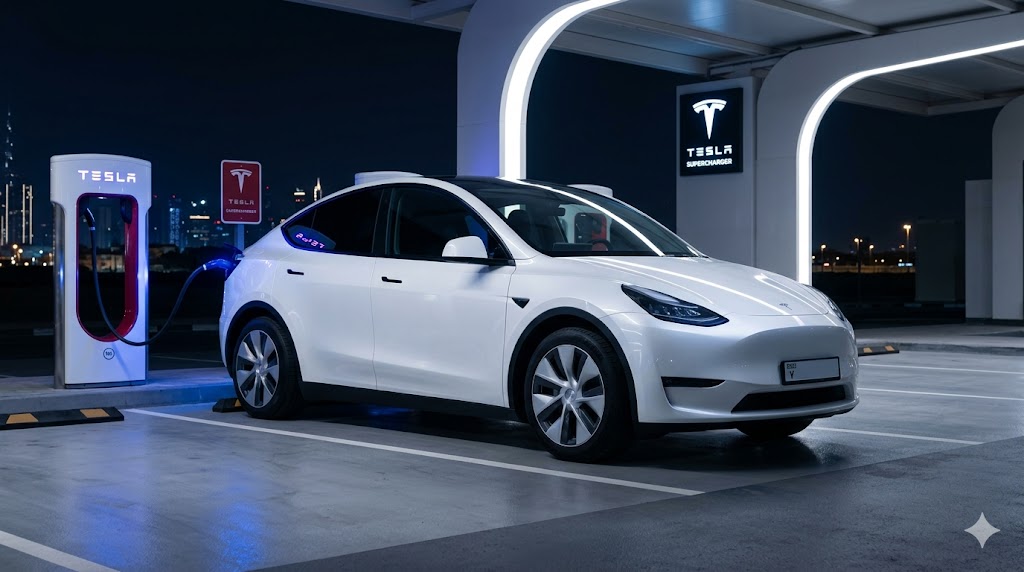
If your EV has built-in navigation with integrated trip planning, you may not need a third-party app at all, and that's a meaningful shift from just a few years ago. Native systems from brands like Tesla, Rivian, and several legacy automakers now route you through charging stops automatically, adjust the plan in real time as you drive, and factor in your actual energy consumption rather than a generic estimate. Tesla's in-car trip planner is frequently cited as one of the smoothest experiences precisely because it's tightly integrated with the car's own battery management and the automaker's charging network, so it knows your actual state of charge, your climate settings, and current stall availability without needing an external data feed.
The tradeoff with native systems is flexibility. They're excellent within their own ecosystem but can be less useful if you need to route through a charging network the automaker doesn't prioritize, or if you want to compare options across multiple networks before committing to a stop. They also vary widely in quality across brands — some automakers have only recently caught up to the sophistication that Tesla and a handful of others established years ago, so it's worth actually testing your specific vehicle's system on a mid-length trip before trusting it completely on a longer one.
Third-Party Route Planners Fill the Gaps
This is where tools like A Better Routeplanner (commonly known as ABRP) earn their reputation. ABRP was built specifically to solve the multi-variable problem described above: it lets you input your specific vehicle model, then calculates routes factoring in elevation, weather, and your own historical driving data if you connect it to your car. It's largely vehicle-agnostic, which makes it valuable for drivers whose native navigation is mediocre or for anyone who wants a second opinion on a route before committing to it. The tradeoff is that it's a separate app you have to manage alongside your car's own systems, and its recommendations are only as good as the charger data it's pulling in, which can occasionally lag real-world conditions.
Google Maps has also built EV routing directly into its mainstream navigation experience, which matters because it means EV-aware routing is now available inside an app most drivers already have open for everything else. It can suggest charging stops along a route and estimate arrival charge level, which makes it a reasonable default for drivers who don't want to manage a specialized app but still want more than a plain charger map. It generally isn't as granular in modeling elevation and weather as a dedicated planner, so for long or mountainous trips it's worth cross-checking against a specialized tool.
Charging Network Apps Serve a Different, Narrower Purpose
Apps tied to specific charging networks and crowdsourced locator apps like PlugShare serve a complementary rather than competing role. PlugShare in particular built its reputation on community-reported details that automated data feeds sometimes miss: whether a specific stall has a history of being broken, whether the location has restrooms and food nearby, and photos from other drivers showing exactly what you'll find when you pull in. That human layer is genuinely valuable on top of algorithmic routing, because official uptime data doesn't always capture the small annoyances that make a stop pleasant or miserable.
Network-specific apps, meanwhile, are mostly about the transaction: starting a charging session, monitoring it, and paying for it. They're not really designed to plan an entire route, but you'll likely end up with one or more installed regardless, since not every charger supports plug-and-charge or a universal payment method yet.
Building a Realistic Multi-Stop Plan
The real test of any planning approach is a multi-stop trip, where small errors compound. A good plan doesn't just find chargers that exist along your route — it sequences them so you're not overcharging at each stop out of caution, and it accounts for the fact that charging speed drops significantly once a battery passes roughly 80% state of charge, which is why efficient trip plans generally aim to arrive at each stop with a modest buffer and leave before the battery is nearly full. Charging to 100% at every stop feels safe but often adds far more time to a trip than a well-sequenced plan that tops up just enough to comfortably reach the next stop.
It's also worth planning a small buffer into your arrival estimates regardless of which app you use, since real-world variables like an occupied charger, a closed rest stop, or worse-than-forecast weather can and do happen. The apps have gotten remarkably good at prediction, but none of them are perfect, and treating any single estimate as gospel is how drivers end up anxious in a parking lot watching a percentage tick down.
Key Takeaways
- The best EV trip planners model elevation, weather, and your vehicle's actual efficiency rather than relying on a flat range estimate.
- Native in-car navigation has improved substantially and may be sufficient on its own, especially for brands with tightly integrated charging ecosystems.
- Third-party planners like ABRP add vehicle-agnostic flexibility and are especially useful for cross-checking native routing on long or mountainous trips.
- Crowdsourced apps like PlugShare add a human layer of detail — reliability history, amenities, photos — that automated data often misses.
- Efficient multi-stop planning means topping up just enough at each stop, not charging to 100% every time, since charging speed slows dramatically above roughly 80%.
- Bottom line: use your vehicle's native planner as a baseline, verify with a dedicated third-party tool on longer trips, and always build in a buffer for real-world surprises.