
Adaptive cruise control appears on new car option lists under a growing collection of names - Intelligent Speed Assist, Radar Cruise Control, Full-Speed Range Dynamic Radar Cruise Control, Active Cruise Control with Stop & Go. Different manufacturers have different terminology, different capability levels, and different marketing claims. What they share is a core technology that is simultaneously more useful and more limited than most drivers who use it understand.
The misunderstanding matters. Adaptive cruise control systems have been implicated in accidents where drivers either over-trusted the system's capability or failed to maintain the attention that the technology requires. Understanding what adaptive cruise control actually does is a prerequisite for using it safely.
The Core Technology
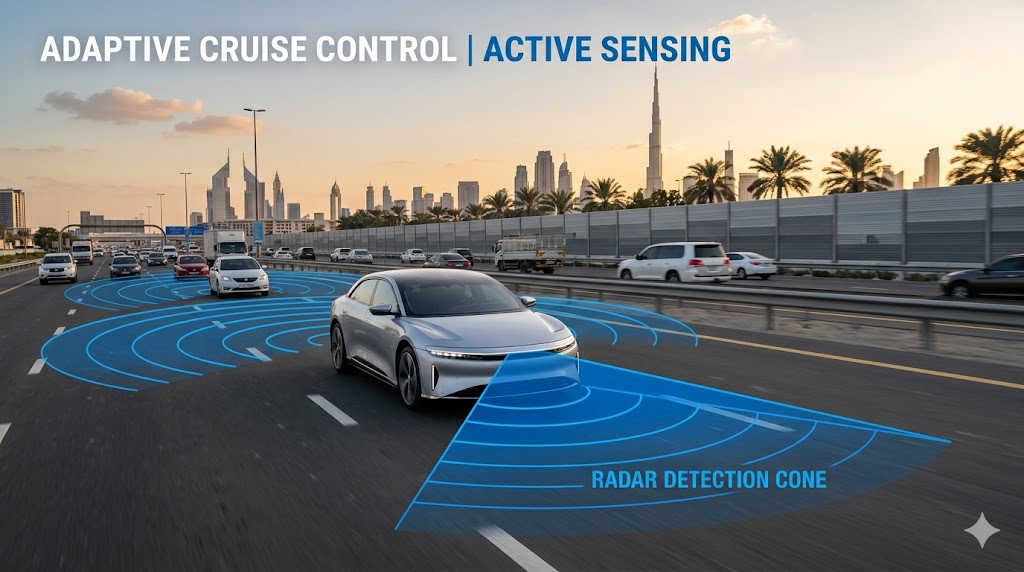
Standard cruise control maintains a fixed speed the driver sets. Adaptive cruise control adds a sensor - radar, camera, or a combination - that detects vehicles ahead and automatically adjusts the car's speed to maintain a driver-selected following distance. When traffic slows, the car slows without driver input. When traffic clears, the car accelerates back to the set speed.
The sensor type affects the system's capabilities significantly. Radar systems are better in adverse weather conditions - rain, fog, snow - because radar signals penetrate water particles more effectively than camera-based systems. Camera systems provide better resolution for object identification but degrade in reduced visibility. Higher-end implementations combine both, using radar for following distance management and cameras for lane detection and object classification.
Stop-and-go capability, which allows the system to bring the car to a complete stop and restart it in traffic, is now common at mid-level trim points. Without this feature, adaptive cruise deactivates below a minimum speed threshold (often around 25 mph), requiring driver intervention in dense traffic.
What Adaptive Cruise Control Does Not Do
The capability gaps are where driver misunderstanding creates risk. Adaptive cruise control reacts to vehicles detected ahead in the same lane. It does not anticipate cut-ins from adjacent lanes. It does not navigate curves without a driver's steering input unless a combined lane-keeping system is engaged. It does not detect stationary objects reliably in all implementations - some radar systems can't distinguish a stopped vehicle from a bridge overpass at speed, which is why automatic emergency braking remains a separate, active safety layer.
Lane centering, when combined with adaptive cruise control, creates what manufacturers call hands-free driving capability. These systems - GM's Super Cruise on designated mapped highways, Ford's BlueCruise, Cadillac's system - are more capable than standard adaptive cruise plus lane keeping assist. They handle lane centering actively rather than just warning when deviation occurs. They still require driver attention and most require confirmed eye tracking to verify the driver is monitoring the road.
Who Benefits Most From Adaptive Cruise Control
Highway commuters who regularly drive in stop-and-go traffic or long stretches of variable-speed freeway gain the most from adaptive cruise. The system reduces the constant acceleration and deceleration workload that fatigues drivers and, in dense traffic, can improve fuel economy by moderating acceleration more smoothly than most drivers do manually.
City driving doesn't benefit meaningfully because urban speeds, intersections, and the frequency of turns require constant driver engagement anyway. Country road driving at variable speeds in curves requires steering input that adaptive cruise alone doesn't provide.
Summary
What it is: A driver assistance technology that uses radar and/or cameras to maintain a set following distance from vehicles ahead, automatically adjusting speed without driver throttle or brake input.
Best for: Highway and freeway driving with variable traffic speeds, particularly in daily commuting conditions where speed fluctuations are frequent.
Biggest cost/risk factor: Systems vary significantly in capability by manufacturer and trim level; the system requires constant driver monitoring and cannot substitute for driver attention.
When to act: Prioritize stop-and-go capability and sensor type when comparing systems - these differences affect daily usefulness more than marketing materials typically clarify.
AutosAdvisor content is for educational purposes. We are not a licensed automotive technology consultant. Always follow manufacturer guidelines for driver assistance system use.