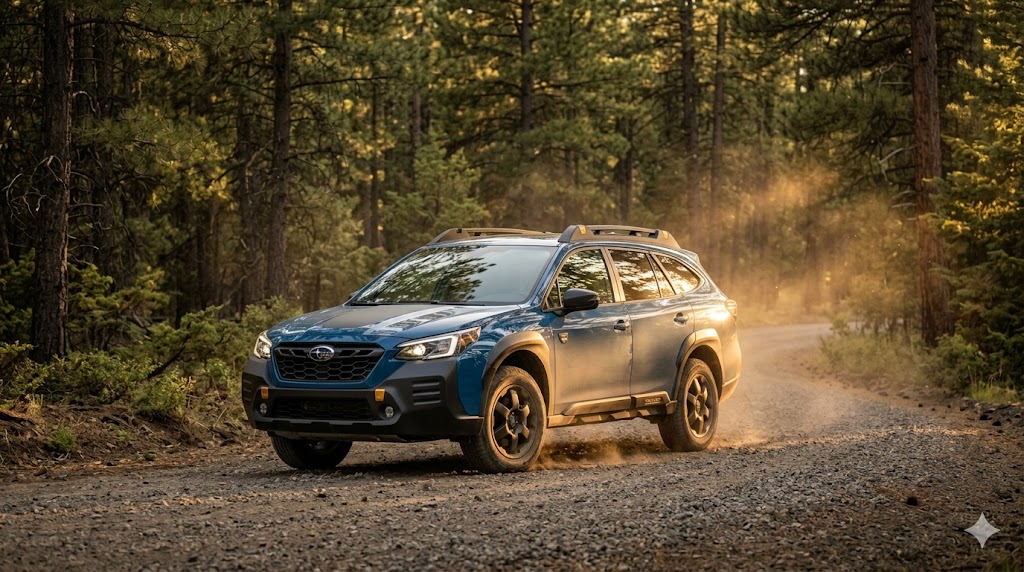

The Subaru Outback has always had a pragmatic honesty that its competitors lack. It doesn't pretend to be a truck. It doesn't dress up in body cladding to imply off-road credentials it can't deliver. The standard Outback is a capable, versatile car that does light off-road work well and everyday work excellently.
The Wilderness trim changes the proposition. The Outback Wilderness isn't trying to look adventurous - it's trying to be adventurous, and the engineering changes it makes to the standard platform deliver on that ambition in specific, measurable ways.
What the Wilderness Package Changes
Ground clearance increases to 9.5 inches through a combination of suspension lift and Yokohama GEOLANDAR all-terrain tires in 225/65R17 size. The all-terrain tires are the most significant change for real-world off-road performance - they provide meaningful additional capability on mud, gravel, loose rock, and snow compared to the all-season tires on standard Outback trims.
The 2.4-liter turbocharged four-cylinder producing 260 horsepower is standard, replacing the naturally aspirated engine from lower trims. The additional torque supports the additional tire load and off-road demands more capably.
X-Mode's dual-mode functionality - standard X-Mode and Deep Snow/Mud - provides terrain management calibration for conditions where the Wilderness's capabilities push toward their limits. The system adjusts throttle response, brake application, and AWD torque distribution for specific surface types. It works as described in conditions that genuinely challenge a crossover.
Departure angle and breakover angles improve meaningfully over the standard Outback. Approach angle is limited by the front fascia, which remains the Wilderness's primary clearance constraint on steep technical terrain.
Real-World Capability Assessment
The Outback Wilderness is not a replacement for a Jeep Wrangler or a Toyota 4Runner on serious trails. Its front-wheel-size constraints limit approach angle, and its unibody construction has load limits that body-on-frame SUVs don't share. What it is: the most capable wagon-format vehicle available at its price point, and a genuinely useful off-road vehicle for the 95% of off-road driving that happens on fire roads, gravel tracks, forest service roads, and light trails.
For buyers who want a vehicle that handles a week of camping with rough road access, manages forest service roads without anxiety, and also serves as a comfortable daily driver - the Outback Wilderness is a more honest choice than pretend-off-road crossovers that look the part but can't do the work.
Summary
What it is: A lifted, all-terrain-tire-equipped Subaru Outback wagon with a turbocharged four-cylinder, 9.5 inches of ground clearance, and dual-mode terrain management.
Best for: Buyers who want genuine light off-road capability in a practical, daily-drivable wagon format without the penalty of full off-road truck ownership.
Biggest cost/risk factor: Approach angle limitations on steep terrain; all-terrain tires add road noise compared to standard Outback; premium over standard Outback requires honest capability assessment.
When to act: After driving it on the type of terrain you actually use - the capability is real, but only relevant if your driving genuinely requires it.
AutosAdvisor is not a licensed dealer or financial advisor. Review reflects editorial testing.