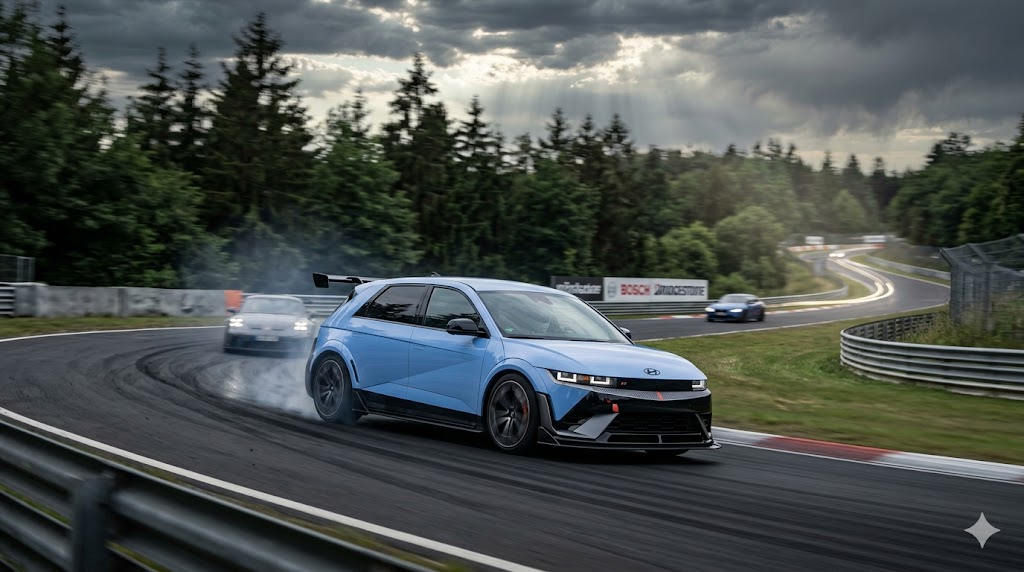

The automotive world has developed a shorthand for performance EVs: high numbers, straight-line speed, instant torque. The Hyundai Ioniq 5 N was built to reject that shorthand. Hyundai's N Division, which has built a genuine track-focused reputation through the Veloster N and Elantra N, treated the Ioniq 5 N not as a power exercise but as a chassis development project that happened to have electric motors.
The results justify the approach. The Ioniq 5 N produces 641 horsepower through dual electric motors with all-wheel drive. That power figure is secondary to the engineering underneath it.
What N Division Actually Changed
The most significant technical development in the Ioniq 5 N is the N e-shift system. Hyundai programmed the powertrain to simulate gear changes, introducing artificial hesitation and torque interruption that mimics the sensation of a dual-clutch transmission shifting. This is a divisive feature - purists find it unnecessary, while others find it adds engagement that pure EV power delivery lacks. In N Grin Shift mode, the simulation is more aggressive. It can be disabled entirely.
The brake pedal feel is the other technical achievement. Hyundai calibrated the blend between regenerative and friction braking to produce a pedal that feels consistent regardless of which system is providing the stopping force. In a performance context, on a track, this consistency matters. Previous EVs that blended regeneration and friction braking sometimes produced unpredictable pedal feel under hard use.
The suspension uses electronically controlled dampers with N-specific calibration that provides genuine track capability without making the car punishing for daily use. Lateral stiffness is high enough to manage the 5,071-pound curb weight in corners without excessive body roll.
Track range is the practical limitation. At Motorland Aragon in our European track test, the battery depleted meaningfully faster than road driving patterns suggested. Sustained high-performance use at a circuit depletes EV batteries at rates that road driving doesn't predict accurately. The Ioniq 5 N is capable of track work, but planning for reduced range is necessary.
Summary
What it is: A 641-horsepower dual-motor EV sport crossover with N Division track development, simulated transmission engagement, and performance-calibrated suspension.
Best for: Performance EV buyers who want track capability and driver engagement, not just straight-line acceleration.
Biggest cost/risk factor: Battery range depletes significantly faster in track use; the simulated gear change system is either compelling or unnecessary depending on your perspective.
When to act: After a track day test if that's your intended use - road performance is strong, but track battery management requires specific evaluation.
AutosAdvisor is not a licensed dealer or financial advisor. Review reflects editorial testing.