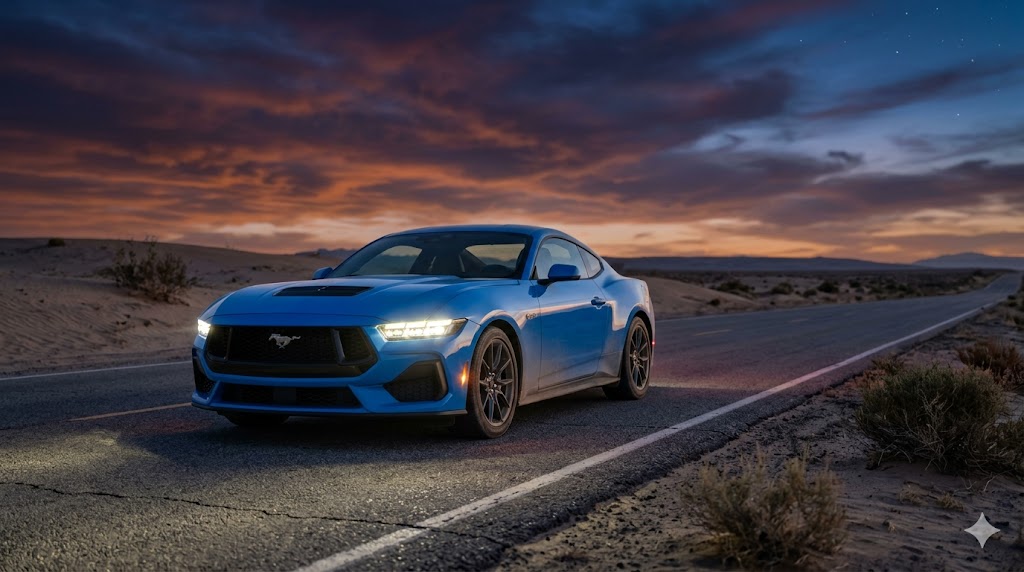

The 2026 Ford Mustang GT exists in a market that keeps telling it the future belongs to something else. EVs, turbocharged four-cylinders, and dual-clutch transmissions are where the performance segment is heading. The Mustang GT with its 5.0-liter Coyote V8 and six-speed manual transmission pointedly disagrees, and the argument it makes is compelling enough to deserve a thorough hearing.
Ford's Coyote V8 produces 480 horsepower in its 2026 state of tune, a number achieved without forced induction through high-revving naturally aspirated engineering that gives the engine a character turbocharged alternatives can't replicate. The intake note between 4,000 and 7,500 rpm is one of the better soundtracks in current production cars. It rewards revving in a way that turbocharged engines, which load up lower in the rev range and flatten before redline, simply don't.
What the Manual Gearbox Changes
The six-speed manual transmission is the element that defines the Mustang GT experience for the buyer this car is designed for. The throws are deliberate rather than sports-car-short, and the clutch engagement point is clearly communicative without being heavy. The combination of a naturally aspirated V8 with a proper manual gearbox is increasingly rare in new cars, and the Mustang GT remains one of the few remaining examples at anything near its price point.
Rev-matching is standard and can be disabled for drivers who prefer to heel-and-toe themselves. The system is well-calibrated when engaged - it blips the throttle at the correct rate without the over-dramatic sound that some manufacturer implementations produce.
Rear-wheel drive is the layout, and the 2026 Mustang GT offers enough electronic management options to suit drivers across the experience spectrum. In Normal mode, the stability and traction control systems manage the power appropriately for average conditions. In Track mode, the thresholds expand enough to allow genuine driving engagement on appropriate roads and tracks. Full manual control over the systems is available for experienced drivers who want it.
The Practical Reality of Mustang GT Ownership
Fuel economy measures around 15 city and 24 highway. Premium fuel is recommended but not required; Ford acknowledges the engine will adjust timing for regular grade at a small power cost. For a 480-horsepower V8, the economy figures are acceptable.
Rear seat space is adequate for occasional adult use but not generous. The Mustang's fastback roofline compromises headroom for rear passengers in a way that matters for regular use. Trunk space is reasonable at 13.5 cubic feet.
Interior quality has improved substantially in the current generation, with more premium materials and a better display integration than previous Mustangs offered. The 13.2-inch touchscreen and the digital instrument cluster provide modern technology in a package that manages to look genuinely new without abandoning the Mustang's visual identity.
The base GT pricing positions it against the Chevrolet Camaro SS, the Dodge Challenger (now in its final years), and the Toyota GR Supra. Among these, the Mustang GT provides the best combination of V8 power, manual availability, and parts/service ecosystem.
Summary
What it is: The 2026 Ford Mustang GT, a rear-wheel-drive pony car powered by a 480-horsepower naturally aspirated 5.0-liter V8 with manual or automatic transmission.
Best for: Performance buyers who want naturally aspirated V8 character, manual gearbox engagement, and practical daily usability in a recognizable American icon.
Biggest cost/risk factor: 15 mpg city in spirited use, rear seat compromises for regular passengers, and a naturally aspirated engine in a market increasingly valuing forced-induction power.
When to act: Before the naturally aspirated V8 option becomes unavailable - the Mustang's electrification path is coming, and this configuration has a limited production window.
AutosAdvisor is not a licensed dealer or financial advisor. Review reflects editorial testing.