
The Ford Maverick Hybrid's sales story is one of the automotive industry's more revealing recent data points. When it launched, Ford received so many orders that it had to close the order bank repeatedly. Buyers who hadn't been considering a truck discovered that the Maverick solved problems their hatchbacks and sedans couldn't - cargo flexibility, towing capability, and the ability to transport oversized items - while delivering fuel economy that rivaled compact crossovers.
The 2026 Maverick Hybrid continues this formula with incremental improvements to the hybrid system's software calibration and interior technology. The fundamental truck remains unchanged: a front-wheel-drive unibody pickup powered by a 2.5-liter Atkinson-cycle four-cylinder with an integrated electric motor, producing a combined 191 horsepower.
Why the Hybrid Powertrain Defines This Truck
The EPA rating of 42 city, 33 highway, and 37 combined miles per gallon is what separates the Maverick Hybrid from every other pickup truck on the American market. No other truck comes close in city driving. The hybrid system's ability to run on electricity at low speeds - the condition where traditional engines waste the most fuel and produce the most emissions - is specifically well-suited to the urban and suburban driving patterns that characterize most Maverick buyers' use cases.
The system operates seamlessly. Unlike plug-in hybrids that require active management, the Maverick Hybrid's powertrain is entirely self-managing. You fuel it like a conventional truck, and it returns significantly better economy without requiring any change in driving behavior or habits.
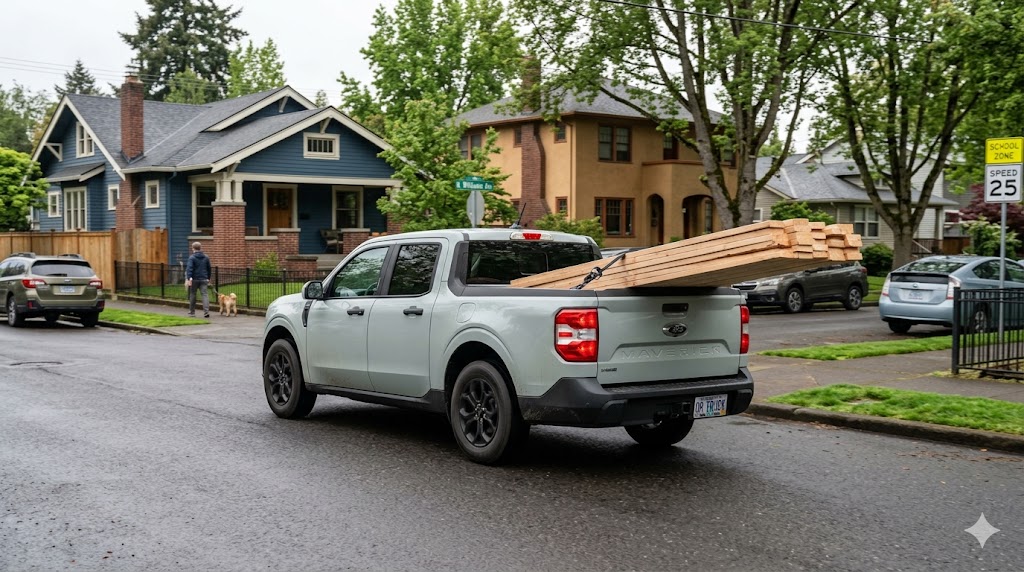
Cargo capability is where the Maverick makes its truck case. The 4.5-foot bed handles sheets of plywood and drywall - the standard construction material test for truck beds - with the tailgate down. Payload capacity reaches 1,500 pounds in some configurations. The FLEXBED system includes tie-down hooks and can be configured with storage dividers, with cleats, or with a fold-down work surface that's genuinely useful.
Towing capacity reaches 2,000 pounds, which is adequate for small trailers, utility trailers, and light boats. Buyers with serious towing requirements need to look at the EcoBoost-powered Maverick or a larger truck.
The Trade-offs Worth Understanding
Front-wheel drive limits the Maverick Hybrid's utility in conditions where traction is the constraint. The EcoBoost Maverick offers all-wheel drive; the hybrid does not. Buyers in climates with significant snow or who need regular off-road capability should consider the EcoBoost configuration.
Interior quality is reflective of the entry-level pricing strategy. Materials are durable and reasonably well-assembled, but the Maverick doesn't attempt premium pretension. The 8-inch SYNC 4 touchscreen is functional and reasonably intuitive; the physical controls for climate are sensibly retained.
Availability remains a challenge despite Ford's production increases. Building to order is still the most reliable path to the specific configuration you want, and order-to-delivery timelines vary.
Summary
What it is: A front-wheel-drive compact hybrid pickup truck producing 191 combined horsepower and achieving 42 mpg city while maintaining practical truck capability.
Best for: Urban and suburban buyers who need occasional truck capability - hauling, occasional towing, cargo flexibility - but spend most miles in typical city and suburban driving conditions.
Biggest cost/risk factor: Front-wheel-drive-only limits winter and off-road capability; towing capacity of 2,000 pounds constrains heavy trailer use.
When to act: If you're currently driving a car but regularly rent or borrow trucks - the Maverick Hybrid solves that problem at a lower total operating cost than most alternatives.
AutosAdvisor is not a licensed dealer or financial advisor. Review reflects editorial testing.