Point the 2025 Rivian R1S down a rutted fire road, raise the air suspension to its tallest setting, and something clicks that doesn't happen in most electric SUVs: you stop bracing for the moment the vehicle tells you to turn around. Most three-row electric crossovers are built for school pickup lines and the occasional gravel driveway, and they telegraph that limitation the second the pavement ends. The R1S doesn't. It was engineered by people who apparently wanted an electric vehicle capable of actual trail use, not just the marketing language of it, and that distinction shapes everything about how this SUV feels, drives, and justifies its position in the market.
Off-Road Capability That Isn't Just for Show
The core of the R1S's identity is its four individually controlled motors, one at each wheel, which gives Rivian's engineers a tool that combustion-based off-roaders can only approximate with locking differentials and brake-based torque steering. Because each wheel can receive precisely metered power independently, the R1S can send torque to whichever corner has grip while essentially withholding it from a wheel that's spinning uselessly in the air or in loose dirt. The practical effect on the trail is a vehicle that claws its way over obstacles with a composure that feels almost unfair compared to traditional four-wheel-drive systems. Rivian has also demonstrated low-speed maneuvers that use opposing wheel rotation to tighten the turning radius dramatically, a tank-turn-like capability that, even in its production-limited form, hints at how differently electric off-roaders can approach terrain compared to a solid-axle truck.
The air suspension is the other half of the equation, and it's not a gimmick bolted on for curb appeal. Raised to its off-road height, the R1S delivers genuinely generous ground clearance, enough to clear boulders and washouts that would send a typical crossover home with a cracked bumper. Rivian has also built the R1S to ford water to a meaningful depth, a figure worth checking in current published specifications, but qualitatively enough to handle flooded trail crossings and stream fords that would stop most electrified competitors cold. None of this is theoretical: owners regularly take R1S models on genuine overlanding routes, not just gravel parking lots.
Built Like Gear Matters, Because It Does
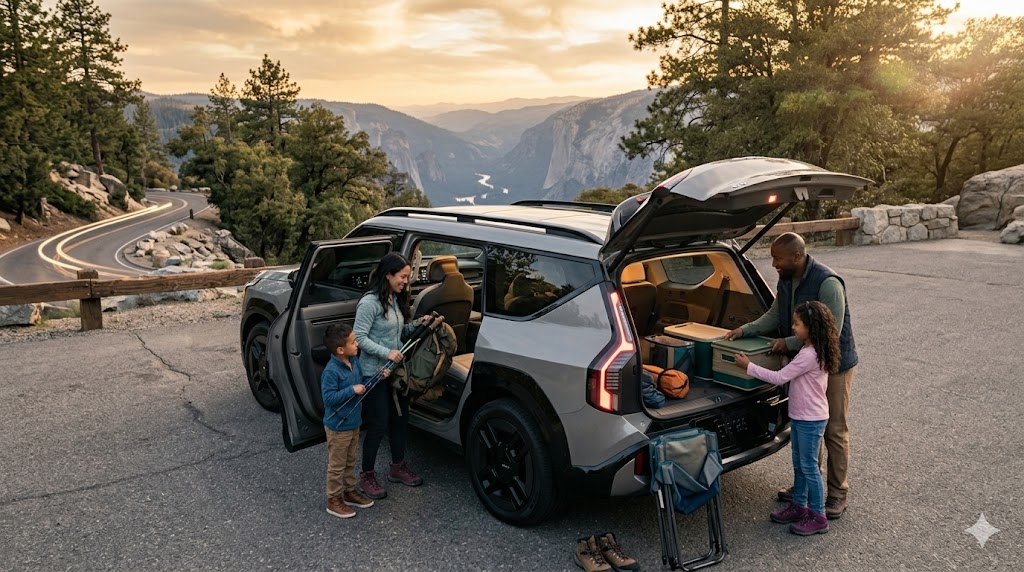
Rivian's obsession with outdoor use extends well past the drivetrain. The signature gear tunnel, a pass-through storage compartment ahead of the rear wheels, lets you stash muddy boots, tents, or recovery gear without tracking it through the cabin, and it's the kind of detail that only makes sense if the design team actually camps. Roof-rack integration, a rugged available kitchen module, and side-opening rear glass all reinforce that this is a vehicle designed around a specific lifestyle rather than one retrofitted to look adventurous in photography. Compare that to most electric SUVs on the market, which prioritize aerodynamic sleekness and lounge-like interiors over any real expectation that an owner will get the underbody dirty, and the R1S's whole design language starts to make sense as a coherent philosophy rather than a checklist of options.
This is also where the R1S separates itself from other rugged-adjacent EVs that talk a good game but stop short of true capability. The R1S doesn't just have skid plates; it has a suspension and motor architecture built to use them.
The Trade-Offs of Being a Genuine Off-Roader On Pavement
None of this capability arrives for free, and a fair review has to reckon with what you give up. The R1S is a large, heavy vehicle, carrying a substantial battery pack along with the reinforced structure needed to survive real off-road abuse, and that mass is noticeable the moment you're back on the highway. Body control during quick direction changes has a discernible lean to it, more than you'd find in a lower, more road-biased electric SUV, and while the air suspension does an admirable job soaking up broken pavement, the R1S never fully disguises its size and weight in corners. This is a vehicle that rewards a relaxed driving style far more than an aggressive one.
Ride quality on smooth roads is genuinely comfortable, arguably plush, and wind and road noise are well contained for a vehicle with this much frontal area. But push it into a tight cloverleaf on-ramp and you'll feel the physics of a tall, heavy off-roader asserting themselves. Acceleration remains strong thanks to the instant torque inherent to electric motors, and Rivian's various drive configurations let you dial in power delivery to suit conditions, but this isn't a vehicle chasing sports-SUV lap times. It's chasing capability, and the on-road dynamics are the honest cost of that priority.
Interior, Software, and the Rivian Experience
Step inside and the R1S feels less like a traditional automaker's product and more like something built by a technology company that also happens to understand outdoor gear, which is essentially what Rivian is. The materials lean toward a clean, almost minimalist aesthetic, with real attention paid to sustainable and washable surfaces that make sense for a vehicle likely to hold sandy boots and wet dogs. Build quality has improved meaningfully since the R1S's early production years, though it's worth noting that fit-and-finish consistency has historically been an area new EV manufacturers struggle with more than legacy players, and it's worth inspecting a specific vehicle rather than assuming uniformity across the lineup.
The software experience is a genuine strength. Rivian's user interface avoids the overstuffed touchscreen sprawl that plagues some competitors, organizing controls with a clarity that makes the learning curve short. Over-the-air updates have added meaningful functionality since launch, a pattern that rewards owners who hold onto the vehicle rather than trade it in quickly. The driver display and center screen work in tandem sensibly, and the overall digital experience feels considered rather than assembled from a parts bin.
Charging Reality and Where the R1S Sits on Price
Rivian has built its own Adventure Network of charging stations, positioned deliberately near trailheads and outdoor destinations rather than exclusively along interstate corridors, which reinforces the brand's identity even as it charges your battery. Access to other major charging networks has also expanded, giving R1S owners a broader safety net than they had in the vehicle's first year or two on the market. It's still sensible to plan longer trips with a charging app open and a backup network in mind, particularly in more remote regions where the outdoor-adventure use case actually lives.
On price, the R1S occupies a space that overlaps with larger luxury electric SUVs from established premium brands, and it generally competes well on value once you weigh in its unique off-road hardware. It undercuts some three-row luxury EV rivals while offering genuine trail capability those competitors don't attempt, though buyers strictly cross-shopping for interior opulence or ultimate on-road refinement may find those established luxury players still hold an edge in outright polish. Check current published pricing directly, as configurations and incentives shift the comparison meaningfully.
Key Takeaways
The 2025 Rivian R1S delivers genuine off-road capability, including strong torque vectoring, generous ground clearance, and real water-fording ability, that most electric SUVs only gesture toward. Gear-oriented design touches like the pass-through gear tunnel and rugged available accessories show a coherent outdoor-focused philosophy rather than superficial styling. On pavement, the R1S's size and weight produce noticeable body lean in corners, a fair trade-off for a vehicle this capable off-road. The interior and software experience stand out for clarity and thoughtful materials, though build quality can still vary and deserves a hands-on inspection. Rivian's own Adventure Network plus growing access to other charging networks improves road-trip confidence, though planning ahead still matters in remote areas. Bottom line: if genuine trail capability matters to you as much as daily livability, the R1S earns its price position against larger luxury EV rivals; if you mainly want a polished road-going family SUV, weigh the on-road trade-offs carefully before committing.