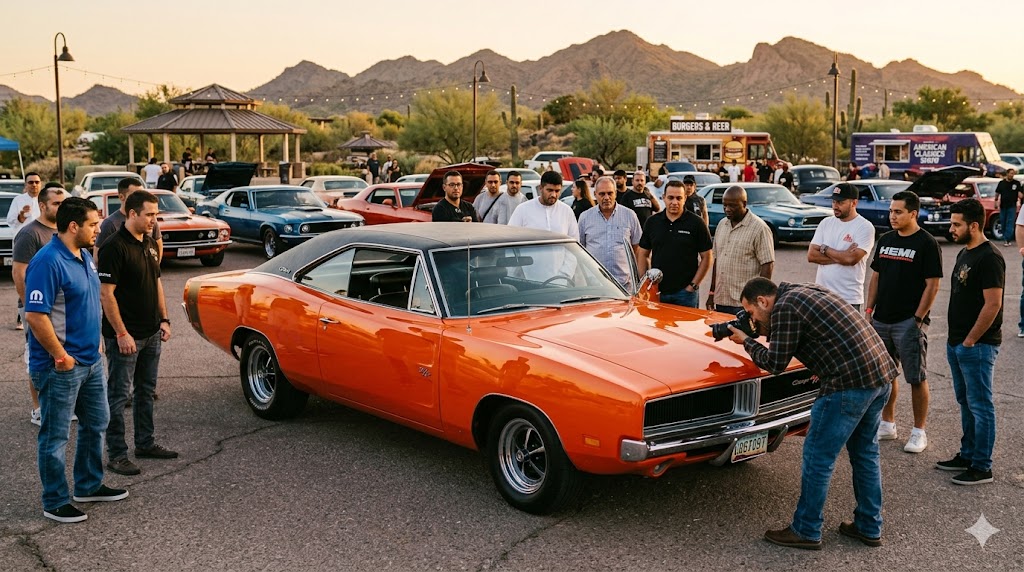

The 1969 Dodge Charger has been a market darling for decades, and for understandable reasons. The second-generation Charger's styling - that swept roofline, the full-width taillamp, the distinctive hidden headlamps - remains one of the cleanest expressions of late-1960s American automotive design. The Dukes of Hazzard put the 1969 Charger in living rooms for seven seasons, and while General Lee mythology has faded from popular culture, the underlying car's appeal has not.
What hasn't faded is the complexity of buying one in 2026. The '69 Charger market is among the most stratified in American muscle, and buyers approaching it without adequate preparation frequently discover that the car they thought they understood is more complicated than the asking price suggested.
The Charger Market in 2026: Three Very Different Cars
When collectors talk about "a 1969 Dodge Charger," they're often conflating three distinct market segments that share a body but occupy entirely different price territories.
The base Charger with a 318 or 383 two-barrel is the most accessible entry point, but it occupies uncomfortable middle ground. These cars carry the styling that makes the '69 desirable, but without the performance credentials that the market rewards most heavily. A solid 318 Charger in driver condition might sell in the $45,000-$65,000 range, which sounds like a fair entry point until you consider that the next step up - a 383 Magnum four-barrel car - commands a meaningful premium without delivering true muscle car performance.
The 440 Magnum and 440 Six Pack cars occupy the mainstream of serious collector interest. These represent the performance the styling always promised. A numbers-matching 440 Magnum Charger in clean, driven condition trades in the $80,000-$120,000 range. Show-quality examples with documentation push higher. The 440 Six Pack, with its trio of two-barrel carburetors, is rarer and correspondingly more valuable.
Then there is the Hemi. The 426 Hemi-powered 1969 Charger exists in a separate universe. Production numbers were deliberately limited - Chrysler installed the Hemi in roughly 432 Chargers in 1969, making authentic Hemi cars among the rarest production American muscle cars ever built. These cars, when documented and correct, trade at prices that most collectors only watch from the sideline. Valuations north of $200,000 are common for clean examples; exceptional cars have brought significantly more.
The Cloning Problem
The '69 Charger market has a well-documented cloning problem that buyers must understand before they can evaluate any car. Because the base Charger body is identical to the R/T body, and because Hemi and high-option parts have been widely reproduced, it is straightforward to build a convincing 440 or even a fraudulent "Hemi clone" from a 318 car. This practice, sometimes called tribute building and sometimes outright fraud depending on intent and disclosure, is common enough that serious buyers treat every claimed high-performance car with initial skepticism.
Authentication for high-value '69 Chargers relies on several overlapping evidence types. The broadcast sheet, a production checklist attached inside the car at the factory, is the most significant document when present. The VIN decoding tells you what the factory ordered, but it doesn't guarantee the original powertrain is still in the car. Fender tag verification and date-code inspection of major components - engine, transmission, carburetor, alternator - provides evidence about whether the drivetrain is original or assembled.
For any car claiming to be a numbers-matching high-performance example, professional appraisal by a Mopar specialist is not optional - it's necessary. The cost of a professional inspection is trivial against the price of a significant purchase. Buyers who skip this step regularly discover, after the fact, that the car they paid Hemi money for is a 383 with transplanted components.
What the Rust Question Means in Practice
The 1969 Charger was built on Chrysler's B-body platform, which has its own rust signature. The lower quarters, trunk floor, trunk extensions, and floor pans are predictable problem areas. More serious, and harder to address, is structural rust in the frame rails at the torque box locations and in the radiator support area.
Cosmetic rust is a cost-of-restoration issue. Structural rust can make a car economically unrepairable when honest costs are calculated. The restoration labor market has shifted significantly - rates that seemed high five years ago look modest now. A complete body restoration including metalwork on a significantly rusted '69 Charger can easily reach $50,000-$80,000 before paint, which means the project car math almost never works for buyers who aren't doing the work themselves.
Buyer preference for rust-free or rust-light cars - typically those from Southwest or Pacific Coast climates - reflects this economic reality. Regional provenance matters, and honest sellers disclose it.
Pricing Reality for 2026 Buyers
The '69 Charger market has cooled from its hottest years without losing its fundamental appeal. Values for common configurations have stabilized or softened slightly. Values for genuinely rare, documented examples - correct Hemi cars, Six Pack cars with broadcast sheets, original paint survivors - remain strong and continue to attract serious collector money.
The opportunity for informed buyers lies in the middle of the market, in 440 Magnum cars that are properly documented but haven't been dressed up with cosmetic work that hides mechanical questions. A car that runs and drives correctly, shows honest wear consistent with its represented history, and has verifiable VIN and broadcast sheet documentation is a better buy than a freshly painted car with no paperwork, regardless of how much more attractive the repainted car looks at first glance.
Buyers who take time to inspect carefully, verify documentation, and get independent professional appraisal on any significant purchase are consistently better positioned than those who let emotional response to an iconic car override due diligence.
Summary
What it is: A 1969 Dodge Charger, one of the most culturally significant American muscle cars, available across a wide range of powertrain configurations that dramatically affect collector value.
Best for: Collectors who have done their homework on authentication, understand the cloning risk, and prioritize documentation over cosmetics.
Biggest cost/risk factor: Misrepresented powertrain configurations and undisclosed structural rust, both of which require specialist inspection to detect reliably.
When to act: Only after independent appraisal by a qualified Mopar specialist confirms the car is what the seller represents it to be.
AutosAdvisor does not provide financial or investment advice. This content is educational and general in nature. Classic car valuations vary significantly based on condition, documentation, and market timing.