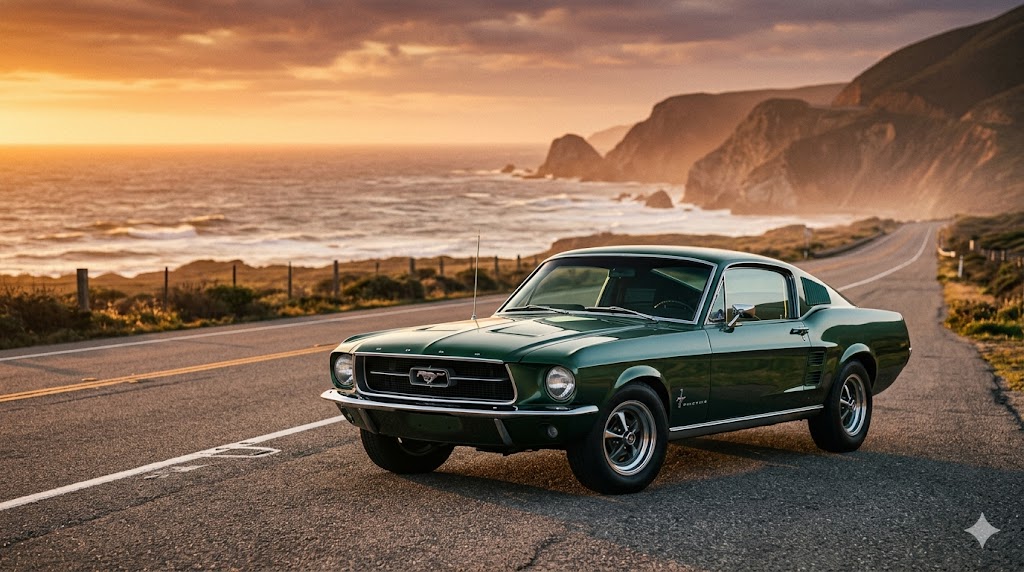

The 1967 Ford Mustang fastback occupies a unique position in the American collector car market. It was the year Ford got serious about the Mustang's performance identity - the roofline became a true fastback rather than the notchback-with-a-slope of 1966, the interior grew more refined, and the engine options expanded to include the 390-cubic-inch FE big-block. Six decades later, that combination of design, heritage, and powertrain variety makes the '67 fastback one of the most discussed and frequently misunderstood classics in the market.
The central question for any potential buyer in 2026 is whether the current market represents a buying opportunity or a plateau. The answer depends heavily on which '67 fastback you're considering.
What the Data Actually Shows
Collector car pricing for the '67 Mustang fastback has experienced notable segmentation over the past several years. Cars with documentation, numbers-matching drivetrains, and original paint codes continue to appreciate steadily. Restored examples without provenance documentation have largely flat-lined. Project cars and runners with replaced engines trade at significant discounts to their potential restored value - and that gap has widened, not narrowed, as restoration labor costs have climbed.
Auction results from major sales including Barrett-Jackson, Mecum, and Bring a Trailer tell a consistent story: the market rewards authenticity and penalizes ambiguity. A well-documented '67 fastback with a date-correct 390 or even a period-correct 289 High Performance will draw competitive bidding. An unverified "barn find" with a date-code-incorrect engine and a repainted body in a non-original color sells for noticeably less, regardless of how the seller describes it.
The broad price range for '67 fastbacks remains wide. Drivers and runners in presentable but unrestored condition can be found in the $30,000-$55,000 range depending on original drivetrain and color combination. Show-quality restorations command $80,000-$130,000, with the top end reserved for genuinely rare configurations - Shelby GT350s occupy an entirely different market tier. Documented, original unrestored examples in original colors are increasingly rare and can bring premiums above comparable restorations.
What Drives Value in This Market
Three variables dominate pricing for '67 Mustang fastbacks in ways that newer collectors frequently underestimate.
Original engine is the first and most significant. A numbers-matching car is worth considerably more than an identical-looking example with a replacement motor, even if the replacement is a factory-correct engine from another vehicle. The data plate on the radiator support, the VIN-encoded engine designation, and the broadcast sheet (if present) are what buyers and auction specialists look for. The '67 fastback was available with six-cylinder and V8 options ranging from the 289 two-barrel through the 390 GT; which engine the car originally left the factory with determines its trajectory in the market.
Color and option combinations follow closely. Certain exterior colors - Acapulco Blue, Lime Gold, Brittany Blue - are more desirable than common colors like Wimbledon White or Candyapple Red, even though rarity doesn't always correlate with desirability. Pony interior, the deluxe interior package with embossed horse images in the seat backs, adds meaningful value. The GT equipment group, fold-down rear seat, and center console are all additive options.
Provenance documentation is the third lever. Marti Reports, available through the Marti Auto Works database, provide factory production data for Ford vehicles and are considered authoritative documentation. Cars with original window stickers, title history, and service records trade at premiums over otherwise comparable cars without documentation.
The Condition Conversation Buyers Need to Have With Themselves
Before approaching the '67 fastback market, buyers need to be honest about what they actually want from ownership. The market for drivers is different from the market for show cars, and buyers who confuse the two frequently make expensive mistakes.
A driver - a car that runs, drives, and presents well enough to enjoy on weekends - doesn't require a numbers-matching drivetrain or original paint. What it requires is a sound structure, a reliable mechanical condition, and enough cosmetic quality to make ownership enjoyable. Buyers in this segment can find excellent value in the $35,000-$50,000 range if they're willing to evaluate mechanicals carefully and accept that a non-original engine doesn't diminish the driving experience.
A show-quality restoration is a different proposition entirely. Labor costs have made professional restorations increasingly expensive, and the math on buying a project car and restoring it rarely pencils out compared to buying an already-restored example. Buyers attracted to the project car market should go in with clear eyes: a full rotisserie restoration on a '67 fastback can easily reach $80,000-$100,000 in labor and parts, which means a $25,000 project car is rarely the deal it appears to be.
What to Inspect Before Buying
The '67 Mustang has predictable rust locations that any serious buyer should inspect carefully. The torque boxes at the front frame rail junctions, the floors (particularly along the seat risers and trans tunnel), the rockers, and the lower quarters are all common problem areas. Surface rust is manageable; structural rust in the frame rails or torque boxes is expensive to address correctly.
Engine compartment condition tells a story about maintenance history. Look for signs of coolant leaks at the intake manifold, oil leaks from the rear main seal area, and evidence of recent work that might be concealing problems. A pre-purchase inspection by a Mustang-specialist shop is money well spent on any significant purchase.
Interior condition is less critical from a structural standpoint but affects value. Reproduction interior parts for '67 Mustangs are widely available and generally of acceptable quality, so interior restoration is one area where restoration costs are more predictable.
Is 2026 a Good Time to Buy?
The '67 Mustang fastback market has settled into a pattern that favors patient, informed buyers. Values for quality cars have not declined meaningfully, but neither are they accelerating the way they were in the early part of the previous decade. That stability is actually a buying signal for buyers who know what they want.
For buyers seeking drivers, the current market offers reasonable selection at prices that have softened from peaks. For buyers seeking investment-grade originals, the market rewards patience - waiting for the right car with verifiable documentation is almost always better than settling for a well-presented car without it.
Summary
What it is: A 1967 Ford Mustang fastback, a first-generation pony car widely considered the pinnacle of early Mustang styling and performance options.
Best for: Collectors seeking a US-market icon with genuine cultural significance and an active, well-documented replacement parts market.
Biggest cost/risk factor: Non-original drivetrains and undisclosed rust repair dramatically affect both value and resale trajectory.
When to act: When you find a documented, honest car at a fair price for its actual condition - not because of market timing speculation.
AutosAdvisor does not provide financial or investment advice. Classic car values fluctuate and past performance does not guarantee future appreciation. Consult with a qualified collector car appraiser before any significant purchase.