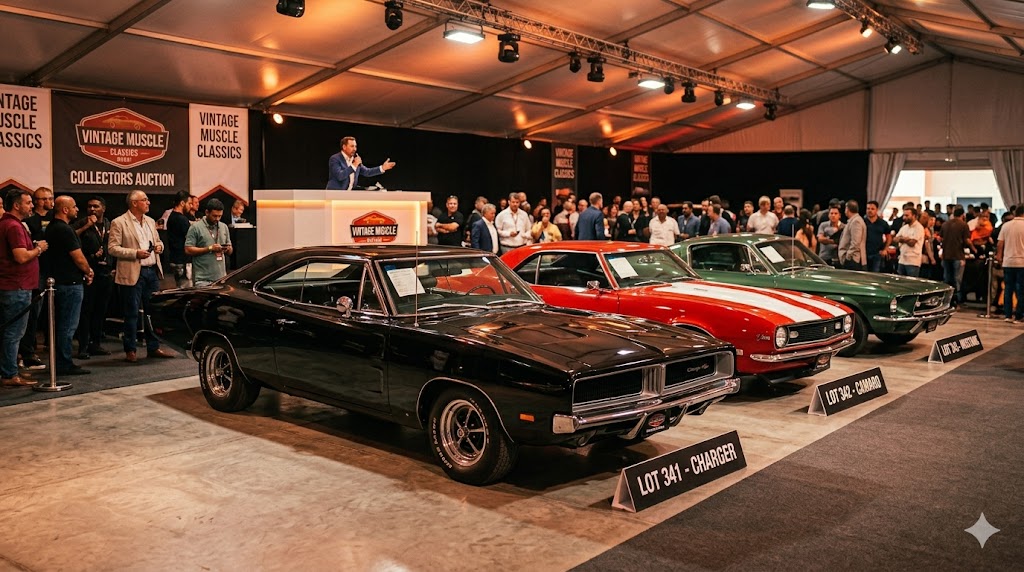
Watch enough auction broadcasts and you'll see it happen: a tired-looking coupe with faded paint, a cracked dash, and a seat that's gone from red to pink crosses the block for more money than a gleaming, freshly restored example of the same model parked two rows over in the display lot. The paint job that cost someone forty thousand dollars and a year of a specialist's time doesn't win. The car that never left its own factory finish does. To newcomers, this looks backward. To serious collectors, it's the most rational outcome in the room.
The reason isn't sentimentality, and it isn't nostalgia for grime. It's that originality is a finite resource, and restoration — no matter how well executed — cannot manufacture more of it. Once a car's original paint is stripped, its factory-applied undercoating disturbed, or its interior re-upholstered, that specific physical record of how the vehicle left the assembly line is gone permanently. You can restore a car to a high standard, but you can never again make it original. That asymmetry is the entire engine behind the survivor premium, and understanding it changes how you look at every car you evaluate, whether you're bidding, selling, or just trying to understand why the market behaves the way it does.
The "Only Original Once" Principle
Collectors have a shorthand for this idea, and it's become close to gospel in serious circles: a car is only original once. A restoration, even a flawless one, is a reversible-in-theory but practically permanent departure from the car's factory state. It can be redone, improved, or redone again. Originality cannot be redone at all — it either survived or it didn't. That scarcity is what buyers are actually paying for when they chase a survivor car, and it's why the premium tends to hold up even when the survivor in question isn't cosmetically superior to a nicely restored alternative.
This matters most for cars where originality carries documentary value — original paint that shows the factory's actual color-matching and application technique, an interior that reveals exactly what materials and stitching patterns left the plant, an underside that still carries its original undercoating and factory markings. These details matter enormously to historians, marque specialists, and concours judges trying to understand how a car was actually built, as opposed to how someone twenty or forty years later believed it should look. A restored car, however competent, is one person's or one shop's interpretation of correctness. A survivor is the primary source document.
Why Verifying Originality Is Easier Than Verifying Restoration Quality
Here's a practical wrinkle that reinforces the premium: it's genuinely difficult for a buyer to verify that a restoration was done correctly, and genuinely easier to verify that a car is original. Originality can be checked against known factory specifications — paint codes, casting numbers, trim tags, upholstery patterns, assembly-line markings — and cross-referenced by people who have studied hundreds of unmolested examples. A knowledgeable inspector can look underneath an original car and read its history in the layers of factory overspray, natural corrosion patterns, and untouched fasteners.
A restoration is a black box by comparison. You're trusting that the shop used correct-spec materials, followed period-correct assembly methods, and didn't take shortcuts hidden beneath the new paint and upholstery. Two restorations that look equally stunning in photographs can differ enormously in accuracy and longevity, and most buyers have no reliable way to tell the difference without tearing the car apart. That uncertainty depresses what buyers are willing to pay, because they're pricing in the risk that "restored" might actually mean "restored incorrectly" or "restored to hide a problem." Originality removes that guesswork. What you see is what happened, not what someone decided should have happened.
The Risk That a Restoration Goes Wrong
It's worth being blunt about something the market has learned the hard way: restorations fail, and not just cosmetically. Incorrect reproduction parts get installed because correct ones aren't available or are too expensive. Modern paint technology gets used where period lacquer would have been accurate, creating a finish that looks too perfect and reads as wrong to a trained eye. Structural rust gets covered rather than properly repaired. Mechanical components get rebuilt with modern internals that change how the car actually drives and sounds compared to when it left the factory. Every one of these choices, even when made in good faith, moves the car further from what it originally was — and every one represents a decision that a savvy buyer has to trust was made well, without being able to fully audit it after the fact.
This is precisely why the risk premium runs the other direction from what newcomers expect. A rough-looking survivor carries known, visible flaws that a buyer can inspect and price accordingly. A restored car carries unknown, invisible decisions that a buyer has to take on faith. Markets generally reward certainty over faith, and that's exactly what's happening every time a scruffy original outbids a beautiful restoration.
The Preservation Class Movement at Concours Events
This isn't just an auction-house phenomenon; it's been formalized at the highest levels of the hobby. Major concours events now run dedicated preservation classes that judge unrestored cars on an entirely different standard than restored ones — rewarding honest wear, original materials, and mechanical authenticity rather than penalizing a car for not looking factory-fresh. The existence of these classes signals something important: the hobby's tastemakers have decided that originality is its own category of excellence, not a lesser version of a proper restoration.
That institutional validation feeds directly back into auction values. When judges, historians, and marque clubs treat survivors as the gold standard for historical accuracy, buyers follow. A car that can win or place in a preservation class carries a credential that no restoration, regardless of budget, can ever earn — because the credential is literally "this car was never allowed to need restoring."
Where the Premium Breaks Down
None of this means every neglected old car is a hidden goldmine, and treating survivor status as an automatic value multiplier will get you into trouble. A rough survivor of a common, mass-produced model can still be worth considerably less than a beautifully and correctly restored example of a genuinely rare or desirable variant — originality matters more when there's something worth preserving in the first place. Survivor condition also frequently means exactly what it sounds like: deferred maintenance, tired mechanical systems, and usability compromises that a fresh restoration simply doesn't have. A car you actually intend to drive regularly, rally, or tour in may be a better ownership experience as a sympathetically restored example than as a fragile original you're afraid to fully exercise.
There's also a legitimate taste argument on the other side. Plenty of experienced buyers genuinely prefer the way a well-restored car drives, smells, and behaves, free of the rattles, seep, and wear that come with age, and they're not wrong to value that experience over documentary purity. The survivor premium describes a real and consistent market pattern, not an absolute rule that overrides every other consideration of rarity, condition, and intended use.
What This Means for How You Evaluate a Car
If you're shopping the collector market, the practical lesson is to stop asking whether a car looks better and start asking what it can prove. A survivor proves its own history simply by existing in unaltered form. A restoration has to prove itself through documentation, receipts, photos of the process, and the reputation of the shop that did the work — and even then, it's asking you to trust a narrative rather than read primary evidence. That distinction, more than any single visual cue, explains why the tired original so often beats the beautiful restoration when the gavel finally falls.
Key Takeaways
- Originality is a non-renewable resource — once a car is restored, it can never become original again, and that scarcity underpins the survivor premium.
- Buyers can verify originality against known factory specifications far more reliably than they can verify the accuracy of a restoration hidden beneath new paint and upholstery.
- Restorations carry real risk of incorrect parts, wrong techniques, or hidden shortcuts, while a survivor's flaws are visible and can be priced in directly.
- Concours preservation classes have institutionalized originality as its own standard of excellence, reinforcing survivor values across the broader market.
- Survivor status isn't an automatic premium — a rough example of a common model can still trail a correctly restored rare one, and daily usability may favor a sympathetic restoration.
- Bottom line: when originality is intact and the underlying car is worth preserving, bet on the survivor: it is documented history, while a restoration is only ever someone's best interpretation of it.