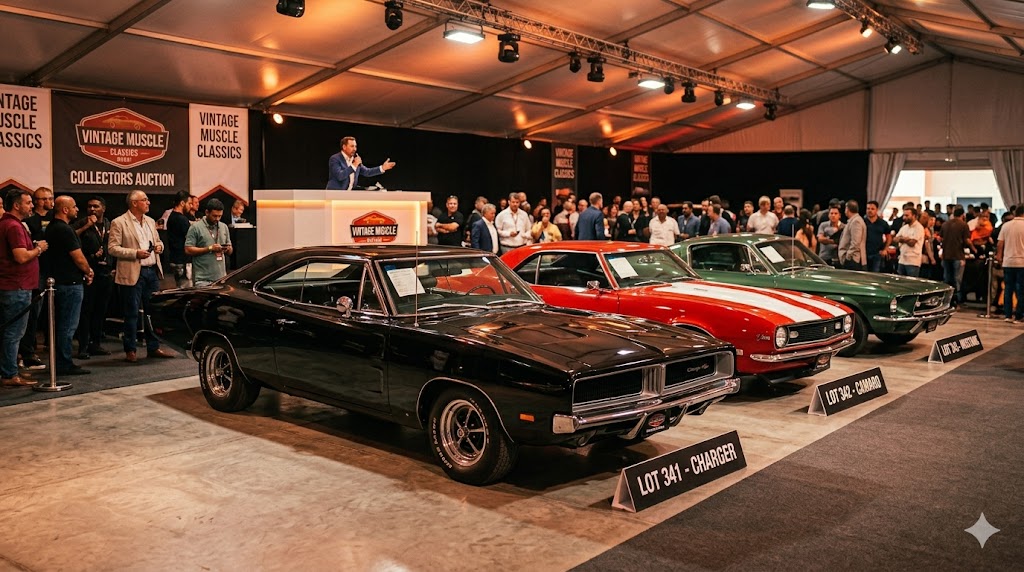
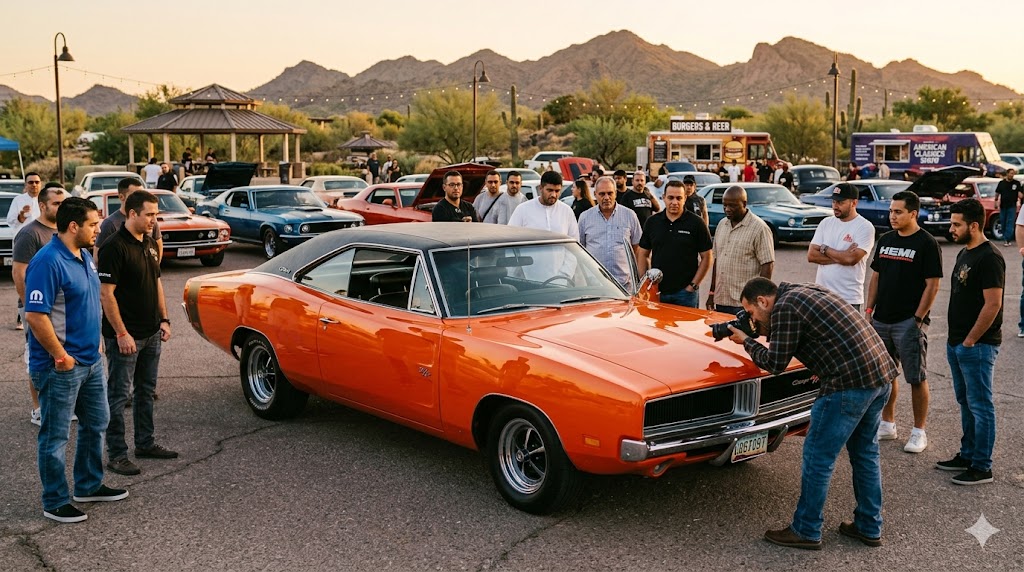
Walk any major collector car auction today and you'll notice something that would have seemed strange fifteen years ago: some of the fiercest bidding wars aren't over pristine Duesenbergs or vintage Ferraris, they're over Detroit iron built for teenagers to drag race on Woodward Avenue. Not every muscle car has shared in this run-up, though. The gains have been lopsided, concentrated in a handful of specific categories, while plenty of period-correct, perfectly nice muscle cars have barely kept pace with inflation. Understanding which slices of the muscle car world have actually pulled away from the pack tells you far more about this market than any single celebrated sale ever could.
The Pattern Behind the Winners
If you look at what has consistently outperformed the broader muscle car field, a clear pattern emerges long before you get to any individual nameplate. The cars that have seen the strongest gains almost always combine three things: documented rarity, a direct tie to factory performance credibility, and a story that's easy to tell in one sentence. First-generation Hemi-powered cars from Mopar are the textbook example. The 426 Hemi was never meant to be a volume engine, it was a homologation special built to legalize a race motor for the street, and dealers ordered shockingly few cars with that option box checked. Decades later, that scarcity didn't just hold up, it became the entire investment thesis. A Hemi Cuda or a Hemi Road Runner isn't valuable because it's fast by modern standards, it's valuable because so few were built and because the ones that survive are trivially easy to verify against factory build sheets.
Boss 302 and Boss 429 Mustangs occupy similar territory for Ford, and Chevrolet's rare COPO Camaros and L88 Corvette-adjacent Chevelles fill the same role for General Motors. In every case, the throughline isn't "muscle car," it's "low-production factory homologation special with a race pedigree and clean paperwork." That's the category that has appreciated the most, far more than muscle cars broadly.
Why Documented Rarity Beats Raw Performance
It's worth being blunt about something the market has quietly figured out: horsepower alone doesn't drive appreciation, provenance does. There were plenty of genuinely quick muscle cars built in bigger numbers, and most of them have appreciated modestly, tracking general classic car trends rather than outpacing them. What separates the true outperformers is documentation. A build sheet, a broadcast sheet, a fender tag that decodes to a specific rare option combination, matching numbers confirmed by a marque registry. Buyers at the top of this market aren't just buying a car, they're buying a verified historical artifact, and they pay a steep premium for that verification.
This has created a strange inversion. A visually identical car without paperwork might be worth a fraction of one with it, even though nothing about how the car drives has changed. That gap has only widened over the past decade as authentication services, marque registries, and specialist appraisers have gotten more sophisticated at cross-referencing production records. The cars that benefit most are the ones built in genuinely tiny numbers with options nobody expected buyers to order in 1969 or 1970, big-block engines paired with unusual color combinations, factory lightweight packages, or drag-package cars sold through specific regional dealers for racing homologation. These "unicorn" configurations, sometimes only a handful of units, have become the aristocracy of the muscle car world specifically because scarcity is provable rather than assumed.
The Buyers Have Changed, and That Changed the Market
None of this appreciation happens in a vacuum, and the demand side of the story matters as much as the supply side. For a long time, this market was driven almost entirely by baby boomers buying back the cars they lusted after as teenagers but couldn't afford at the time. That nostalgia-driven demand set the tone for decades, and it explains why muscle cars from roughly 1966 to 1972 dominate the conversation so completely. But that generation is aging out of active buying and, in some cases, beginning to sell rather than acquire, which has forced a generational handoff that the market watched closely.
What's kept prices firm, and pushed the rarest cars even higher, is that Gen X buyers have stepped in with more purchasing power than many expected, and they're not just buying nostalgia, they're buying status and scarcity. A Gen X collector in their fifties today was a kid when these cars were already becoming collectible, so their emotional attachment is filtered through car magazines and posters rather than direct ownership experience. That shifts demand toward the cars with the best stories and the most bulletproof documentation, rather than toward whatever their specific family happened to drive. It's a more curated, more research-driven form of collecting, and it rewards exactly the low-production, well-documented cars discussed above. Younger buyers, meanwhile, have shown real interest in the category too, but they tend to gravitate toward different touchstones entirely, later Trans Ams, Fox-body performance cars, and Japanese performance icons from their own youth, which has actually helped stabilize demand for classic muscle by broadening the collector base rather than concentrating it in one generation.
First-Year Models and Racing Lineage Carry Their Own Premium
Beyond raw rarity, two other factors have quietly driven outsized appreciation. The first is first-year significance. A 1964 or early 1965 Pontiac GTO, a first-year Trans Am, or an early Camaro SS carries a premium simply for being the car that started something, even when a later model year might be objectively better engineered or more powerful. Collectors have always placed a premium on origin points, and muscle cars are no exception. The second is direct racing lineage. Cars that can be tied to a specific historic race, a documented NHRA record, or a well-known factory racing program tend to command attention that generic examples never will, because the story does a huge amount of the value creation on its own.
The Risks Nobody Likes to Discuss
None of this means buying into the top tier of muscle car collecting is a sure thing, and it's worth being honest about the downsides. Survivorship bias distorts almost every conversation about this market. The stories you hear are about the Hemi Cuda that sold for a fortune, not the dozens of ordinary small-block muscle cars sitting unsold at regional auctions for years. That skews perception of the entire category toward stories of appreciation that are real but narrow. There's also real risk of buying at the top of a cycle that has already run for over a decade; markets that rise for that long eventually cool, and illiquid collector assets can sit unsold for a long time if sentiment shifts.
Fakes and clones remain a persistent problem too. Because rare options and homologation packages command such steep premiums, there's a strong financial incentive to build convincing tribute cars or to "improve" a base car's documentation. Buyers who skip rigorous third-party authentication expose themselves to serious downside. And restoration cost overruns can quietly erase paper gains; a numbers-matching frame-off restoration on a rare muscle car can run well into six figures, and it's easy to spend more restoring a car than the finished result will ever be worth unless the underlying car was rare enough to justify it going in.
Key Takeaways The strongest appreciation in the muscle car market has been concentrated in documented low-production, high-performance factory specials, not muscle cars broadly. Hemi-powered Mopars, Boss Mustangs, and rare COPO or homologation-special GM cars consistently sit at the top of the category because scarcity is provable through records. Paperwork and provenance often matter more to value than horsepower or condition alone. Demand has shifted from boomer nostalgia buying toward Gen X collectors with strong purchasing power and an appetite for well-documented, storied cars. First-year models and cars with direct racing lineage carry premiums independent of raw rarity. Buyers should weigh survivorship bias, clone risk, and restoration cost overruns before assuming any muscle car purchase is a guaranteed investment.