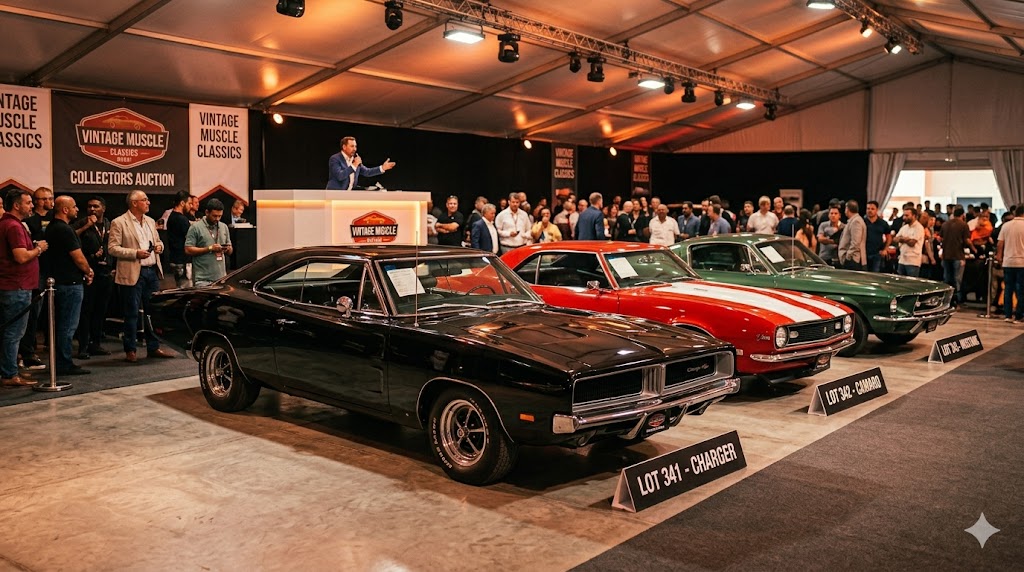
Walk the concours lawn at Amelia Island on a March morning and you'll notice something before you ever see a price paddle raised: the cars that draw the thickest crowds are rarely the loudest ones. They're the low, hand-formed European exotics with a coachbuilder's badge on the flank and a provenance file thick enough to need its own suitcase. That's the pattern RM Sotheby's has built its Amelia Island sale around for years, and it's the reason this particular auction has developed a reputation for results that run past their pre-sale estimates rather than settling neatly within them.
If you're tracking the 2025 sale, the headline worth understanding isn't a single number. It's a behavior. Certain categories of car at this specific auction, in this specific setting, have a documented habit of drawing bids well beyond what cataloguers initially projected. Knowing why that happens, and which cars are most likely to do it, tells you far more about the health of the collector market than any single hammer price could.
Why Amelia Island Skews European and Expensive
RM Sotheby's has run its Amelia Island sale alongside the Amelia Island Concours d'Elegance for more than two decades, and the pairing matters. Consignors who want their car evaluated by serious judges, photographed on a fairway in front of marque historians, and then sold within forty-eight hours to a buyer pool that just spent all weekend immersed in automotive history tend to bring their best material. That combination of concours-grade prestige and single-weekend urgency is part of why the sale has become a magnet for European coachbuilt cars in particular: pre-war Bugattis, Alfa Romeos with Touring or Zagato bodywork, and mid-century Ferraris and Maseratis that were built in small numbers by hand.
These are cars where the estimate itself is more art than science. A generic vintage Ferrari might have dozens of comparable sales to draw from, but a coachbuilt one-off, or a car with a documented competition history, has essentially no direct comparable. Specialists set a range based on the closest analogues they can find, then the room decides whether that range undersells the car's rarity. At Amelia Island, where the buyer pool skews toward serious collectors rather than casual bidders, that gap between conservative estimate and enthusiastic room frequently gets exposed.
The Mechanics of Beating an Estimate
It helps to understand what an auction estimate actually represents before assuming a result that clears it is remarkable. Estimates are typically built from a mix of recent comparable sales, the specific car's condition report, and how complete its ownership and restoration history is. Auction houses have some incentive to set estimates on the conservative side, since a sale that closes within or above its range reads as a stronger result than one that requires a post-sale price chop to move.
That said, several genuine market forces can push a result meaningfully past even a well-researched estimate. Rarity is the most obvious: if only a handful of examples of a given chassis survive, and one hasn't come to market in a decade, comparable sales data goes stale fast. Condition matters just as much. A car that has been sympathetically restored with matching numbers and original coachwork will consistently outperform a similar model that's been re-bodied or heavily modified over the decades. Provenance compounds both of those factors. A chassis with a documented racing history, a link to a notable original owner, or an unbroken paper trail back to the factory carries a premium that's difficult to model until the room actually starts bidding. And finally, there's simple competition. When two or three determined bidders decide they each need the same specific car, the final price becomes less about the spreadsheet and more about how badly each of them wants to win.
The Categories Worth Watching in 2025
Based on the kinds of consignments RM Sotheby's has historically slotted into its Amelia Island catalog, a few categories are worth watching closely this year. Pre-war European exotics, particularly cars from French and Italian coachbuilders of the 1930s, tend to draw serious institutional and museum-adjacent interest because so few roadworthy examples remain. Mid-century Ferraris, especially those with coachwork from Pininfarina or Scaglietti and any hint of period competition use, are perennial strong performers because Ferrari's collector base is deep and well-capitalized. Porsches, particularly early 911s and any car with factory racing ties, have also become a fixture of strong Florida results as that market has matured over the past decade. And European sports-racing cars with legitimate Le Mans, Mille Miglia, or Targa Florio history occupy their own tier entirely, since competition provenance is the one attribute that can't be manufactured after the fact.
None of that guarantees any specific lot will exceed its estimate this year. Markets shift, and even celebrated model lines can have a soft day if the wrong two bidders stay home. But the pattern across multiple Amelia Island sales has been consistent enough that watching these categories closely is a reasonable way to read the temperature of the broader classic car market.
What Buyers Should Weigh Before Chasing These Results
If a strong Amelia Island result tempts you to think about consigning or bidding at a future sale, it's worth going in with clear eyes about the costs layered on top of the hammer price. Buyer's premiums at major auction houses typically run in the low double digits as a percentage of the sale price, and that's before sales tax, shipping, and insurance are factored in. A car that "exceeded estimate" at the podium can still be a mediocre value once those costs are added, especially if the underlying condition report glossed over deferred maintenance.
Provenance verification is the other piece that deserves real scrutiny rather than trust in the catalog copy. Auction houses do meaningful diligence, but ownership histories on cars that are eighty or ninety years old can have gaps, and a claimed competition history is only as good as the documentation behind it. Buyers serious about a six- or seven-figure coachbuilt car should expect to commission independent authentication, ideally through the relevant marque registry or a recognized independent expert, before wiring funds. Restoration costs are the final wildcard: a car that looks concours-ready in auction photography can still need a six-figure mechanical sort-out if it hasn't been sympathetically maintained, and that risk is highest on cars that have spent long stretches in static collections rather than being driven and serviced regularly.
How to Check the Actual Results
The most useful thing you can do after this year's sale wraps is go straight to the source. RM Sotheby's publishes final hammer prices, including buyer's premium, for every lot on its own website shortly after the auction closes, and that data is far more reliable than secondhand recaps. Cross-referencing those figures against the pre-sale estimates published in the catalog will tell you exactly which categories ran hot this year and by how much, without relying on anyone's memory or spin. For collectors and enthusiasts trying to time a future purchase or consignment, that primary-source comparison is worth more than any preview.
Key Takeaways
- RM Sotheby's Amelia Island has a long-standing pattern of strong results for European coachbuilt classics, pre-war exotics, and provenance-rich Ferraris and Porsches, though final 2025 figures should be confirmed on RM Sotheby's own website.
- Estimates beating expectations usually comes down to some combination of rarity, documented condition, verified provenance, and multiple bidders competing for the same car.
- Categories historically worth watching include pre-war European coachbuilt cars, mid-century Ferraris with coachbuilder pedigree, early Porsches, and cars with genuine Le Mans or Mille Miglia history.
- Buyer's premiums, shipping, insurance, and restoration costs can significantly change the real value of a "strong" result, so factor them in before getting caught up in the room's energy.
- Provenance claims on high-value classics warrant independent verification through marque registries or recognized experts, not just catalog copy.
- Bottom line: treat any pre-sale hype around Amelia Island 2025 as a guide to which categories to watch, then verify the actual hammer prices directly on RM Sotheby's site before drawing conclusions about the market.