Sit in a 2025 Forester after a week in almost any other compact crossover and the first thing you notice isn't a feature at all — it's what's missing. There's no thick D-pillar blocking your shoulder check, no chopped rear window forcing you to trust a camera instead of your own eyes, no beltline creeping up to your armpits like the design team decided visibility was a problem to be solved rather than a feature to be preserved. The Forester still looks like a vehicle designed by people who assumed you'd want to see out of it. That, paired with genuine standard all-wheel drive and real ground clearance, is the whole argument for this car, and it's a stronger argument than it sounds.
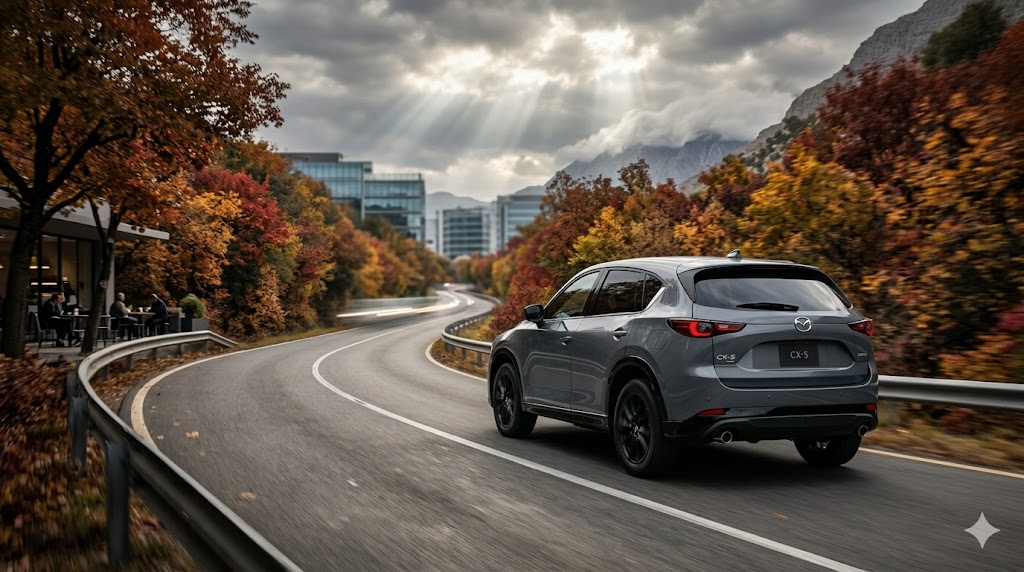
Start with the visibility claim, because it's the one buyers underrate until they live with it. Subaru has kept the Forester's greenhouse tall and its beltline low for generations, and the 2025 model doubles down rather than chasing the coupe-crossover trend. The pillars are thin, the rear glass is generous, and the hood slopes away from the driver instead of rising into a wall you have to guess the end of. In practice this means parking garages stop being a stressful guessing game, merging into blind spots on the highway requires less faith in a chime, and pulling out of an angled parking spot with cars on both sides is something you can do by looking rather than inching forward and praying. Rivals like the Honda CR-V, Toyota RAV4, and especially the Mazda CX-5 have all traded away sightlines for a lower, sportier roofline and a more dramatic beltline over the last two redesigns. They look sleeker in photos. They are measurably harder to see out of in a parking lot, and that's not a subjective style opinion — it's a function of pillar thickness and window area that you can feel the first time you back out of a spot.
Why Outward Visibility Is a Safety Feature, Not Just a Comfort One
It's easy to dismiss good sightlines as a nice-to-have, but the case is more concrete than that. Backup cameras and blind-spot monitoring are genuinely useful, but they're supplements to looking, not replacements for it, and every safety engineer will tell you redundancy beats reliance on a single system. A driver who can see a pedestrian stepping between parked cars through an actual window reacts differently than one waiting for a chime. The Forester's greenhouse also pays off in towing small trailers, backing up to a hitch, or navigating a tight trailhead parking area — situations where a swoopy roofline's blind spots turn a two-minute maneuver into a five-minute one. This is the kind of advantage that doesn't show up in a spec sheet or a magazine cover shot, which is probably why so many competitors have quietly sacrificed it in the name of a more aggressive silhouette.
The capability side of the equation is just as central to what the Forester is trying to be, and it's not a marketing veneer. Every trim comes with standard symmetrical all-wheel drive — no upcharge, no separate configuration to hunt for — and the Forester's ground clearance remains among the best in the compact-crossover class, rivaling vehicles that cost thousands more or require a separate off-road trim package to match. X-MODE, Subaru's terrain-response system, lets you dial in settings for deep snow, mud, or loose gravel, and it pairs with hill-descent control that actually earns its keep on a steep, rutted driveway or a snowy mountain road rather than existing as a checkbox feature nobody uses. This isn't a vehicle built to summit rock crawls, and Subaru doesn't pretend otherwise, but for the buyer who drives through genuine winters, unplowed rural roads, or the occasional gravel forest-service route to a trailhead, the Forester's blend of clearance, standard AWD, and low-range-adjacent terrain modes is more useful than the vast majority of crossovers that offer AWD as a box to check rather than a system built around it.
Where the Compromises Show Up
None of this comes free, and the most obvious cost is under the hood. The Forester's naturally aspirated flat-four is adequate rather than exciting, and the continuously variable transmission that pairs with it is tuned for efficiency and smoothness rather than responsiveness, which means it can drone under hard acceleration in a way that CVT-skeptical shoppers will notice immediately on a merge ramp or a mountain pass. Subaru has gotten better at simulating shift points to break up the monotony, but if you're cross-shopping something like a turbocharged CX-5 or a Tucson with a punchier powertrain, the Forester will feel like the slower, more relaxed sibling — because it is. This is a vehicle tuned for capability and composure over speed, and Subaru has made that trade-off deliberately, but it's a real trade-off, not a footnote.
Cargo space tells a similar story of prioritization. The Forester's boxy shape helps it use its interior volume efficiently, and rear-seat headroom benefits enormously from that tall greenhouse, but outright cargo capacity behind the rear seats trails a few class leaders that stretch their bodies longer and lower. Buyers who regularly haul bulky gear should measure their specific needs rather than assume the Forester's boxy look automatically means class-leading cargo volume — the shape helps with usability and loading ease more than outright maximum capacity. The interior materials are another area where the Forester plays it straightforward rather than flashy; the cabin is well-built and logically laid out, but it doesn't reach for the upscale ambiance that some rivals now offer at similar price points, and buyers cross-shopping for a more premium-feeling cabin may walk away underwhelmed.
Who the Forester Is Actually For
The Forester isn't trying to be the sportiest, quickest, or most stylish compact crossover on the lot, and that's precisely the point. It's built for buyers who value being able to see their surroundings, drive confidently through weather that stops other crossovers, and trust that all-wheel drive is standard equipment rather than an expensive option buried three trims up. If your driving life includes real snow, gravel driveways, or you've simply grown tired of straining to see out of increasingly stylized crossovers, the Forester addresses both problems directly and without pretense. If your priorities skew toward punchy acceleration, a hushed CVT-free driving experience, or maximum cargo volume, you'll find better matches elsewhere, and that's a fair trade to walk into with open eyes rather than discover after the fact.
Key Takeaways
- The 2025 Forester's tall greenhouse and thin pillars give it genuinely better outward visibility than most compact crossovers, which pays off in parking, blind-spot awareness, and everyday driving confidence.
- Standard all-wheel drive, strong ground clearance, and X-MODE terrain settings make the Forester's all-weather and light off-pavement capability real rather than cosmetic.
- The CVT-and-flat-four powertrain is tuned for smoothness and efficiency over excitement, and it will drone under hard acceleration compared to more powerful rivals.
- Cargo capacity and interior polish are solid but not class-leading, so buyers prioritizing maximum hauling space or an upscale cabin should compare closely before committing.
- The Forester rewards buyers who value sightlines and dependable capability over styling drama and outright power.
- Bottom line: if you want a crossover you can actually see out of and trust in bad weather without hunting for the right trim, the Forester remains one of the smartest choices in its class.