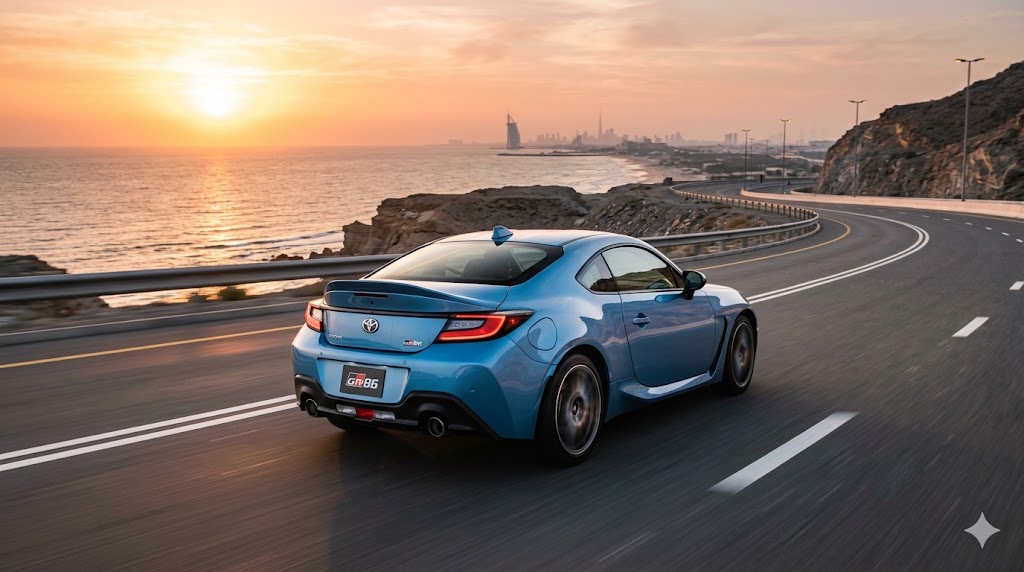
Twin cars built on shared platforms usually get treated as an afterthought — one gets the marketing budget and the enthusiast buzz while the other quietly exists as the "same thing, different badge" option. The BRZ deserves better than that framing, because the partnership between Subaru and Toyota that produced this car and the GR86 is precisely what makes both of them possible at this price point, and the small differences Subaru's engineers introduced give the BRZ its own distinct case for existing rather than just riding along as a rebadge.
The Boxer Engine Is the Real Point of Differentiation
While the two cars share a platform, the BRZ's flat-four "boxer" engine is a genuinely Subaru piece of engineering, built with the horizontally opposed cylinder layout the brand has used across its lineup for decades. That layout keeps the engine's center of mass lower than a conventional inline or V-configuration engine would allow, which lowers the car's overall center of gravity and contributes directly to the flat, poised cornering behavior that both twins are known for. This isn't a marketing footnote — the boxer layout is a legitimate engineering advantage for a car whose entire mission is cornering balance, and Subaru's decades of boxer engine development show in how naturally the car settles into a corner.
The exhaust note this engine produces is also distinct from a conventional four-cylinder, with a subtle burble at idle that longtime Subaru owners will recognize immediately from the brand's WRX and other boxer-powered models. It's not a dramatic V8 rumble by any means, but it gives the BRZ a mechanical character that's identifiably its own rather than a generic four-cylinder drone, and that small sensory detail matters more than it might sound like on paper for a car built around driving enjoyment.
Suspension Tuning: Where the Subaru Diverges From Its Twin
Subaru's engineers tuned the BRZ's suspension with a slightly different philosophy than Toyota applied to the GR86, aiming for marginally more compliance and a touch less outright aggression in the standard car's default setup. The practical result is a ride that's a bit more forgiving over rough pavement without sacrificing the fundamental agility both cars share from their identical chassis architecture and near-identical weight distribution. For buyers who intend to use this as a daily driver more than an occasional track-day toy, that slightly softer edge can make the BRZ the more livable choice without giving up much in the way of cornering competence.
This doesn't mean the BRZ is the "soft" version of the pairing — both cars remain firmly focused on driver engagement, and the differences here are measured in degrees, not categories. But if you've driven both back to back, as serious shoppers should before committing to either, the BRZ's slightly more forgiving character over broken pavement is noticeable, and it's a meaningful data point for anyone whose daily commute includes rough roads rather than smooth canyon pavement.
Styling and Interior: Distinct Enough to Matter
Subaru gave the BRZ its own sheet metal, and the result is a more aggressive, sharper-edged design than the GR86's softer curves, particularly around the front fascia and the hood, which features a subtle power bulge that echoes styling cues from Subaru's performance lineage. Inside, the BRZ's cabin uses different trim materials and a different infotainment interface than the Toyota, and while neither car is going to be mistaken for a luxury product, the BRZ's interior finishes lean slightly more toward a sportier, driver-focused aesthetic that fits the brand's identity.
Neither car has a meaningful advantage in outright interior quality — both share the same fundamental limitations of a compact, affordable sports car, including tight rear seats that are functionally decorative and a cabin that prioritizes the driving position over passenger comfort. But the styling differences are real enough that buyer preference here isn't just badge snobbery; some people will genuinely prefer the BRZ's sharper design language, and others will prefer the GR86's approach, and that's a legitimate factor in the decision.
Manual Transmission and the Shared Driving Experience
Like its twin, the BRZ offers a manual transmission that represents the purest way to experience this platform, with the same short throws, well-weighted clutch, and mechanical precision that make rowing your own gears through a set of corners genuinely satisfying. This is not a case where one twin got a better manual and the other got shortchanged — the transmission is essentially identical between the two cars, which underscores just how much of what makes this platform special comes from shared engineering rather than brand-specific tuning.
The naturally aspirated engine's power delivery remains linear and predictable in the BRZ just as it does in the GR86, which continues to be the right choice for a lightweight chassis built around cornering feel rather than straight-line urgency. Neither car has particularly strong horsepower figures relative to turbocharged rivals in this price range, and that's a deliberate trade-off both brands made in favor of predictable, progressive power delivery that doesn't upset the chassis balance mid-corner.
Which Twin Should You Actually Buy?
This is ultimately the question every shopper considering either car has to answer, and the honest response is that it depends more on dealer network, service relationships, and styling preference than on any dramatic difference in driving character. If you already own other Subaru vehicles and value that brand relationship, or if you simply prefer the BRZ's sharper styling and slightly more compliant ride, there's no compelling reason to choose the GR86 instead. Conversely, if Toyota's dealer network is more convenient for you or you prefer the GR86's specific styling, that's an equally valid reason to go the other direction.
What matters more than the badge is understanding that both cars share the same fundamental strengths and the same fundamental limitations. Both are light, rear-drive, manual-friendly sports cars that prioritize handling feel over horsepower, and both ask you to accept real compromises in rear-seat space, cargo capacity, and outright straight-line performance in exchange for that handling purity. Cross-shopping them against each other makes sense; cross-shopping either against a more powerful, more practical alternative only makes sense if you're willing to accept a different set of trade-offs entirely.
Where the BRZ Still Asks for Patience
The same practicality limitations that define the GR86 apply equally here. Rear seats are unusable for adults, cargo space is modest, and the low ride height means care is needed around steep driveways and parking curbs. Highway comfort, while improved by the slightly softer suspension tune, is still firmer than a mainstream commuter car, and buyers expecting Outback-level comfort from the Subaru badge will be disappointed. These aren't flaws unique to the BRZ so much as inherent characteristics of the platform both cars share, but they're worth restating clearly for anyone drawn in primarily by the Subaru name rather than by genuine cross-shopping research.
Key Takeaways
- The BRZ's boxer engine gives it a lower center of gravity and a distinct exhaust character compared to a conventional four-cylinder rival.
- Subaru's suspension tuning is marginally more forgiving than the GR86's, which can make the BRZ the better daily-driver choice for rough roads.
- Styling and interior trim differences are real and meaningful enough to justify a genuine preference between the two twins.
- The manual transmission experience is essentially identical between both cars, reflecting shared platform engineering at its best.
- Practicality limitations — tight rear seats, modest cargo space, low ground clearance — apply to the BRZ just as much as to its Toyota twin.
- Bottom line: choose the BRZ over the GR86 if you prefer its sharper styling, slightly softer ride, or Subaru's dealer network, not because it offers a dramatically different driving experience.