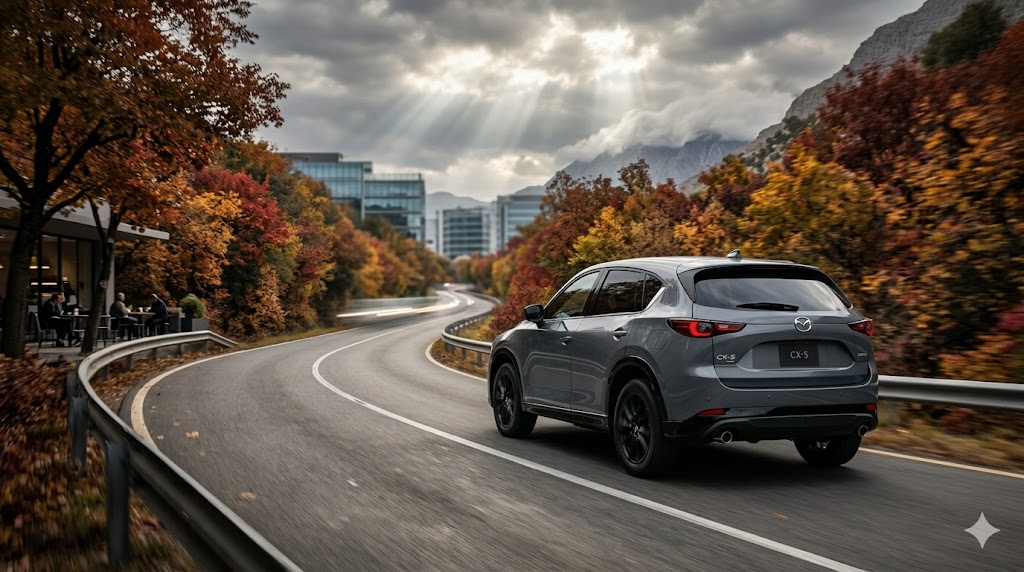
Sit in a 2025 Mazda CX-5 with your eyes closed and touch the dashboard, the door panels, the seats. Nothing about the texture, the stitching, or the way the switchgear moves under your fingers tells you that you're in a mainstream compact crossover rather than something wearing a German or Japanese luxury badge. Open your eyes and the illusion holds a little longer than it has any right to. This is the CX-5's whole argument, and it's a claim Mazda has been building toward for a decade: that you shouldn't have to spend luxury money to sit in a cabin that feels considered rather than merely assembled. For the most part, the 2025 CX-5 makes good on that promise. But "for the most part" is doing real work in that sentence, and the places where the claim breaks down are exactly where you'd expect a mainstream price tag to leave fingerprints.
Start with the cabin, because it's the CX-5's clearest evidence. Mazda uses genuinely soft-touch materials across the dash and upper door panels, and on higher trims, real or convincingly finished wood and metal accents replace the piano-black plastic that plagues so much of this segment. The switchgear — physical dials for climate, a rotary infotainment controller mounted where your hand naturally falls near the shifter — has the kind of tactile weight and precision usually reserved for cars costing considerably more. Panel gaps are tight, the seats are well-bolstered without feeling stiff, and even the ambient design language, restrained rather than button-covered, contributes to a sense of calm you don't typically get in a compact crossover. Climb out of a CR-V or Tucson and into a CX-5 and the difference registers within about ten seconds.
Driving Dynamics That Actually Back Up the Feel
The premium positioning isn't just skin-deep, either — it extends to how the CX-5 drives, which is where Mazda's engineering philosophy pays off most convincingly. The steering is weighted with real precision and builds effort naturally as you turn in, rather than feeling artificially heavy or numb the way many electric power steering setups do. Body control through corners is tighter than the segment average, with less of the float and lean you feel in a RAV4 or Escape pushed at the same pace. Mazda has always prioritized driver engagement over outright comfort in this class, and the CX-5 rewards a spirited back road the way few of its rivals do — you can place it precisely, trust the front end, and generally feel like the car is a willing partner rather than a numb appliance transporting you between points. This is the strongest, most defensible part of the CX-5's premium claim, because it's not about materials or badges — it's about a genuinely different, more engaging character behind the wheel.
Where the Mainstream Price Shows Through
None of this comes free, and Mazda has made specific, identifiable trade-offs to hit a price point that undercuts real entry-luxury crossovers like the Audi Q3 or BMW X1. The most obvious compromise is rear seat space. The CX-5's back seat is adequate for average-height adults on shorter trips, but it's tighter on both legroom and headroom than the CR-V, RAV4, or even the Tucson, and taller passengers will notice it on anything beyond a quick errand run. Mazda prioritized the driving experience and front-seat ambiance over outright cabin volume, and that's a defensible choice for a design-and-driving-focused vehicle, but it's a real limitation for families who need to regularly haul adults or growing teenagers in the back row.
Infotainment technology is the second compromise, and it's the one longtime Mazda critics keep returning to. The current system relies heavily on a rotary controller rather than a touchscreen for most functions while driving, which some owners genuinely prefer for reducing distraction, but which frustrates anyone used to tapping and swiping the way you would on a phone. The screen itself is smaller than what rivals now offer, and the graphics, while clean, don't feel as current as the CR-V's or the Tucson's larger, sharper displays. It's a philosophical choice as much as a cost one, but the net effect is a tech experience that lags what the price and cabin quality elsewhere would lead you to expect.
Powertrain refinement is the third and perhaps most telling compromise. The CX-5's available turbocharged engine delivers the kind of eager, punchy acceleration that reinforces the car's sporty pretensions, but it comes with noticeable turbo lag off the line and under quick throttle applications from a stop, a trait that a genuine entry-luxury crossover with more sophisticated engine tuning and forced-induction management tends to mask better. Fuel efficiency with the turbo engine also isn't a standout in the segment, and the CX-5 has conspicuously never offered a hybrid variant while nearly every major competitor — RAV4, CR-V, Escape, Tucson — now does. For a shopper cross-shopping efficiency as heavily as cabin ambiance, that absence is a real strike, not a minor footnote.
How It Actually Stacks Up Against True Entry-Luxury Crossovers
The honest comparison here isn't just against other mainstream crossovers — it's against what you'd get spending meaningfully more on a genuine entry-luxury badge. A true luxury compact crossover will out-refine the CX-5 in cabin sound isolation, offer more sophisticated driver assistance suites, and generally deliver a more finished powertrain experience without the turbo lag. The CX-5 doesn't erase that gap; it narrows it dramatically while asking for a mainstream price, which is a genuinely different and more useful proposition for most shoppers than pretending the gap doesn't exist. You're not getting a luxury car for a mainstream price. You're getting the parts of the luxury experience that Mazda judged most people actually care about — how the cabin feels to sit in every day, and how the car feels to drive — while accepting real cutbacks in space, tech, and outright refinement.
That's a smart bet on Mazda's part, and it's why the CX-5 has built such a devoted following among buyers who cross-shopped it almost by accident and left surprised. It won't be the right call for a family that needs maximum rear-seat room or the latest touchscreen tech, and the missing hybrid option is a legitimate gap that will cost Mazda efficiency-focused shoppers outright. But for someone who wants to feel a little bit spoiled every time they get in the car, without stretching into genuine luxury payments, the CX-5 delivers on a specific promise more convincingly than almost anything else in the class.
Key Takeaways The CX-5's interior materials and tactile switchgear genuinely rival entry-luxury crossovers, not just other mainstream compacts. Steering precision and body control give the CX-5 a driving character that's more engaging than the segment norm. Rear seat space is tighter than key rivals, a real trade-off for families needing to regularly carry adults in back. The infotainment system's rotary-controller focus and smaller screen lag behind newer touchscreen-forward competitors. Turbo lag and the complete absence of a hybrid option are notable refinement and efficiency shortfalls versus rivals like the RAV4 and CR-V. Bottom line: choose the CX-5 if cabin feel and driving engagement matter most to you, but look elsewhere if rear-seat space or hybrid efficiency are priorities.