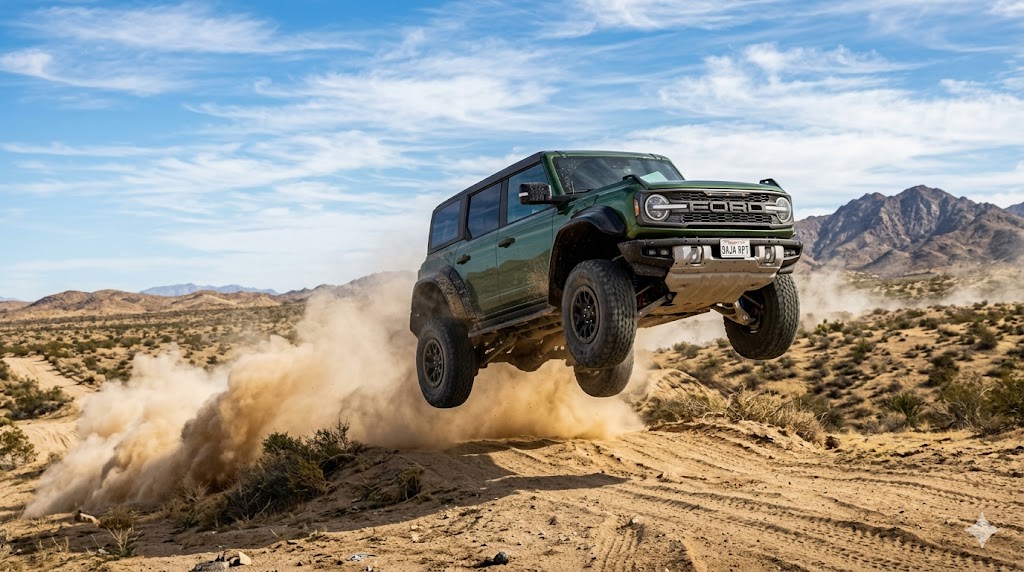
Most SUVs marketed as off-road capable need a trip to an aftermarket shop before they can actually handle serious terrain — better tires, a lift, skid plates, maybe a locker if the factory didn't include one. The Bronco Badlands exists to short-circuit that entire process. Ford built this trim specifically for buyers who want to drive off the dealer lot and onto a genuinely difficult trail the same weekend, and the spec sheet backs up that ambition in ways that go beyond typical trim-level marketing language.
The Badlands sits in an interesting spot in the Bronco lineup: below the extreme Raptor in outright capability and price, but above the Outer Banks and Big Bend trims in the hardware that actually matters off-road. It's the trim Ford clearly intends as the volume off-road choice, the one aimed squarely at buyers cross-shopping the Jeep Wrangler Rubicon rather than a Wrangler Sahara.
The Hardware That Justifies the Name
Badlands trim brings a front and rear locking differential setup, a disconnecting front sway bar similar in concept and purpose to the Wrangler Rubicon's, and specifically tuned Bilstein position-sensitive dampers designed to handle both slow rock crawling and faster, rougher trail sections without needing separate suspension setups for each. The disconnecting sway bar is worth dwelling on, because it's the piece of engineering that most directly enables the kind of wheel articulation that turns a merely capable off-roader into a genuinely excellent one — letting the front axle twist independently over uneven terrain rather than fighting against a bar that wants to keep both wheels level.
Ground clearance, approach angle, and breakover angle on the Badlands are all genuinely competitive with the segment's benchmarks, and the available 35-inch tire package pushes those numbers further while adding the kind of visual presence that Bronco buyers clearly want. Ford's terrain management system, dubbed GOAT modes for Goes Over Any Terrain, adjusts throttle response, traction control, and drivetrain behavior for a wide range of specific conditions, and unlike some competitors' equivalent systems, the Bronco's modes feel genuinely tuned to distinct real-world scenarios rather than existing mostly as a menu novelty.
Where the Two-Door and Four-Door Differ
Buyers choosing a Badlands face the same fundamental decision Wrangler buyers face: two-door or four-door. The two-door's shorter wheelbase brings a tighter turning circle and marginally better breakover angle, favoring technical low-speed work over tight, rocky sections. The four-door offers meaningfully more interior room and a more usable back seat, at some cost to that ultimate maneuverability. Neither choice is wrong, and the difference is smaller in practice than the spec sheet numbers might suggest, since both configurations share the same core off-road hardware on Badlands trim.
The removable roof and doors, a signature Bronco feature matching the Wrangler's open-air appeal, work well in practice, though the process of removing and storing the roof panels and doors is genuinely a two-person job for some configurations and requires care to avoid damaging trim pieces. Buyers who plan to remove and reinstall regularly should test the process themselves before assuming it's as effortless as it looks in marketing materials.
On-Road Manners Are Better Than Expected
One of the pleasant surprises with the Bronco generally, and the Badlands specifically, is how composed it feels on paved roads despite the off-road-focused suspension tuning. The independent front suspension, a genuine advantage over the Wrangler's solid front axle, delivers noticeably better on-road steering precision and ride quality on rough pavement, even if it theoretically sacrifices some ultimate articulation in extreme rock-crawling scenarios compared to a solid-axle setup. In practice, this trade-off rarely matters outside of the most extreme rock crawling, and most Badlands buyers will appreciate the more car-like on-road behavior far more often than they'll miss the theoretical off-road ceiling of a solid front axle.
Wind and road noise remain more present than in a typical crossover, a consequence of the boxy shape and removable roof architecture, but this is true of every vehicle in this class and shouldn't be treated as a Bronco-specific weakness.
Interior Usability and Everyday Livability
Ford equipped the Bronco with a straightforward, physical-switch-heavy interior that off-road enthusiasts tend to appreciate, since fumbling through touchscreen menus while navigating a technical trail section is a genuine safety concern that button-and-switch layouts avoid. The available portable Bluetooth speaker, removable and rechargeable, is a genuinely clever touch that fits the vehicle's outdoor-lifestyle positioning without feeling gimmicky. Cargo space, particularly in the four-door, is competitive with segment rivals, and the flat-folding rear seats add practicality for gear-hauling trips.
Materials throughout are durable rather than plush, with washable, rugged surfaces in Badlands trim that suit a vehicle expected to come home muddy on a regular basis. Buyers wanting a softer, more luxurious cabin experience should look toward higher trims or a different vehicle entirely, since the Badlands' interior philosophy prioritizes function over indulgence throughout.
The Verdict on Factory-Ready Capability
The Badlands succeeds at its central promise. This is a trim that doesn't require an aftermarket shopping list to become genuinely trail-capable, and the specific engineering choices — the disconnecting sway bar, the position-sensitive dampers, the locking differentials — reflect real off-road engineering priorities rather than trim-level badge engineering. It gives up a small amount of ultimate rock-crawling ceiling to the solid-axle Wrangler Rubicon in the most extreme scenarios, but gains meaningfully better on-road composure in exchange, a trade most buyers will find favorable given how much time any vehicle spends on pavement relative to a technical trail.
Key Takeaways
- Badlands trim brings locking differentials, a disconnecting sway bar, and position-sensitive dampers as factory equipment, not aftermarket additions.
- The independent front suspension trades a small amount of extreme rock-crawling articulation for meaningfully better on-road ride and steering precision than a solid-axle competitor.
- Two-door and four-door Broncos share the same core Badlands hardware, with the two-door favoring tight technical maneuvering and the four-door favoring interior room.
- The physical switchgear and portable speaker reflect genuine outdoor-use thinking rather than superficial styling.
- Bottom line: the Badlands is the right Bronco trim for buyers who want real trail capability without aftermarket work, and who value on-road composure alongside off-road ability.