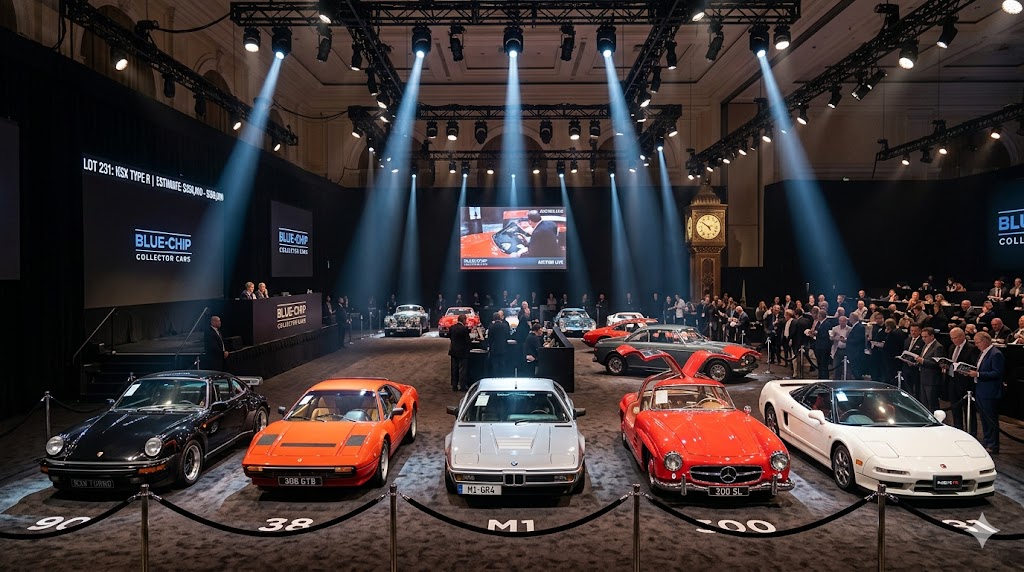
Park a 1993 Honda NSX Type R next to a Ferrari from the same era and you'll notice something odd: the Honda looks almost polite. No theatrical scoops, no aggressive vents demanding attention, just a low, clean aluminum body that seems more interested in cutting air than cutting a figure. That restraint was the point. Honda wasn't trying to out-flash Ferrari. It was trying to out-engineer it, and in doing so, it forced the entire supercar establishment to confront an uncomfortable question: what if the fastest way to build an exotic car wasn't through romance and drama, but through obsessive precision?
The Claim: Beating Ferrari at Its Own Game
The idea that a Honda could humble Ferrari sounds like hyperbole until you understand what Honda was actually attempting with the NSX program. This wasn't a company dabbling in prestige for marketing purposes. Honda had spent years dominating Formula 1 as an engine supplier, and it brought that same mentality directly into the NSX's development. The car was engineered with an all-aluminum monocoque chassis at a time when aluminum construction of that scale was still rare and expensive, a decision that prioritized structural rigidity and weight distribution over conventional steel-bodied practicality. The goal wasn't simply to build a fast car. It was to build a car that behaved with the same predictability and feedback that Honda's engineers were used to extracting from race cars, then package that experience so a regular driver could access it on a public road.
The Type R variant, introduced in Japan in the early 1990s, sharpened that mission further. Where the standard NSX was already unusually refined for a mid-engine exotic, the Type R stripped away sound deadening, air conditioning, and other comfort features to shed weight and heighten the connection between driver and machine. Suspension tuning was firmed up, the steering was quickened, and the car was fitted with lighter wheels, all in service of a singular idea: this was a road car built with a racetrack's priorities. That approach directly mirrored what Italian manufacturers claimed to be doing with their own limited-run specials, except Honda executed it with a manufacturing discipline that Ferrari and its contemporaries, by most accounts of the period, struggled to match consistently.
Senna's Fingerprints on the Chassis
Much has been written about Ayrton Senna's involvement in the NSX's development, and while exact details of his contributions are often retold with varying levels of embellishment, the broader story is well established and worth taking seriously. Senna, then at the height of his Formula 1 career and closely tied to Honda through its engine partnership, tested early NSX prototypes and reportedly gave feedback that pushed Honda's engineers to stiffen the chassis further. The result was a car that felt tauter and more communicative than its horsepower figures alone would suggest. This qualitative input mattered enormously to the car's identity. It wasn't a marketing story invented after the fact; it reflected a genuine cross-pollination between Honda's racing division and its road car engineers, something few manufacturers of any nationality could claim with a straight face at the time.
That connection to motorsport wasn't incidental branding. It shaped how the NSX approached the fundamental challenge every mid-engine car faces: making a car that is thrilling near its limits without being terrifying for a less experienced driver to approach those limits. Ferraris of the period had a reputation, fair or not, for demanding respect and punishing mistakes. The NSX, especially in Type R form, was tuned to communicate clearly with its driver, giving confidence rather than intimidation. That's a very different philosophy from build a car that feels special because it's difficult, and it's one that came directly from Honda's racing culture rather than from any attempt to copy European supercar conventions.
Stripped Down, Not Dressed Up
The Type R's approach to going fast is worth dwelling on because it reveals something about Honda's engineering values that contrasts sharply with how Italian exotics of the era typically chased performance. Rather than adding power or exotic materials for their own sake, Honda's engineers focused on subtraction. Removing weight, tightening tolerances, and refining the chassis dynamics did more for the car's character than any spec-sheet flex could have. This is a lesson borrowed directly from racing, where every excess kilogram is treated as a problem to solve rather than a feature to justify.
Contemporary Italian exotics of the same period were frequently praised for outright drama and emotional intensity, qualities that remain genuinely compelling and part of why those cars are cherished today. But that same era's Italian supercars also carried a reputation for temperamental behavior, finicky electronics, and maintenance demands that could turn ownership into a part-time job. Quality control inconsistencies were a common thread in road tests and owner accounts from the period, and while individual cars varied, the general perception among enthusiasts and journalists at the time was that exotic ownership meant accepting compromise as the price of passion. The NSX Type R offered a pointed counterargument: perhaps you didn't have to accept that compromise at all.
Reliability as the Real Disruption
This is where the NSX's true disruption lived, and it's easy to underestimate today because reliable exotics no longer feel radical. In the early 1990s, the notion that a car could deliver genuine supercar dynamics and also start every morning, hold its tune, and require nothing more exotic than routine maintenance was nearly unheard of. Honda applied the same manufacturing rigor it used for its mainstream Civics and Accords to a mid-engine exotic, and the result was a car that owners could actually use. Road testers of the era repeatedly commented on this quality, often expressing genuine surprise that a car this capable could also be this dependable.
That reliability wasn't a side benefit bolted onto an otherwise conventional exotic recipe. It was the entire argument. Honda seemed to be asking why a supercar had to be fragile, temperamental, or precious in order to be taken seriously, and the NSX Type R answered that question emphatically by simply not breaking down. For buyers who wanted to actually drive their exotic rather than trailer it to shows, this changed the calculation entirely.
Living With the Legacy Today
None of this means the NSX Type R was without trade-offs, and it's worth being honest about them. The stripped interior and firmer suspension made it a less comfortable daily companion than the standard NSX, let alone a touring Ferrari built for effortless long-distance cruising. Some enthusiasts at the time felt the NSX's competence came at the cost of the raw emotional theater that made Italian exotics so intoxicating in the first place. A car that never misbehaves can, to some tastes, feel like it's missing a bit of soul. And because the Type R was originally sold only in Japan, examples that have made their way to other markets since have often commanded significant premiums and required careful import consideration, which is a real practical hurdle for anyone chasing one today.
Even so, the NSX Type R's influence on how the industry thinks about exotic cars is hard to overstate. It demonstrated that precision engineering, disciplined weight management, and manufacturing quality could produce something every bit as thrilling as cars built around a more romantic, less disciplined philosophy. If you're researching one today, treat the reliability reputation as a real asset but still budget for specialist maintenance and verify service history carefully, since these cars are now decades old regardless of how well they were built.
Key Takeaways
- The NSX Type R's disruption wasn't raw power, it was proving an exotic could be both track-focused and dependable enough to drive daily.
- Honda's Formula 1 background directly shaped the NSX's aluminum chassis and suspension tuning, with Ayrton Senna's qualitative feedback reportedly sharpening its dynamics.
- The Type R's stripped-out, weight-conscious approach mirrored racing philosophy rather than the power-and-drama formula common among Italian exotics of its era.
- Contemporary Italian supercars were often celebrated for emotional intensity but also carried a reputation for reliability and maintenance headaches that the NSX avoided.
- The tradeoff was a firmer, less indulgent driving experience and, since it was Japan-only, real complexity for buyers seeking one outside that market today.
- Bottom line: the NSX Type R earned its reputation not by beating Ferrari on paper, but by proving a supercar could be engineered rather than merely styled into greatness.