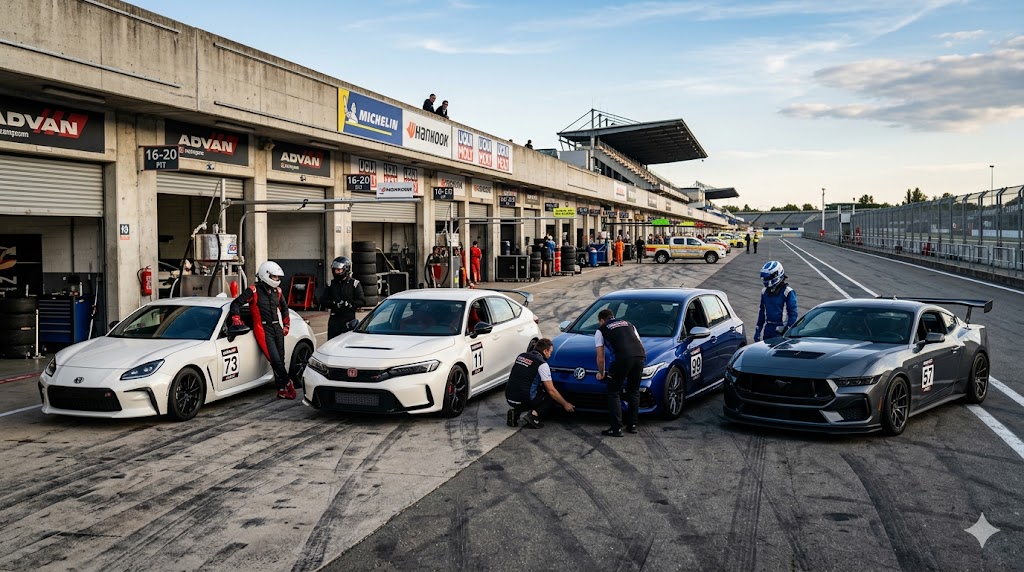
The moment your car crosses pit-out and onto a circuit, your personal auto policy almost certainly stops covering it. That's not a scare tactic — it's a standard exclusion written into the vast majority of personal auto policies, and it's the single fact that catches more track-day newcomers off guard than any other piece of paperwork they'll encounter. Once you understand that exclusion actually exists, the next question is obvious: who covers you instead, and how do you tell a good option from a bad one? That's a harder question to answer honestly than most "best of" lists suggest, because the honest answer is that the right choice depends heavily on your car's value, how often you track it, and what kind of event you're attending — not on a fixed ranking of providers.
This article won't hand you a ranked list of specific companies with claimed prices or coverage terms, and that's a deliberate choice rather than an omission. Insurance products change frequently, availability varies by state and by insurer's underwriting appetite in a given year, and any specific pricing or coverage claim you read on a content site should be verified directly with the provider before you rely on it. What this article will do is walk you through the categories of protection that exist, the tradeoffs between them, and the questions you should be asking before your next event.
Why Your Personal Auto Policy Won't Follow You Onto the Track
Most personal auto insurance policies contain a racing or speed-contest exclusion, and many insurers interpret "track day" or "high-performance driving event" (HPDE) broadly enough to fall under that exclusion even when there's no wheel-to-wheel racing involved. Some insurers draw a distinction between a non-competitive HPDE with an instructor and passing rules versus a timed event or a wheel-to-wheel race, but you should never assume your policy makes that distinction favorably without asking. The practical result is that if you crash during a track day, there's a real risk your personal insurer denies the claim entirely, leaving you responsible for both your own car's damage and, in a worst case, damage to track property or another participant's car.
This is the gap that specialty track-day insurance products exist to fill, and it's also why event organizers build their own liability structures into the entry process regardless of what personal coverage you carry.
The Event Waiver Is Not Insurance, and It's Not Meant to Be
Nearly every organized track day requires you to sign a liability waiver before you're allowed on course. It's worth being clear-eyed about what that waiver actually does: it primarily protects the organizer and the facility from liability claims arising from your participation, and in many cases it also requires you to release other participants from liability for ordinary racing incidents. A waiver is not a substitute for insurance covering damage to your own car, and it generally does nothing to protect you financially if you damage someone else's car or the facility's infrastructure — tire walls, guardrails, timing equipment, and so on can all be expensive to repair, and organizers do pursue reimbursement for that damage from at-fault drivers. Some events layer on a supplemental liability policy purchased by the organizer that provides a baseline of coverage for facility and third-party damage, but the details of what that policy covers, and whether it extends to your own car, vary by organizer and should be confirmed on the event's own registration materials rather than assumed.
Specialty Track-Day and HPDE Insurance Brokers
Over the past decade or so, a category of specialty insurance broker has grown specifically around track-day and HPDE participants, typically offering per-event or annual policies that cover physical damage to your car while on track, and sometimes extending to towing, spotting damage, or off-track excursions. These products are generally underwritten differently from personal auto policies because the risk profile of a supervised, single-direction track session with run groups is different from public road risk, and specialty underwriters who understand that difference are often more willing to offer meaningful coverage than a general personal auto insurer would be.
The tradeoffs are real, though. Specialty track policies are typically priced based on your car's value, the specific track, the type of event, and your experience level, and premiums for high-value cars or full race-prep vehicles can be a meaningful expense relative to the cost of the event itself. Coverage limits, deductibles, and exclusions — for example, whether wheel-to-wheel racing is covered versus only non-competitive lapping — vary significantly between brokers, and some products explicitly exclude certain categories of car (heavily modified vehicles, for instance) or cap payouts well below a car's actual replacement value. None of that makes these products bad; it means you have to read the policy document, not the marketing page, before you assume you're covered for the specific kind of driving you plan to do.
Club Racing and Sanctioning Body Coverage
If you move from open-lapping HPDE events into actual wheel-to-wheel club racing, the insurance landscape shifts again. Many racing clubs and sanctioning bodies either require proof of specific competition insurance as a condition of a competition license, or they offer access to group policies negotiated on behalf of members. These programs are usually built specifically around the risk profile of wheel-to-wheel racing, which general HPDE-focused products often exclude outright. If you're planning to race rather than lap, checking what your sanctioning body requires and what group programs it may offer members is a more productive starting point than searching broadly for "track insurance," since a policy built for non-competitive lapping may simply not apply once you're racing door to door.
Questions to Ask Before You Buy Anything
Rather than chasing a ranked list, you'll get further asking a handful of pointed questions of any provider or organizer: does this policy cover damage to my own car, damage to others' cars, or both? Does it distinguish between non-competitive lapping and wheel-to-wheel racing, and which does my event count as? What's excluded — mechanical failure, off-track excursions, contact with another car, damage caused by a passenger or instructor driving? What's the deductible relative to my car's value, and is there a payout cap that matters given what my car is actually worth? And critically, does my event's waiver interact with this policy in any way I need to understand, such as a requirement to also carry the organizer's supplemental coverage? A broker or organizer who can't answer these clearly is telling you something important on its own.
A Brief Note on the Limits of This Guide
This article is general information intended to help you understand the categories of track-day protection that exist and the questions worth asking. It is not financial, legal, or insurance advice, and it should not be used as the basis for a coverage decision. Insurance availability, terms, and pricing change, vary by state, and depend on details specific to your car and driving history, so you should confirm current details directly with any provider, broker, or event organizer before you rely on their coverage.
Building Your Own Layered Approach
In practice, most serious track-day participants end up layering protection rather than relying on a single product: understanding exactly what their personal auto policy excludes, reading the event waiver closely enough to know what it does and doesn't cover, and then deciding — based on their car's value and how often they track it — whether a specialty per-event or annual policy makes financial sense. For an inexpensive daily driver taken to a handful of low-speed HPDE days a year, some drivers reasonably decide the cost of a specialty policy isn't justified given their own risk tolerance. For a dedicated track car or anything of significant value, that calculation usually flips. Either way, the decision should be made with current numbers in hand, not last year's assumptions.
Key Takeaways
- Personal auto insurance policies almost universally exclude track driving, so don't assume your existing coverage follows your car onto a circuit.
- Event liability waivers protect organizers and other participants; they are not a substitute for insurance on your own car.
- Specialty HPDE and track-day insurance brokers exist specifically to fill this gap, but coverage limits, deductibles, and exclusions vary significantly between products.
- Wheel-to-wheel club racing typically requires separate competition-specific coverage distinct from non-competitive lapping policies.
- This article intentionally avoids ranking named providers with specific prices, since terms and availability change and should be confirmed directly with providers.
- Bottom line: treat track-day insurance as a layered decision based on your car's value and how you actually drive it, and verify every coverage detail in writing before your next event.