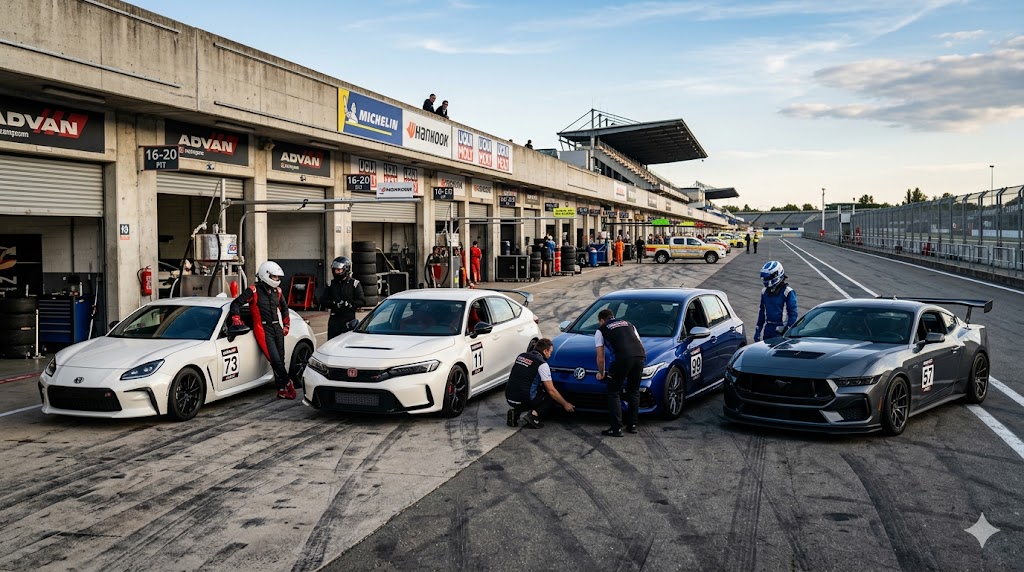
The driver who gets black-flagged on their out-lap for a loose wheel didn't skip an obvious step. They skipped a small one, buried in a category they assumed someone else had covered, and it cost them the rest of their session while the corner workers cleared debris off the racing line. Track days don't punish carelessness evenly. They punish the one overlooked bolt, the one skipped fluid check, the one piece of safety gear left in the trunk because it seemed unnecessary for "just a few sighting laps." A real pre-session inspection isn't a formality; it's the difference between a day that ends with a grin and one that ends with a tow.
Tires and Wheels: Your Only Contact With the Track
Start here because nothing else matters if the contact patch fails. Check tread depth across the full width of each tire, not just the center, since camber settings for track use often wear the shoulders unevenly. Inspect for cuts, bulges, or embedded debris picked up during a previous session, and confirm cold pressures against your target hot pressures rather than the door-jamb sticker, which is calibrated for street driving, not sustained lateral load. Torque every lug nut or wheel bolt to spec with a calibrated wrench, even if you didn't personally remove the wheels, because you're trusting whoever last touched them. Look at wheel weights, valve stem caps, and TPMS sensors if equipped, and make sure aftermarket wheels haven't developed hairline cracks near the spokes, which is more common on track-driven cars than most owners assume.
Brakes: The System You'll Ask the Most Of
Brakes fail progressively long before they fail completely, and the inspection window before your session is your last chance to catch that progression. Check pad thickness on all four corners and estimate whether what remains will survive the day's sessions, not just the first one. Look at rotor surfaces for scoring, cracking, or uneven wear, and flex-test brake lines by hand for any soft spots or visible cracking in the rubber. Bleed and top off brake fluid with a high-temperature racing fluid if you haven't already, since standard fluid boils at temperatures a hard track session reaches easily, and boiling fluid means a spongy or nonexistent pedal exactly when you need it most. Confirm the parking brake isn't dragging and that caliper pins move freely, since a sticking caliper on one corner will cook that pad and rotor well before the others.
Fluids: The Quiet Failure Point
Track driving multiplies thermal and mechanical stress on every fluid in the car simultaneously, so a full fluid check belongs on every pre-session pass. Confirm engine oil level and, if you're running an older or high-mileage car, consider whether it's due for a track-oriented oil with better high-temperature shear resistance. Check coolant level and look for any residue suggesting a slow leak, since cooling systems that are merely adequate on the street often reveal their limits after twenty continuous minutes at wide-open throttle. Inspect transmission and differential fluid if accessible, particularly on cars that haven't been track-driven before, and verify power steering fluid if your car uses a hydraulic system. Fuel level matters too: run too low and you risk fuel starvation under hard cornering, when fuel sloshes away from the pickup at the exact moment you need consistent delivery.
Safety Gear: Non-Negotiable, Not Optional Extras
Every item here exists because someone, somewhere, needed it and didn't have it. Helmet certification and fit come first; a helmet that shifts under impact or one that's aged past its usable life provides a false sense of security. Confirm your harness or seatbelt is properly routed and not frayed, and if your car has a harness bar or roll bar, make sure padding is intact where your head could contact it. A fire extinguisher, mounted securely and within reach, is required at most organized events and useful everywhere else. Check that your kill switch, if installed, is clearly labeled for corner workers, and that your car's numbers or class markings are visible and legible from a distance since that's how flaggers and other drivers identify you at speed.
Under the Hood and Underneath: What You Can't See From the Driver's Seat
A visual sweep of the engine bay and undercarriage catches problems that never show up on a dashboard. Look for loose or disconnected hoses, exposed wiring that's rubbed through insulation, and any fluid residue on the ground beneath the car that wasn't there before. Check belt tension and condition, and give the battery terminals a firm check since vibration loosens connections over time. Underneath, inspect suspension components, especially sway bar end links and control arm bushings, for play or visible damage, and confirm that any aftermarket aero pieces, splitters, or diffusers are still securely fastened after transport. A loose splitter that departs the car mid-corner isn't just embarrassing; it's a hazard for everyone behind you.
Interior and Cockpit Prep
Inside the car, remove anything that isn't secured, since loose items become projectiles under hard braking or cornering. Floor mats deserve a specific check because a bunched mat can trap a pedal at the worst possible moment. Confirm your seat is properly bolted if it's an aftermarket unit, mirrors are adjusted, and window nets or arm restraints, if your class requires them, are properly installed. A quick test of your data logger, lap timer, or camera mount now saves you from discovering a dead battery after your best session of the day is already over.
Paddock Logistics and Final Checks
The last category isn't mechanical, but it's just as capable of ruining your day. Confirm you've attended the driver's meeting and understand flag rules and passing zones specific to that circuit, since they vary meaningfully between tracks. Check your tow hook or strap is accessible, in case you need a retrieval, and that your transponder, if the event uses timing, is mounted and functioning. Make sure you have water, sunscreen, and a plan for tire pressure adjustments between sessions as the day heats up. Finally, walk around the entire car one more time before you leave the paddock. This final lap on foot, done slowly and without distraction, catches the small things that a rushed mental checklist misses, and it takes less time than a single slow lap behind a red flag.
Key Takeaways
- Tire condition and correct hot pressures are the single most consequential pre-session check, since they're your only contact with the track surface.
- Brake fluid should be a high-temperature racing fluid, and pads and rotors need enough life remaining for the full day, not just the next session.
- Fluid levels across engine, cooling, and drivetrain systems deserve fresh attention before every session, not just once at the start of the day.
- Safety gear, including helmet fit, harness condition, and a mounted fire extinguisher, is non-negotiable regardless of how experienced you are.
- A visual sweep of the engine bay, undercarriage, and interior catches loose components and hazards that dashboards and gauges won't reveal.
- Bottom line: build your walk-around into a fixed routine organized by category, tires, brakes, fluids, safety gear, and car prep, so nothing gets skipped when you're excited to get out on track.