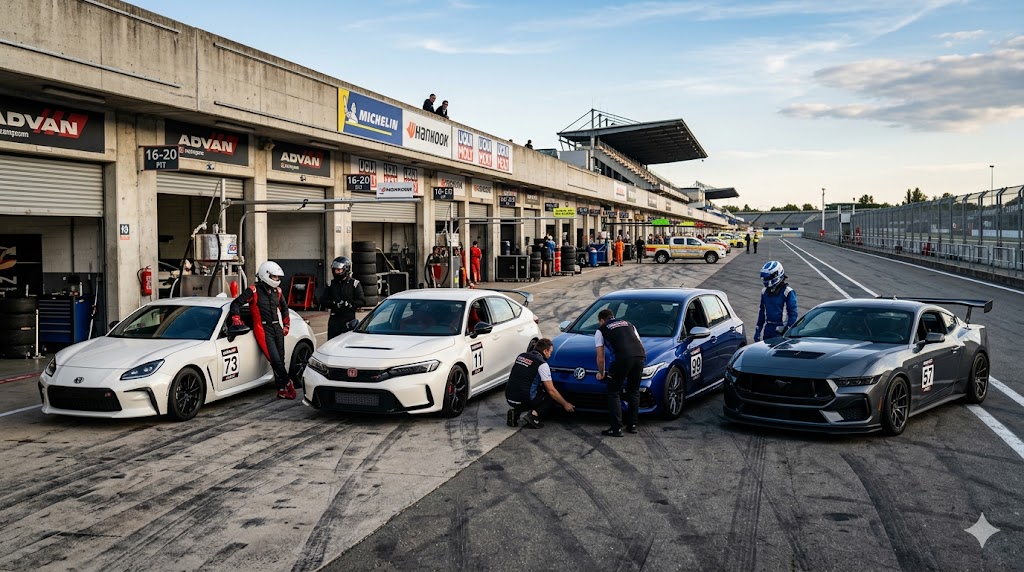
Walk any regional track day paddock and you'll see the split within the first twenty minutes. One group is topping off coolant, checking pad wear with a flashlight, and rotating tire pressures between sessions. The other group is standing next to a car that looked incredible on the drive in and is now cooking its brakes into a soft, fading mess by lap four. Both groups probably spent similar money. The difference is that one of them bought a car that was built, or can be built cheaply, to survive sustained lateral and longitudinal load, and the other bought a car that's fantastic for a stoplight run and miserable once the cooling systems and friction surfaces have to work continuously for fifteen minutes at a stretch.
That's the entire question this article is trying to answer, and it's a narrower one than "what's a fun sports car under $40,000." Plenty of cars in that price band are fun. Far fewer are genuinely track-day-capable without a trip to the parts counter first, and fewer still stay affordable to run once you factor in tires, pads, and the incidental damage that comes from a car that overheats or steps out unpredictably at eight-tenths.
Why Street-Fast Doesn't Mean Track-Ready
The gap between a quick street car and a competent track car comes down to duration and repetition. A street car needs to make one hard stop from highway speed, or pull one strong run up an on-ramp. A track session asks for ten, fifteen, twenty consecutive hard braking zones, each one loading the same pads and rotors that never get more than a few seconds to recover before the next corner. Stock brake pads on a lot of factory sports cars are formulated for cold bite and quiet operation in daily driving, not for sustained heat. Push them on track and you'll feel the pedal go long and soft, a classic sign of fade, sometimes within a single 20-minute session on a car that felt utterly composed on your commute.
Cooling tells a similar story. A car with a marginal factory oil cooler or a tightly packaged radiator might never show a temperature warning in normal use, because normal use rarely holds a car at high rpm and high load for more than a few seconds. On a circuit, oil and coolant temperatures climb steadily over a session and can spike hard on hot days or at high-elevation tracks. Some platforms shrug this off. Others go into limp mode or start showing oil pressure warnings by the third or fourth lap, which is the car's computer telling you it wasn't designed with this kind of use in mind.
Tire wear and grip character matter just as much, though they show up in your wallet rather than as a warning light. A soft, grippy tire that feels amazing generates more heat and wears faster, which is fine if you've budgeted for a dedicated set of track tires and a trailer to bring them on. A car that's forgiving at the limit, with a chassis balance that lets you feel a slide developing before it becomes a spin, will save you far more money in avoided incidents than any spec sheet number ever will. This is where affordable rear-drive cars with modest power often beat quicker, heavier options: you can actually explore the limit without either scaring yourself or destroying a tire in one session.
The Miata Case: Low Mass Solves Most Problems Before They Start
The Mazda MX-5 Miata, across its generations, keeps showing up at track days for a simple structural reason: less mass means less energy the brakes have to dissipate, less heat generated in the tires, and less strain on a cooling system that only has to manage a modest engine's output. A well-sorted Miata on stock or lightly upgraded brake pads can run a full session without the pedal going to the floor, something far harder to achieve in a heavier car making more power. The aftermarket for these cars is enormous and mature, decades deep at this point, so upgraded pads, coilovers, and sway bars are inexpensive and well documented. Insurance and running costs tend to be low because the car is cheap to insure, easy on tires relative to its grip level, and simple enough mechanically that a shop unfamiliar with performance cars can still service it. The tradeoff is straightforward: modest power means you're not going to post eye-catching lap times against faster metal, and on a fast, flowing track a Miata driver often has to lean on momentum and precision rather than outright pace to keep up.
GR86 and BRZ: A Modern Take on the Same Formula
The Toyota GR86 and Subaru BRZ apply the same lightweight, balanced-chassis philosophy with a bit more power and a more current design. Both have earned a reputation for progressive, communicative handling that rewards smooth inputs, which matters enormously at a track day where the goal is usually building skill rather than chasing a trophy. Where these cars ask for attention is the same place most naturally aspirated four-cylinder sports cars do: factory brake pads and stock tires are streetable compromises, not track components, and owners who run repeated sessions typically upgrade pads fairly early to avoid the fade that shows up under sustained use. The factory cooling setup handles normal track day conditions reasonably well, though hot-weather events or extended lapping days are where owners start watching gauges more closely. Well under $40,000 on the used market, and often new as well depending on trim and options you should verify against current listings, these twins remain some of the more complete packages for someone who wants one car that's genuinely happy both commuting and doing track days.
Mustang and Camaro: Power That Outruns the Factory Hardware
A V8 Mustang or Camaro is enormously satisfying on a back road and during short bursts on track, but this is where the "looks the part versus actually works" divide gets sharpest. The extra mass of a V8 pony car means the brakes and tires are working harder to slow the same car down, and factory pads on base trims often aren't specified with repeated track sessions in mind. Fade becomes a real conversation after a handful of hard-braking laps unless you've stepped up to a performance package with track-oriented brakes, or added aftermarket pads and fluid yourself. Tire wear on these cars can also be steeper, since more weight and more torque both accelerate degradation, particularly on the rear axle under hard acceleration out of corners. None of this rules them out. It just means the honest budget for track use includes a pad and fluid upgrade almost immediately, and a tire budget that's noticeably higher than what a Miata or GR86 owner is spending. The aftermarket support for both nameplates is excellent, arguably the best of any car discussed here, so solving these issues is well documented and inexpensive relative to the car's price. It's just not optional the way it can be with a lighter platform.
Hot Hatches as the Overlooked Value Play
A Civic Type R or similarly track-focused hot hatch brings genuinely serious factory-grade cooling and braking hardware to the conversation, since Honda engineered that car with sustained track use in mind rather than treating it as an afterthought. That factory seriousness is part of why it tends to sit at or above the upper end of this budget range depending on age and mileage, so shopping the used market and checking current pricing carefully matters here more than with some other options. Front-wheel-drive character also changes how a car behaves at the limit compared to the rear-drive cars above, with understeer as the more common failure mode rather than oversteer, which some drivers find more predictable and others find less rewarding to work with. Either way, it's proof that "track-ready from the factory" is achievable under $40,000, just not universal across every hot hatch wearing a big wing.
What to Actually Check Before You Trust Any of These at Speed
Regardless of which car you're considering, the practical filter is the same: look up whether the specific model and trim year has a documented brake fade issue in track day communities and forums, price out a pad and fluid upgrade before you need it rather than after a scary lap, and budget realistically for tire wear based on how the car is actually driven rather than how it's marketed. Resale value also deserves a look, since a car that's been tracked hard and shows it can be harder to sell later, while a well-documented, carefully maintained track car with upgraded brakes and fresh fluid can actually be an easier sell to the next enthusiast owner.
Key Takeaways
- Lightweight, balanced cars like the Mazda MX-5 Miata and Toyota GR86/Subaru BRZ tend to survive track days on modest budgets because they generate less heat in brakes and tires in the first place.
- V8 muscle cars like the Mustang and Camaro are track-capable but almost always need a brake pad and fluid upgrade early, plus a larger tire budget, before they can handle repeated sessions without fading.
- Factory-engineered track hardware, as seen on the Civic Type R, proves true track readiness under $40,000 is possible, though front-wheel-drive balance feels different at the limit than rear-drive alternatives.
- Aftermarket support and parts availability matter as much as raw pace, since every car on this list needs at least some upgrade path to run consistent sessions without damage.
- Always verify current pricing, specs, and known issues for your specific year and trim before assuming a car will hold up, since factory changes between model years can meaningfully affect track behavior.
- Bottom line: for most first-time track day drivers on a real budget, a light, well-balanced car like a Miata or GR86/BRZ delivers more usable track time and lower running costs than a heavier, more powerful car that looks faster in the parking lot.