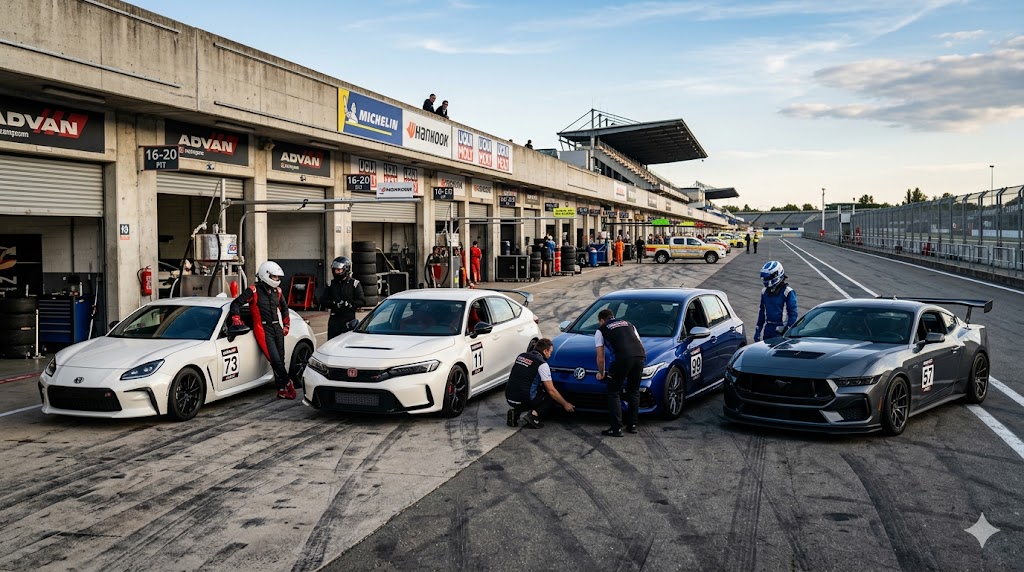
Watch two identically prepped cars roll off pit lane at any regional track day and the fastest one usually isn't the one with more power or a better driver. It's the one wearing semi-slick tires. Swap a set of aggressive street performance tires for a DOT-legal semi-slick and, on most cars, you'll find several seconds a lap on a course that takes ninety seconds to two minutes to complete. That gap is the entire subject of this article, and it's bigger than most first-time track-day drivers expect.
Why the Gap Exists in the First Place
Semi-slick tires — think of the R-compound category that includes track-focused options from the major tire manufacturers — use a softer rubber compound and a tread pattern with far less void area than a street tire. A typical street performance tire might have 30 to 40 percent of its contact patch cut away by grooves and sipes for wet-weather evacuation and tread life. A semi-slick often trims that down to a handful of shallow grooves, sometimes as little as 5 to 10 percent void, which means dramatically more rubber is actually touching the pavement at any given moment. More contact patch plus a stickier compound equals more lateral and longitudinal grip, and grip is what lets you carry speed through a corner rather than scrubbing it off.
The lap-time consequence shows up everywhere in the lap, not just in one spot. Entry speed into corners goes up because the front tires can resist understeer longer under trail braking. Mid-corner speed goes up because the car simply holds a higher cornering load before it starts to slide. Exit speed goes up because the rear tires put down power earlier without spinning. None of these gains are dramatic in isolation, but they compound lap after lap, corner after corner, until a driver on semi-slicks is running a meaningfully different lap time than the same driver on street rubber, even in the same chassis with the same setup.
What You Actually Give Up
The trade-off is real, and it's worth being honest about it before you order a set. Semi-slick compounds are built to work in a narrower temperature window, which means they can feel numb or slippery on cold sighting laps and in cool morning sessions until they come up to operating temperature. Tread life is the other obvious casualty — a set that might last tens of thousands of miles as a street tire could be worn out after a handful of track weekends, especially if you're aggressive with camber and track surface is abrasive. Wet-weather performance is where the compromise becomes most stark: with so little tread depth and void area, semi-slicks can be genuinely dangerous in standing water, hydroplaning at speeds a street tire would handle without drama. Most drivers who run semi-slicks on track also keep a separate set of street tires for the drive home, which adds cost and logistics that a street-tire-only approach avoids entirely.
Noise and ride comfort matter too, particularly if the car in question is also a daily driver. Semi-slicks tend to be louder on the highway and transmit more road texture into the cabin, and their stiffer sidewalls (common on track-oriented constructions) can make everyday potholes and expansion joints feel harsher than they would on a comfort-oriented street tire.
Where Street Tires Still Make Sense
None of this means street tires are the wrong choice for every track-day driver. If you're newer to driving on a circuit, a high-performance street tire has a real advantage: it tells you when it's about to let go with more progressive breakaway characteristics, and it does so at a lower overall grip ceiling, which makes mistakes more forgiving and less likely to end in an off-track excursion. A street tire that's also your daily driver tire means one set of rubber does everything — commute, road trip, and track day — without a second set of wheels sitting in the garage. For drivers doing only one or two track days a year, the incremental lap-time gain from semi-slicks may not justify the expense and hassle of swapping tires, storing a second set, and dealing with a compound that's miserable to drive home on if weather turns.
There's also a car-specific dimension. Underpowered or lightweight cars sometimes benefit less dramatically from semi-slicks than heavier, higher-powered cars that were traction-limited on street rubber to begin with. If your car was already tire-limited in a straight line or under power, moving to a semi-slick unlocks more of the chassis and powertrain's potential than it would in a car that was brake- or aero-limited instead.
Reading the Actual Lap Time Difference
It's tempting to look for a single number — "semi-slicks are X seconds faster" — but that number moves depending on track length, corner count, ambient temperature, and how track-ready the specific tire model is. A short, tight autocross-style course with few high-speed corners will show a smaller gap than a longer circuit with sustained high-g corners where sustained grip matters more. What stays consistent across nearly every comparison is the direction and rough magnitude: semi-slicks are faster, often by low-single-digit seconds per minute of lap time, and the gap tends to widen as ambient and track temperatures rise into the range where semi-slick compounds are designed to operate. If you want a real answer for your specific car and track, the only reliable method is back-to-back testing — same driver, same day, same fuel load, swapping only the tires — because published comparison numbers from magazines and forums rarely translate cleanly to a different car, track, and climate.
Making the Choice for Your Own Track Days
The decision comes down to how you use the car and how much of the lap-time gain you're prepared to pay for in convenience. A dedicated track car that trailers to events, with a second set of wheels and street tires for road use, is the ideal home for semi-slicks — you get the lap time without the daily-driving penalties. A car that pulls double duty as your only vehicle points toward a quality street performance tire, accepting a slower lap time in exchange for one set of tires that works everywhere, every day, in any weather. Many experienced track-day drivers actually run both categories depending on the event: street tires for casual open-lapping days where the goal is seat time and car control, semi-slicks when they're chasing a specific lap-time goal or running in a time-trial class where the extra grip actually changes their competitive result.
Budget also plays into this more than enthusiasts like to admit. Semi-slick sets, a second set of wheels, and more frequent tire replacement add up to a real annual cost that a street-tire approach avoids. Weigh that cost against how much you value shaving seconds off a lap versus simply enjoying seat time, because both are legitimate reasons to be at a track in the first place.
Key Takeaways
- Semi-slick tires generally produce faster lap times than street tires because of increased contact patch and a stickier compound, often adding up to several seconds per lap on typical circuits.
- The performance gain comes with real trade-offs: reduced tread life, poor wet-weather grip, a narrower effective temperature window, and less forgiving breakaway behavior for less experienced drivers.
- Street performance tires remain a sound choice for daily-driven track cars, beginners, and drivers doing only occasional track days where convenience matters more than outright pace.
- The size of the lap-time gap varies by track layout, temperature, and how traction-limited your specific car was to begin with, so published comparisons don't always transfer directly.
- Back-to-back testing on your own car and track is the only way to know the real number for your situation.
- Bottom line: choose semi-slicks if you have a dedicated track setup and care about lap time, and stick with a quality street tire if your car does double duty on the road.