Turn into a tightening corner in a rear-wheel-drive sports car, ease into the throttle a beat early, and feel the tail step out a few degrees before the front tires bite back into line. That moment — not a spec sheet, not a lap time — is why the purist argument for RWD still matters. It's a conversation the car is having with you in real time, one that all-wheel drive, for all its brilliance, tends to mute.
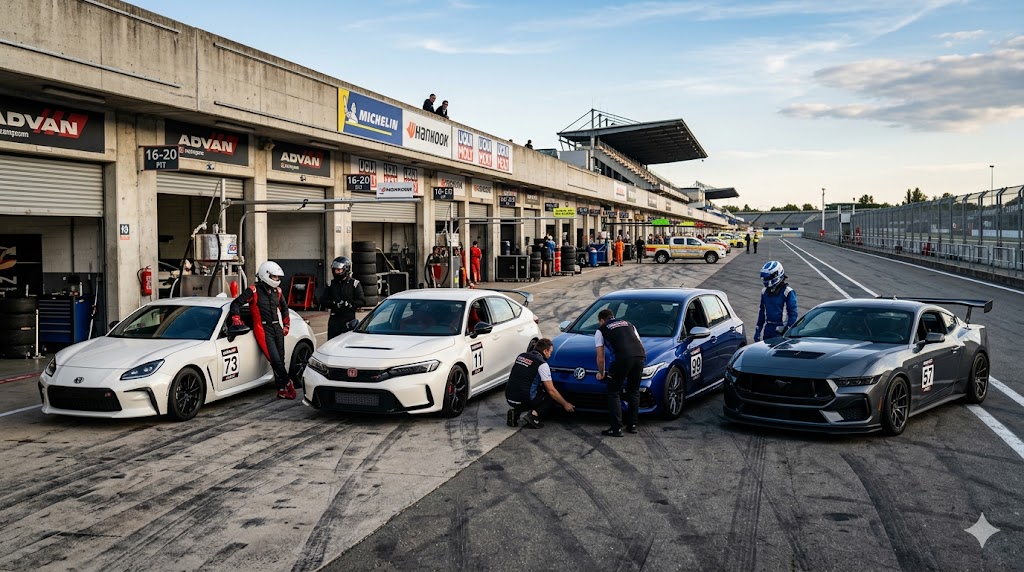
This isn't a dismissal of AWD. Cars like the Nissan GT-R and Audi R8 prove that four driven wheels can deliver blistering, repeatable performance that plenty of RWD cars simply cannot match. But there's a reason enthusiasts keep returning to rear-drive layouts in cars like the Mazda MX-5 Miata, the Toyota GR86 and Subaru BRZ twins, the Chevrolet Corvette, the Ford Mustang, and the Nissan Z. RWD isn't the objectively faster answer in every scenario. It's the more honest one.
Why RWD Feels Like a Conversation, Not a Command
The core of the purist case comes down to a simple division of labor. In a rear-wheel-drive car, the front tires have one job: steering. The rear tires have one job: putting power down. Nothing is fighting for grip at the same contact patch, which means the steering wheel tells you exactly what the front end is doing, uncorrupted by torque trying to route itself through those same wheels. Turn in, and you feel the front axle load up cleanly. Add throttle, and you feel the rear end respond independently, rotating the chassis rather than just hauling it forward in a straight line.
That separation is what engineers mean when they talk about steering feel, and it's not a vague notion — it's the absence of interference. All-wheel-drive systems, particularly ones biased toward the front axle under certain conditions, can introduce a faint but real dulling of that signal, a sense that the steering is managing traction as much as direction. Modern AWD sports cars have gotten remarkably good at hiding this, but drivers who spend real time in both layouts back to back can usually still feel the difference on a demanding road.
Then there's weight balance. A rear-wheel-drive sports car built from the ground up as RWD typically enjoys a more even front-to-rear weight distribution, since there's no need to route a driveshaft, a front differential, and additional CV joints and cooling hardware to the nose of the car. Lighter weight up front means quicker, more willing turn-in. Less overall mass — because you're not carrying a transfer case, extra driveshafts, and a second differential — means the whole car changes direction with less inertia to fight. The Miata is the purest expression of this idea: it's not fast in a straight line by modern standards, but its lightness and balance make every input feel amplified, every back road feel like an event.
The Throttle as a Steering Input
Ask any driver who's spent time on a track why they prize RWD, and eventually they'll mention throttle steering — the ability to adjust your line mid-corner by modulating the gas pedal rather than just the wheel. Lift slightly, and weight transfers forward, sharpening turn-in. Get back into the throttle, and the rear tires can be coaxed into a small, controlled slip angle that rotates the car toward the apex. It's a skill that takes time to learn and is deeply satisfying to execute, and it's largely unavailable — or at least far less pronounced — in a car where the front wheels are also being asked to pull.
This is also where the debate gets honest rather than nostalgic. All-wheel-drive systems exist specifically because they solve real problems that rear-wheel drive creates. A powerful RWD car putting its output through only two tires is fundamentally more likely to break traction under hard acceleration, especially off the line. Launch a high-output rear-drive Mustang or Corvette on a cold, dry track and you'll manage it fine with the right technique and modern electronic aids. Try the same launch in the rain, or on a damp on-ramp, and the rear end will happily remind you which wheels are doing the work. Wet and snowy conditions are where the purist case for RWD runs into its sharpest limits. A rear-wheel-drive sports car with summer tires in a snowstorm is, bluntly, a liability, and no amount of steering feel changes that math.
Where AWD Genuinely Wins
Give credit where it's due. The Nissan GT-R built its reputation partly on a sophisticated AWD system that lets it put down enormous power with a level of composure that would be genuinely difficult to replicate with two driven wheels. The Audi R8, sharing bones with the Lamborghini Huracán, uses its quattro system to make supercar power accessible in conditions — cold mornings, damp roads, mixed-grip surfaces — where a comparable RWD exotic would demand far more restraint from its driver. Porsche offers the 911 in both flavors for exactly this reason: the Carrera 4 and Turbo variants exist because plenty of buyers, including serious enthusiasts, want the extra confidence that comes with power going to all four corners, particularly if they live somewhere with real winters or simply want to use their car's full performance envelope more often.
AWD's advantage isn't limited to foul weather, either. In dry, high-grip conditions, all-wheel drive still helps a powerful car accelerate out of corners more effectively, because the front tires can contribute tractive force instead of just steering duty. This is a major reason why AWD dominates in rallying and why so many of the fastest accelerating road cars, historically including the Acura NSX in certain eras of thinking about the segment, have leaned on driven front axles to translate power into forward motion rather than wheelspin. If your priority is minimizing the time between "throttle down" and "car moving," four driven wheels will generally get you there with less drama than two.
The Trade-Offs Purists Accept
None of this is free, and that's precisely the purist's point. AWD hardware adds weight — often a meaningful amount — positioned in places that don't help handling balance, typically loading the nose of the car with additional mass. That extra weight has to be hauled around every corner, on every lap, on every drive, whether or not you ever need the extra traction it provides. AWD systems also add mechanical complexity: more parts to maintain, more parasitic drivetrain loss sapping power before it reaches the pavement, and historically, more cost. For a driver whose sports car lives mostly on dry roads and closed circuits, that's a tax paid every single time out, in exchange for a safety net that rarely gets used.
There's also a psychological dimension purists talk about less openly but feel just as strongly. Driving a RWD car well requires a kind of attentiveness that AWD can let you skip. You have to manage weight transfer, respect the throttle, and understand that the rear end is always a variable you're actively negotiating with. That negotiation is uncomfortable at first and deeply rewarding once it clicks — it's the difference between a car that flatters you and a car that teaches you.
Choosing Between Them Honestly
The right answer depends on what you're actually optimizing for, and pretending otherwise does a disservice to both camps. If your sports car is a weekend toy driven on favorite roads and track days in reasonable weather, RWD's lighter weight, sharper feel, and throttle-adjustable balance are hard to argue against. If your sports car has to be a daily driver through genuine winters, or if you're chasing the kind of all-weather, all-condition acceleration that only comes from power reaching every contact patch, AWD stops being a compromise and starts being the smarter engineering choice. Neither layout is wrong; they're simply optimized for different relationships between driver, car, and road.
Key Takeaways
- Rear-wheel drive separates steering and power duties between the front and rear axles, producing cleaner steering feel and a more communicative chassis.
- RWD's lighter overall weight, achieved by omitting transfer cases and front differentials, sharpens turn-in and rewards throttle-based cornering technique.
- The purist case weakens fast in wet, snowy, or low-grip conditions, where two driven wheels struggle to put power down safely.
- AWD cars like the Nissan GT-R, Audi R8, and Porsche 911 Carrera 4/Turbo variants deliver genuinely superior traction and confidence, especially in poor weather or hard acceleration.
- AWD's traction comes at the cost of added weight, complexity, and some drivetrain loss that RWD purists feel on every single drive, not just the risky ones.
- Bottom line: choose RWD for the purest, most engaging dry-road and track experience, and choose AWD if all-weather usability or maximum straight-line traction matters more to how you actually use the car.