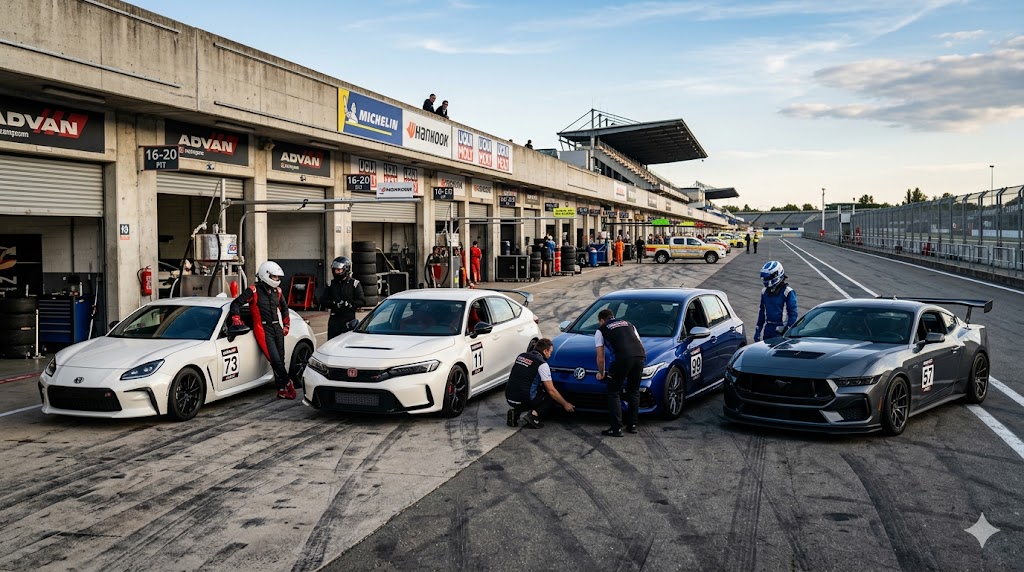
You spin out on a skid pad at low speed, correct the wrong way, spin out again, and a laughing instructor over the radio tells you to try once more—except this time, don't think, just look where you want to go. On the fourth attempt, something clicks. Your hands move before your brain finishes the sentence. That reflex, built in twenty minutes on a wet skid pad, is the entire case for racing school even if you never plan to turn a wheel in anger on an actual racetrack. The skills taught there are not racing skills wearing a costume. They are the exact skills that keep a car pointed the right direction when a deer jumps out, when a driver ahead brakes hard, or when black ice shows up uninvited on a bridge deck.
The Skid Pad Rewires Your Panic Response
Most drivers have never experienced their car losing traction in a controlled setting, which means the first time it happens for real—on a rain-slicked highway on-ramp, say—their body has no template to draw on. Fear takes over, and fear tends to produce exactly the wrong inputs: stomping the brake mid-slide, yanking the wheel too far, freezing entirely. Racing schools spend a disproportionate amount of their curriculum on low-speed skid pad exercises precisely because they let you fail safely, repeatedly, until the correct response becomes automatic. You learn what oversteer actually feels like through the seat of your pants rather than from a diagram, and you learn that the fix is almost always smaller and calmer than instinct suggests. That muscle memory doesn't expire when you leave the facility. It sits dormant in your hands until the day you need it on a public road, and on that day it fires faster than conscious thought could.
Vision Habits That Change How You Read Traffic
Instructors hammer one idea above all others: look where you want to go, not at the thing you're afraid of hitting. This sounds almost too simple to matter, but target fixation is a documented, well-understood failure mode—drivers who stare at an obstacle tend to steer toward it. On track, this lesson gets drilled into you through cone exercises and high-speed corners where looking through the turn, rather than at the apex cone, is the difference between a smooth line and a spin. Take that habit back to city driving and it changes how you scan intersections, how you handle a sudden lane-change need on the interstate, and how you position your eyes three or four seconds ahead rather than fixating on the bumper in front of you. Most street driving education never addresses eye discipline in any structured way. Racing school does, aggressively, because at speed there's no margin for a bad habit to hide in.
You Learn What Your Brakes Are Actually Capable Of
Ask most daily drivers to describe their car's threshold braking behavior and you'll get a shrug. They've never braked hard enough, for long enough, to find out. Racing schools put you through repeated hard-braking exercises specifically so you feel the point where the tires start to lose grip and the anti-lock system engages, and so you understand that modern ABS wants you to keep the pedal pinned rather than pumping it the way older driver's-ed manuals still suggest. This single piece of calibration—knowing what maximum braking feels like and trusting the car through it—can shorten your real-world stopping distance in an emergency because you're not hesitating or second-guessing the shudder under your foot. It also teaches you the less glamorous but equally useful skill of trail braking, easing off the brake progressively as you turn in, which smooths out weight transfer and keeps the car settled rather than darty when you need to brake and steer at the same time, such as when someone cuts you off and you need to both slow down and change lanes in the same breath.
Space, Following Distance, and the Physics You Now Respect
Something happens to your relationship with following distance after you've experienced how quickly a car's grip can evaporate and how long it actually takes to scrub off speed from a track-day pace. The abstract safety-course advice to "leave three seconds" stops being a rule you tolerate and becomes a number you've felt the consequences of ignoring. Racing schools don't lecture about tailgating, but by putting you through exercises where following another car too closely through a braking zone results in an immediate, visceral near-miss, they teach the lesson more effectively than any classroom ever could. Drivers who've been through this kind of training tend to report that they naturally give more room on the highway afterward, not because they were told to, but because they now have a felt sense of how much space speed actually consumes.
Handling Emergencies Without the Adrenaline Spike
Perhaps the most underrated benefit is emotional regulation under stress. A day spent deliberately provoking slides, missing braking points on purpose, and recovering from induced mistakes desensitizes you to the panic that ordinarily accompanies a loss of control. Racers describe this as "slowing the world down"—the sensation that a fast-developing situation suddenly gives you more time to think than it used to. That's not a mystical car-guy claim; it's a documented effect of practiced exposure to high-stress, fast-decision scenarios. A driver who has calmly caught a slide on a skid pad twenty times is far less likely to freeze or overreact when a real skid happens on the way to work. The calm itself is the transferable skill, arguably more valuable than any specific steering technique.
Choosing a Program That Actually Teaches Street-Relevant Skills
Not every racing school emphasizes the same things, and if your goal is street-driving improvement rather than lap times, it's worth choosing a program accordingly. Look for schools that dedicate real time to skid pad work, threshold and trail braking, and low-speed car control rather than ones that rush straight to high-speed lapping in a spec race car. Multi-day programs generally offer more repetition and better skill retention than a single afternoon, though even a one-day introductory course delivers a noticeable shift in confidence and awareness. Cost and car options vary widely by program and region, so check current pricing and curriculum details directly with schools near you rather than relying on secondhand figures, and ask specifically how much of the day is spent on car-control fundamentals versus lapping for its own sake.
Key Takeaways
- Skid pad training builds automatic, correct reflexes for skids and slides that ordinary driving never teaches.
- Racing schools train your eyes to look through a situation rather than fixate on hazards, directly reducing target-fixation crashes.
- You learn true threshold braking and trail braking, both of which can shorten stopping distances and improve control during panic stops.
- Experiencing controlled loss of traction recalibrates your sense of following distance and space more effectively than safety lectures.
- Repeated exposure to induced high-stress scenarios reduces panic and improves decision-making speed in real emergencies.
- Bottom line: even a single well-chosen racing school day makes you measurably safer on public roads, and the skills stick long after the checkered flag.