Turn into a tight corner too fast in a mid-engine car and the rear doesn't just slide, it swings, like a door pivoting on a hinge planted somewhere near your shoulder blades. Do the same thing in a front-engine car and the back end washes wide in a slower, more telegraphed arc that gives you a beat longer to catch it. Both moments happen in well under a second. Neither is more "correct." But they feel like two different sports wearing the same helmet, and that difference has almost nothing to do with horsepower and everything to do with where the engine sits relative to you.
Weight distribution is the quiet variable that shapes every other sensation in a performance car. It decides how quickly the nose answers your steering input, how the car settles (or doesn't) when you lift off the throttle mid-corner, and how much warning you get before things go wrong. Engineers talk about this in terms of polar moment of inertia, a way of describing how mass is arranged around the car's vertical axis. Everything else people love to argue about, steering feel, exhaust note, badge snobbery, sits on top of that foundation.
Why Mid-Engine Cars Rotate Like They Do
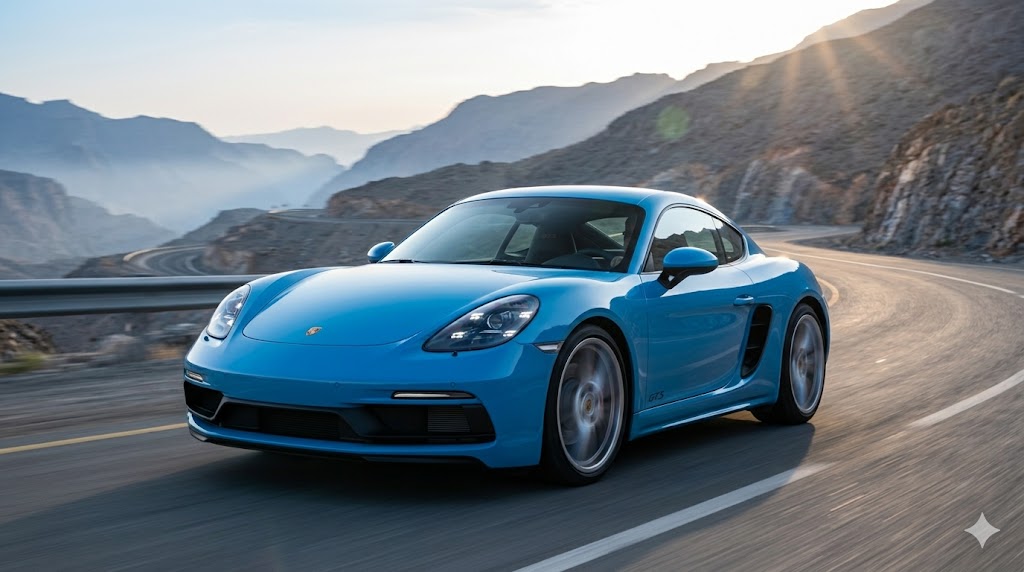
Put the engine behind the seats and ahead of the rear axle, and you concentrate mass near the car's center. That's a low polar moment of inertia, and the practical effect is a car that changes direction almost the instant you ask it to. There's less mass swinging out at the extremities, so the chassis doesn't have to fight its own inertia to rotate. A Chevrolet Corvette built on the current mid-engine architecture, a Porsche Cayman or Boxster, an Acura NSX with its hybrid-assisted all-wheel-drive system, all share this trait: they pivot around a point close to the driver rather than pivoting around some distant axle you can't see or feel.
On track, this translates into corner entry that feels almost telepathic. Trail off the brake, turn in, and the nose tucks in with an eagerness that front-engine cars can't quite match, because there simply isn't as much front-axle weight resisting the change of direction. The flip side is what happens when the rear tires give up grip beyond that limit. Because so little mass is hanging out past the axle, once the rear does break away, it doesn't ease into a slide, it snaps. Drivers who've spun a Cayman or an early mid-engine Corvette on a wet apex will tell you the same thing: the transition from grip to no-grip is narrower and less forgiving than they expected, and the correction window is shorter. That's the trade a low polar moment buys you. Faster direction changes at the limit, but less runway once you're past it.
Why Front-Engine Cars Talk to You Differently
A front-engine, rear-drive car carries its heaviest single component out over the front axle, well ahead of the car's center of mass. That higher polar moment of inertia means the car resists rotation more, which sounds like a disadvantage until you're actually driving one hard. Because the chassis is slower to respond, it also gives you more time to read what's happening underneath you. Load transfer, the way weight shifts forward under braking and rearward under acceleration, happens over a slightly longer time window, and that extra beat is where you feel the car "talking."
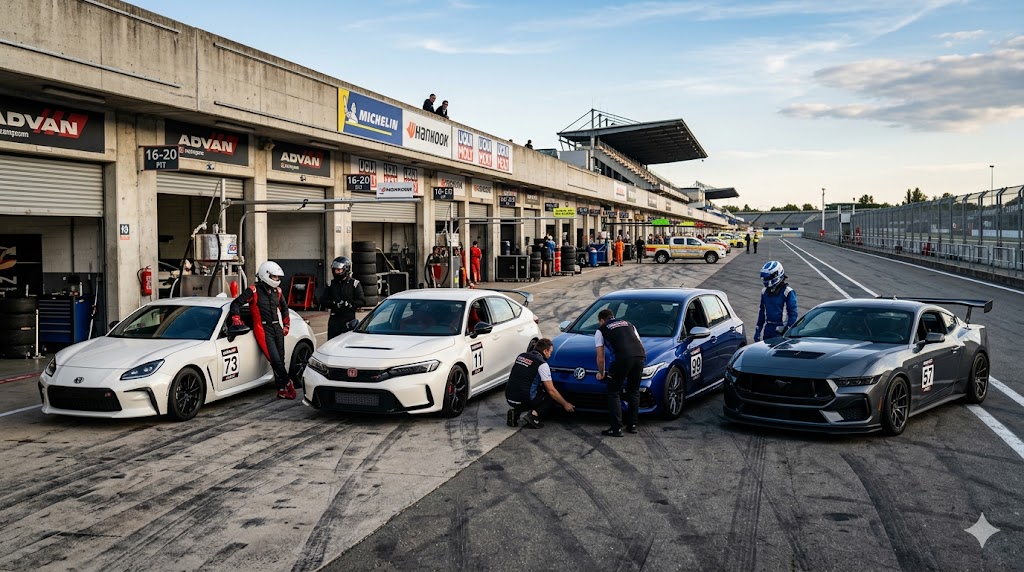
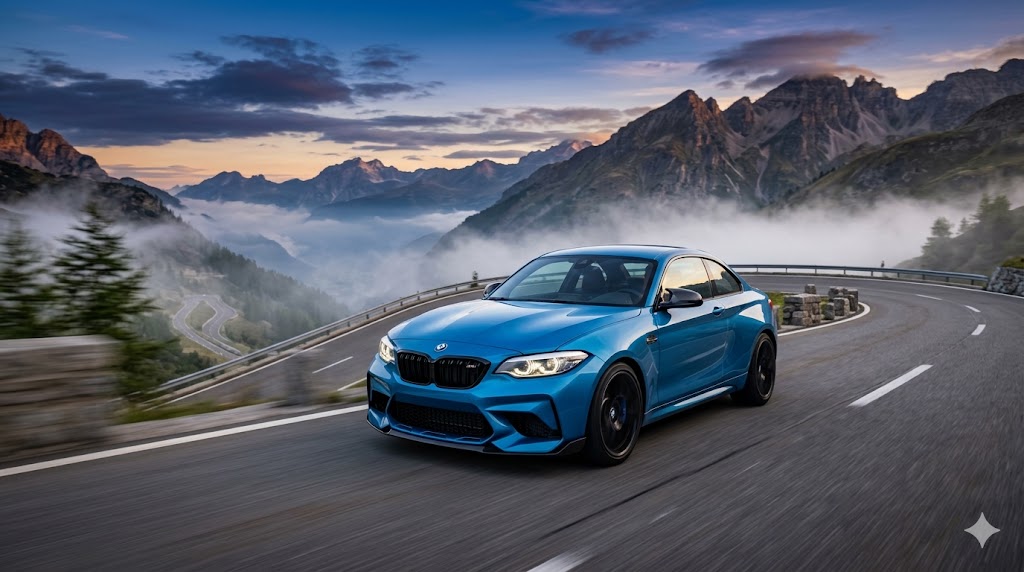
A Ford Mustang or a BMW M3 will understeer first as you push into a corner too hot, plowing gently wide rather than darting anywhere, and that understeer is a built-in warning system. Get back on the throttle too early on corner exit and the rear will start to slide, but it typically arrives progressively enough that a driver with reasonably quick hands can catch it, hold a bit of opposite lock, and keep driving through the slide rather than spinning out of it. This is why front-engine cars have long been considered the more approachable platform for drivers still learning where a car's limits actually are. The car's mass distribution is doing some of the teaching for you.
Porsche's 911 deserves its own mention here, because it breaks the pattern entirely. It's rear-engine, not front or mid, with the engine hanging out behind the rear axle. That configuration gives it a personality all its own: a nervous, light-feeling front end under trail braking, paired with prodigious rear traction on the way out of a corner thanks to all that weight pressing down on the driven wheels. It's proof that "front-engine versus mid-engine" isn't a complete map of the sports car world, but for the purposes of comparing the two dominant philosophies, it's the exception that makes the front-engine feel even more like the sensible middle ground.
Living With the Layout, Not Just Driving It
The differences don't disappear when you're not attacking a canyon road. A mid-engine car forces the engine to occupy the space where a front-engine car would normally put a proper cabin and cargo bay, so you end up with two small trunks, one up front, one out back, rather than a single usable space. Packing for a road trip in a Cayman or a mid-engine Corvette means thinking in smaller units and accepting that your golf clubs or a full set of luggage might not fit as one load. Visibility suffers too. With the engine mounted just behind your head, rearward sightlines in a mid-engine car are often compromised by thick roof pillars or a shallow rear window, and you'll lean on mirrors and backup cameras more than you would in a Mustang or an M car with a conventional greenhouse.
Cabin noise is the other honest trade-off. An engine sitting a few feet behind your ears delivers a raw, mechanical soundtrack that many drivers find addictive, but it's also relentless on a long highway stretch, with less insulation between you and the intake and exhaust than a front-engine layout typically allows. Front-engine cars, by contrast, put more structure and sound deadening between the engine bay and the cabin, which is part of why a Mustang or an M-badged BMW can play daily-driver duty more comfortably than most mid-engine machines are built to.
None of this makes mid-engine cars impractical toys or front-engine cars lesser performers. It just means the two layouts are optimized for different priorities, and those priorities show up every time you turn the key, not just when you're pushing toward the limit.
Cost, Complexity, and Why Mid-Engine Stays Rare
Part of the reason front-engine cars still dominate showrooms comes down to engineering cost. Routing a driveshaft, cooling lines, and exhaust plumbing around a mid-mounted engine while keeping the car serviceable and crash-safe is a harder, pricier problem than bolting an engine to the front of a well-understood platform. Front-engine architecture is mature, flexible, and cheaper to adapt across a lineup, which is exactly why brands like Ford and BMW can offer a wide spread of trims and body styles on a shared front-engine platform, while mid-engine cars like the Corvette, Cayman, and NSX remain comparatively narrow, focused lineups.
Which One Should You Actually Drive
If you're chasing the sharpest, most immediate connection between your hands and the car's rotation, and you're comfortable with a narrower margin for error at the true limit, a mid-engine car rewards that trust in a way nothing else quite matches. If you want a car that teaches you as you go, communicates trouble before it arrives, and still does a competent job hauling people and cargo on the way to the track, a front-engine car remains the more forgiving, more livable choice. Both are legitimate answers. The honest question isn't which layout is better, it's which kind of conversation you want to have with your car.
Key Takeaways
- Mid-engine cars like the Corvette, Cayman, Boxster, and NSX rotate faster because their lower polar moment of inertia concentrates mass near the car's center, sharpening turn-in at the cost of a narrower margin once the rear tires lose grip.
- Front-engine cars like the Mustang and BMW M models telegraph load transfer more gradually, giving drivers extra time to read understeer and oversteer before they become unmanageable.
- The Porsche 911's rear-engine layout is a genuine third path, delivering light, nervous front-end feel paired with strong rear traction rather than fitting neatly into either camp.
- Mid-engine layouts sacrifice practicality, splitting cargo into two small trunks, reducing rear visibility, and piping more raw engine noise into the cabin.
- Front-engine architecture remains cheaper to engineer and easier to adapt across model lineups, which is part of why it still dominates showrooms.
- Choose mid-engine if you want the sharpest, most immediate response at the limit and can live with less warning when grip breaks; choose front-engine if you want a more forgiving, practical car that still rewards a committed driver.