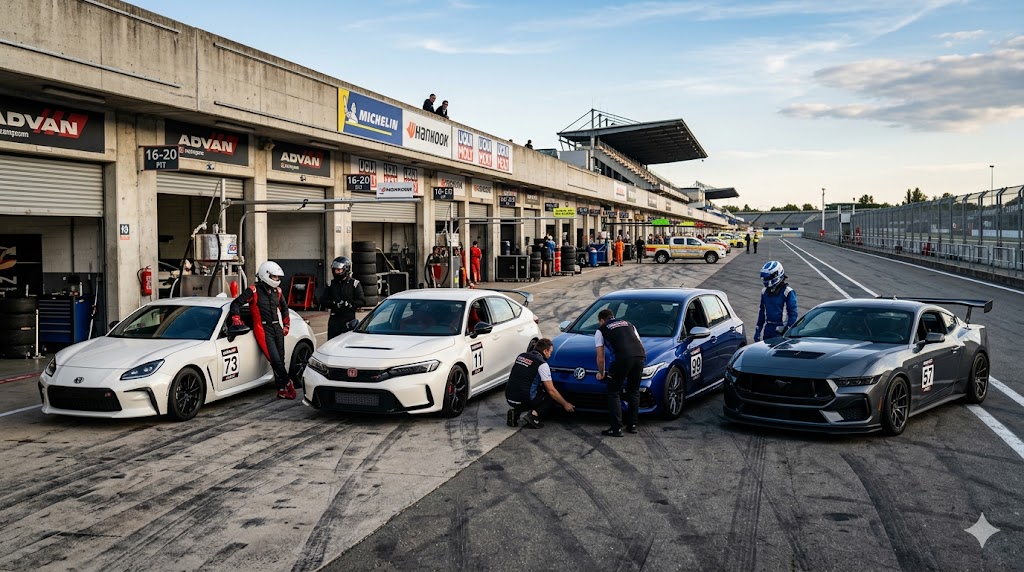
Floor the throttle out of a tight corner in a front-wheel-drive car with an open differential and you'll feel it immediately: the inside tire spins uselessly, a chirp of wasted rubber, while the outside tire that actually has grip gets none of the engine's attention. Swap in a limited slip differential and that same corner exit becomes a shove forward instead of a wheelspin light show. That single difference, in how torque gets distributed between two wheels on the same axle, is the entire reason enthusiasts talk about LSDs the way they do.
The Problem an Open Differential Creates
Every differential exists to solve one problem: your car's two driven wheels travel different distances through a turn, so they need to spin at different speeds. An open differential solves this cleanly but carelessly. It sends torque to whichever wheel offers the least resistance, which sounds fine until you realize "least resistance" usually means the wheel with the least grip. Lift a wheel on a bumpy back road, hit a patch of wet leaves, or simply unload the inside tire during hard cornering, and the open diff dumps power there instead of to the tire that could actually use it. The result is the corner-exit wheelspin every autocrosser and track-day driver has experienced, plus a subtler issue: inconsistent, unpredictable power delivery that makes the car harder to trust at the limit.
What a Limited Slip Diff Actually Changes
A limited slip differential still allows the wheels to rotate at different speeds, but it resists letting one wheel spin freely while the other sits still. Depending on the design, clutch-type, gear-type (like a Torsen), or electronically controlled, it works by creating internal friction or geometric resistance that transfers a meaningful share of torque to the wheel with more traction. The practical effect on the road is that when you get back on the throttle mid-corner, the outside tire, the one loaded up with grip from cornering forces, actually receives power instead of watching the inside tire spin away your acceleration. Corner exits tighten up, throttle response feels more direct, and the car stops feeling like it's fighting itself under power.
This is the part that surprises people who've never driven a properly set up LSD car back to back with an open-diff version: the transformation isn't subtle. It's not a marginal handling tweak, it's a fundamentally different relationship between your right foot and the road. Rally cars, autocross builds, and serious track cars all run limited slip differentials for this exact reason, because in any situation involving hard acceleration through a corner, an open diff is simply leaving performance on the table.
Clutch-Type Versus Torsen: Different Personalities
Not all LSDs behave the same way, and the type installed shapes how the transformation feels. Clutch-type differentials use stacked clutch plates that lock together under load, and they tend to have a more aggressive, mechanical feel, some initial bite as the clutches engage, and a tendency to need periodic fluid changes with a friction modifier additive since the clutch material wears. Torsen-style and other gear-based units use worm gears to bias torque without friction plates, producing a smoother, more transparent feel that many drivers prefer for street use because it doesn't telegraph its presence the way a clutch-type unit can. Electronically controlled LSDs, increasingly common on modern performance cars, use a computer-actuated clutch pack that can vary locking force in real time based on throttle position, steering angle, and wheel speed, offering the broadest range of behavior but also the most complexity if something goes wrong.
None of these is universally "better." A clutch-type diff on a dedicated track car rewards a driver who wants to feel exactly what the rear axle is doing, while a Torsen unit suits someone who wants the benefit without the driveline chatter during low-speed parking lot maneuvers, which clutch-type diffs are notorious for.
The Trade-Offs Nobody Puts on the Brochure
An LSD is not a free upgrade, and treating it as one leads to disappointment. Clutch-type units introduce driveline noise, that characteristic clunking or chattering during tight, slow turns, because the diff is fighting the natural speed difference between the wheels even when you're not accelerating hard. This is often mistaken for a mechanical fault by first-time owners. There's also a real cost to maintenance: clutch-type LSDs need their fluid changed more frequently than an open diff, and many require a specific friction-modifier additive that, if omitted, causes the clutches to chatter or wear prematurely.
Front-wheel-drive cars introduce another wrinkle entirely: torque steer. Because a limited slip diff actively sends more power to whichever front wheel has grip, and steering forces run through those same wheels, a strong LSD can make the steering wheel tug in your hands under hard acceleration, especially exiting a corner with the wheels turned. Manufacturers and aftermarket tuners spend real engineering effort mitigating this, but it never disappears entirely on a front-driver with a locking differential. This is a genuine trade-off, more usable power exiting corners in exchange for a steering wheel that occasionally has its own opinion about where you're going.
Matching the Diff to How You Actually Drive
The right choice depends heavily on what the car is for. A street car that occasionally sees a track day benefits from a moderate-lock Torsen-style or a well-tuned electronic LSD, enough transformation in handling to notice on a spirited backroad without turning every parking garage into an exercise in patience. A dedicated track or autocross car can run a more aggressive clutch-type setup because the driveline noise and maintenance schedule are prices worth paying for maximum corner-exit traction, and low-speed parking lot maneuvering isn't the priority. It's also worth considering that many performance trims already come with a factory LSD, so before spending on an aftermarket unit, it's worth checking your specific car's published specifications to confirm what, if anything, is already fitted.
Living With the Upgrade Day to Day
The everyday experience of owning a car with a good LSD is less about lap times and more about confidence. Merging onto a wet highway on-ramp, pulling out of a gravel driveway at an angle, or just accelerating hard through a decreasing-radius on-ramp all become less anxious because the car is putting power down more evenly across both driven wheels. That said, drivers coming from an open-diff car should expect an adjustment period, the added grip under power means the car will change direction and accelerate differently than expected the first few times, and it rewards smoother throttle inputs rather than punishing ham-fisted ones.
Key Takeaways
- An open differential sends power to whichever wheel has the least grip, which is often the wrong wheel during hard cornering.
- A limited slip differential forces torque toward the wheel with more traction, transforming corner-exit acceleration and overall confidence under power.
- Clutch-type LSDs feel more mechanical and require friction-modifier fluid changes, while Torsen-style and electronic units feel smoother for daily use.
- Front-wheel-drive cars with an LSD will experience more torque steer, a real trade-off for the added traction.
- Check whether your car already has a factory LSD before assuming you need an aftermarket unit.
- For drivers serious about track days or autocross, a properly matched LSD is one of the most noticeable handling upgrades available for the money.