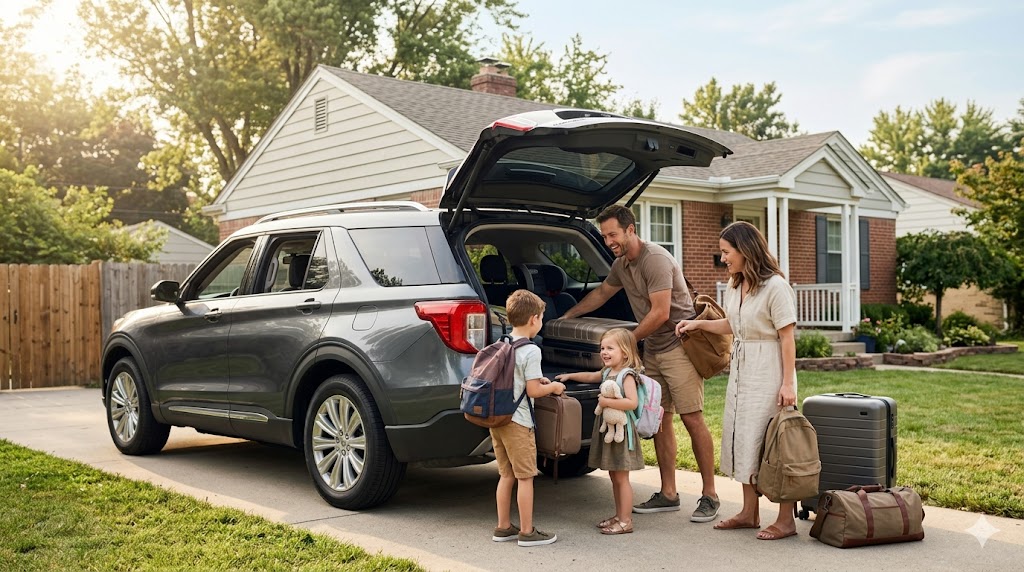
If you've spent any time in a school pickup line lately, you've noticed the pattern. Three-row family SUVs used to mean minivans with slightly higher ground clearance, but the segment now has three genuine standouts that shoppers cross-shop obsessively: the Kia Telluride, the Hyundai Palisade, and the Volkswagen Atlas. The Telluride and Palisade are corporate cousins built on shared bones, yet they've carved out distinct personalities and loyal followings. The Atlas is the outlier — a German-engineered, American-built alternative that drives a little differently and courts a buyer who wants something other than the default Korean pick. All three exist for the same customer: someone hauling car seats, cleats, and grandparents, who needs a third row that adults can actually tolerate and cargo space that survives a Costco run. The question isn't which is objectively "best" in a vacuum — it's which one fits your family's specific version of chaos.
Third-Row Space and Cargo: Where the Real Differences Show Up
This is the category that actually matters for the people buying these vehicles, and it's where the Telluride and Palisade's shared platform becomes obvious. Both offer a third row that can genuinely seat adults for a highway trip, not just kids for a school run, with second-row seats that slide and tilt forward to ease the climb back. The Palisade leans slightly more upscale in how it packages that space, with Hyundai offering configurations with second-row captain's chairs that make third-row access easier, while the Telluride counters with boxier, more upright styling that translates into a bit more headroom for taller passengers. Cargo behind the third row is respectable on both, and folding the third row flat opens up a genuinely useful mid-size cargo hold for strollers, sports gear, or a Target haul.
The Atlas takes a different approach and, in some ways, wins the raw-space argument. Volkswagen stretched the Atlas's wheelbase specifically to maximize interior volume, and it shows in third-row legroom that can outdo both Korean rivals, along with a cargo area behind the third row that's among the largest in the class. The trade-off is that the Atlas's third row sits a bit lower to the floor, which some adults find less comfortable for extended rides even though there's more legroom to stretch into. If your primary use case is regularly hauling six adults rather than four adults and a couple of kids, the Atlas deserves a serious look. If your third row is mostly for children with occasional adult duty, the Telluride and Palisade's more thoughtfully sculpted access and second-row flexibility may matter more day to day.
Interior Quality and the Everyday Livability Test
Climb inside all three and you'll notice how far Kia and Hyundai have pushed material quality and design confidence. The Telluride's interior favors a rugged, almost SUV-truck aesthetic with chunky switchgear and a dashboard that feels substantial, while the Palisade goes softer and more lounge-like, with available second-row relaxation seats on higher trims that recline like a business-class seat. Both feel like they belong a class above their price point, with soft-touch materials in the places your hands and elbows actually land, and cabin storage that reflects real thought about where families stash snacks, wipes, and tablets.
The Atlas's interior is clean and functional but noticeably plainer in places, particularly on earlier design cycles where hard plastics show up lower on the dash and doors. Volkswagen has improved the design and materials in updated versions, and the build quality inside feels tight and rattle-free, but it doesn't chase the same visual flourish as its Korean rivals. Where the Atlas pulls ahead is in the simplicity of its control layout on models that retain physical buttons and knobs — a relief if you've ever tried to adjust cabin temperature through a touchscreen while merging onto a highway. Infotainment is a genuine differentiator here: Kia and Hyundai's systems are typically snappier and more intuitive, while some Atlas model years have drawn criticism for touch-sensitive controls and menu response that feels a step behind, something worth test-driving specifically before you commit.
Ride, Powertrain Character, and How They Feel With a Full Load
Loaded with passengers and cargo, these three reveal real personality differences. The Telluride and Palisade both pair a naturally aspirated V6 with an automatic transmission, and that combination delivers smooth, linear power delivery that doesn't feel strained even with six people and a full cargo hold. Neither is quick in a sporty sense, but both build speed predictably, which is exactly what you want merging onto a freeway with a car full of kids. Ride quality on both leans toward soft and absorbent, tuned clearly for comfort over cornering enthusiasm, with the Palisade edging toward a slightly quieter, more isolated cabin experience and the Telluride feeling marginally firmer and more truck-like underneath.
The Atlas uses a turbocharged four-cylinder in many configurations, with a V6 available depending on trim and model year, and the driving character reflects VW's European roots — tighter steering weight, a firmer suspension tune, and a sense of body control through curves that neither Korean rival quite matches. Families who spend real time on winding roads or who simply prefer a more buttoned-down, "driver's car" feel to their SUV often gravitate to the Atlas for this reason alone. The flip side is that the turbo four, when paired with a full load, can feel like it's working harder than the Telluride or Palisade's V6, and the firmer ride transmits more road texture into the cabin, which matters if you've got a napping toddler in the back. All three offer all-wheel drive as an available upgrade, which is worth prioritizing if you deal with snow or regularly haul near maximum capacity.
Safety, Tech, and Ownership: The Long Game
Every one of these SUVs comes with a strong suite of driver-assistance features — automatic emergency braking, lane-keeping assistance, blind-spot monitoring, and adaptive cruise control are all available, and increasingly standard, across the lineup. Where they diverge is in the details: Hyundai and Kia have both been aggressive about bundling advanced safety tech onto lower trims, while Volkswagen has historically reserved some of its more advanced driver-assistance features for higher trim levels, so it's worth cross-checking exactly what's standard versus optional on the trim you're actually shopping.
Ownership costs and long-term confidence are where the conversation gets more nuanced, and where buyers should do their own research on current reliability data and cost-to-own estimates rather than take marketing claims at face value. Kia and Hyundai have both built their reputations in this segment partly on generous warranty coverage that tends to outlast what Volkswagen offers, which matters to buyers who keep vehicles for the long haul or who worry about repair costs after the warranty clock runs out. Volkswagen's dealer network in the US is meaningfully smaller than Hyundai's or Kia's, which can mean fewer service appointment options and, anecdotally, a different ownership experience depending on your region — something worth weighing if you live outside a major metro area. None of this means the Atlas is unreliable or that you should avoid it; it means the calculus around long-term ownership looks different enough that it deserves its own line of research before you sign anything, especially since model-year-to-model-year reliability can shift.
Making the Call for Your Family
None of these three is a wrong answer, which is exactly why the decision feels harder than it should. Choose the Palisade if you want the most refined, quiet, lounge-like cabin experience and don't mind that it shares its core engineering with the Telluride. Choose the Telluride if you prefer a slightly more rugged aesthetic and don't need the Palisade's plusher second-row options, since mechanically the two are close enough that styling and dealer relationships often break the tie. Choose the Atlas if maximum third-row legroom, cargo volume, and a more engaged driving feel outweigh your interest in the flashiest interior or the longest warranty — and if you've confirmed a VW dealer near you that you trust for service.
Whichever way you lean, drive all three back to back with your actual car seats installed and your actual passengers along for the ride. Spec sheets tell you what's possible; an afternoon with your family in the third row tells you what's true for your life.
- The Telluride and Palisade share a platform and V6 powertrain, so the choice between them often comes down to styling preference, second-row seat configuration, and dealer relationship rather than mechanical differences.
- The Atlas offers a genuine edge in third-row legroom and outright cargo volume, making it the strongest pick for families who regularly need to seat full-size adults in every row.
- Hyundai and Kia generally offer more upscale-feeling cabins, snappier infotainment, and longer warranty coverage, which matters for buyers focused on long-term value and daily usability.
- The Atlas rewards drivers who want tighter steering and more composed handling, but its turbocharged four-cylinder can feel taxed under a full load compared to the Korean twins' naturally aspirated V6s.
- Volkswagen's smaller US dealer footprint is a real practical consideration for service convenience and should factor into your decision if you don't live near a dealership.
- Bottom line: pick the Palisade or Telluride for the most polished, family-optimized ownership experience, and pick the Atlas if third-row space and driving feel matter more to you than interior flash or warranty length.