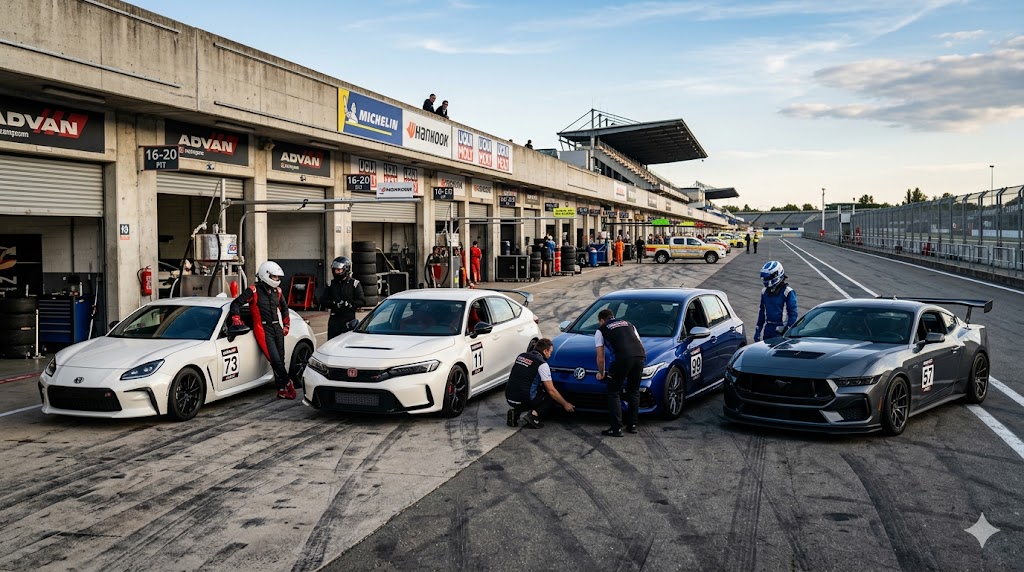
Watch a professional driver walk a corner before a session and you'll notice something odd: they barely look at the apex. Instead, their eyes drift to the exit, then the entry, then somewhere off in the distance past where the corner actually ends. Meanwhile, the weekend enthusiast standing next to them is staring straight at the orange cone marking the apex, mentally rehearsing the exact line they plan to drive. Both drivers will turn the wheel at roughly the same point. Only one of them is actually processing the corner correctly, and the gap between those two mental models is a big part of why lap times separate the way they do.
The Apex Is the Least Important Point, Not the Most Important
Enthusiasts tend to treat the apex as the goal of the corner, the single point they're trying to hit with precision. Professionals treat it as a byproduct. A pro driver's attention is almost entirely consumed by the exit — where the car needs to be pointed and how much throttle it can carry the moment the wheel starts unwinding. This isn't a minor semantic difference. If you drive toward the apex as your primary target, you tend to arrive there at the wrong speed and with the wrong amount of steering lock already used up, which leaves nothing in reserve for getting back on the power. If you drive toward the exit and let the apex happen as a consequence of that line, you naturally carry a geometry that unwinds the wheel earlier and lets you feed in throttle sooner. Professional drivers describe this as "seeing through" the corner rather than "seeing to" the corner, and it's the single biggest conceptual difference between the two groups.
This matters more on exit-critical corners — the slow ones leading onto long straights — than it does on high-speed sweepers, and professionals instinctively rank corners by which ones actually reward this kind of exit-first thinking. Enthusiasts often apply the same mental approach to every corner on a track regardless of what follows it, which wastes effort on corners where the exit barely matters and under-focuses on the two or three corners per lap where it matters enormously.
Peripheral Vision Versus Fixed Focus
A related but distinct skill is where the eyes actually point during the corner itself, not just what the driver is thinking about beforehand. Enthusiasts, especially those still building confidence, tend to fixate on a single reference point close to the car — the edge of the track, the apex curbing, a wall that feels uncomfortably near. This is a natural response to speed and perceived risk, but it actively works against smooth car control because a fixed, close focal point gives the brain very little advance warning of what's coming and encourages small, late, corrective inputs.
Professional drivers train themselves to look far down the road, using peripheral vision to manage the car's proximity to curbs and track edges while their direct focus stays well ahead — often through the corner and into the next braking zone or corner entry. This "look where you want to go, not at what scares you" habit isn't just a driving cliché; it's a genuine perceptual strategy that gives the brain more time to process closing speed and line, which in turn produces smoother, earlier inputs. The car doesn't actually go where the eyes point, but the timing and smoothness of inputs improve dramatically when the eyes are calibrated further ahead, and that's measurable in how early and how confidently a driver gets back to full throttle.
Reading the Track Surface, Not Just the Racing Line
Enthusiasts generally learn a track by memorizing a line — a sequence of braking points, turn-in points, and apexes tied to fixed visual markers like cones, paint, or curbing. That's a reasonable starting point, but it's also brittle. Professionals read the corner itself: camber changes, surface grip variation, where the pavement has more rubber laid down, where it's polished and slippery, where a subtle crown in the road will unload the inside tire at a bad moment. This is why professional drivers can often go quick almost immediately at a new track while enthusiasts need many sessions to get comfortable, and it's also why professionals adjust their line lap to lap as track temperature and rubber buildup change, while less experienced drivers tend to drive the same geometric line all day regardless of changing conditions.
This distinction becomes especially visible in changing weather or as a session wears on. A professional treats the racing line as a starting hypothesis that gets adjusted in real time based on what the car and the track surface are telling them, while many enthusiasts treat the line as fixed information to be executed as precisely as possible. Neither approach is "wrong" as a starting point, but only one of them scales as conditions change.
Speed Sensation Versus Data
One of the more counterintuitive differences is how little professional drivers trust their own sensation of speed. Enthusiasts often brake or lift based on how fast a corner feels, which is influenced by seating position, wind noise, and general nervousness — none of which are reliable. Professionals build a reference model based on markers, braking points, and reference gears, and they trust that model over the feeling in the moment, especially in high-speed corners where the perception of speed can be wildly wrong. This is part of why in-car video of a skilled driver at a fast corner can look almost uncomfortably casual: they've decoupled the decision to stay on the throttle from the visceral sense that they're going too fast.
That said, professionals aren't simply ignoring feel. What they're doing is separating two different jobs: using vision and reference points to make the go/no-go decision, and using feel — through the seat, the wheel, and the pedals — to fine-tune the execution once the decision is made. Enthusiasts often blend these two jobs together, letting the emotional sensation of speed influence a decision that should be made on more objective information.
Building the Skill Without a Racing Budget
None of this requires a professional coaching budget to start practicing. Deliberately shifting your eyes further down the track, consciously identifying the exit before you think about the apex, and paying attention to how the car's grip changes throughout a session rather than assuming it's constant are all habits that can be practiced in a single lapping day. Onboard video is one of the more useful tools here, not because it shows you your line, but because it can reveal — with a bit of self-honesty — exactly where your eyes were pointed relative to where they should have been, since your head position and the direction of your gaze are often visible even in inexpensive dash-cam footage.
The gap between a fast enthusiast and a professional is rarely about bravery or reflexes. It's about what information the brain is prioritizing well before the car reaches the corner, and that's a skill that responds to deliberate practice far more than most drivers assume.
Key Takeaways
- Professional drivers prioritize the exit of a corner over the apex, while enthusiasts often over-focus on hitting the apex precisely.
- Looking further down the track with peripheral awareness of the car's edges produces smoother, earlier inputs than fixating on a close reference point.
- Professionals read and adapt to the actual track surface and changing grip levels, rather than executing a fixed memorized line all day.
- Trusting data and reference points over the raw sensation of speed helps professionals stay committed in fast corners where perception is unreliable.
- These are learnable habits, not innate talent, and onboard video is one of the most accessible ways to diagnose where your visual focus is going wrong.
- Bottom line: if you want to close the gap to faster drivers, spend less time perfecting your line to the apex and more time training your eyes to look through the corner toward the exit.